





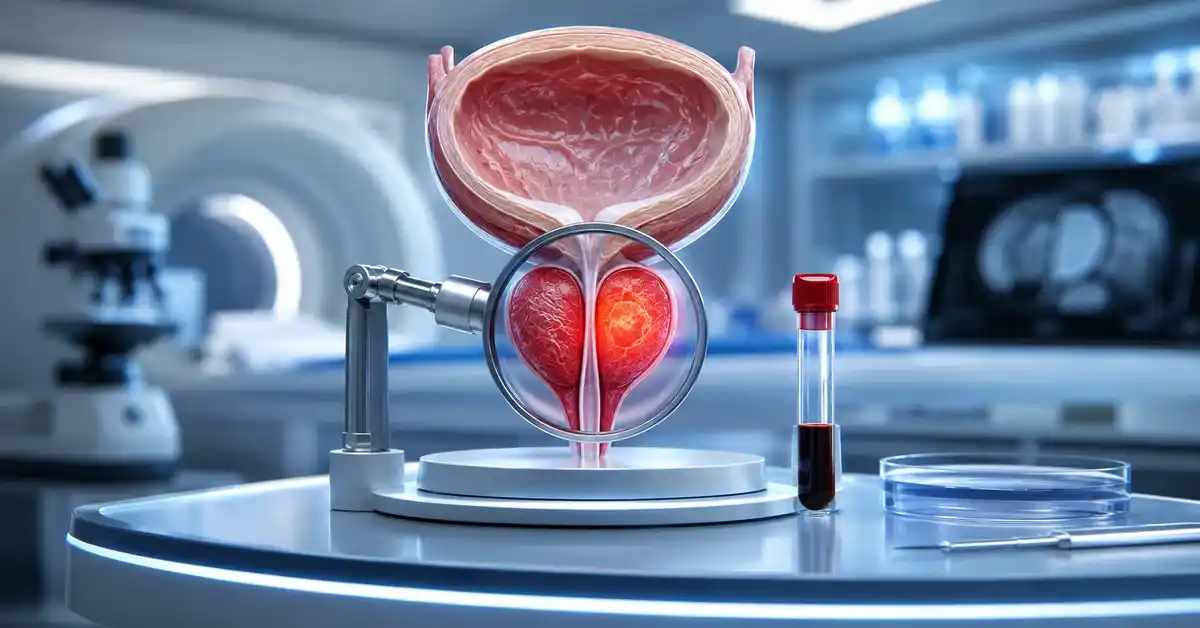
The PSA test is one of the most commonly used blood tests for evaluating prostate health and assessing the possible risk of prostate cancer. However, an elevated PSA does not always mean cancer, and a lower PSA does not always remove the need for follow-up when symptoms or risk factors are present. For this reason, PSA results should be interpreted by a urologist within the full clinical context, not by the number alone.
PSA stands for prostate-specific antigen. It is a protein produced by both normal and cancerous prostate cells and can be measured in the blood. PSA may rise with age, benign prostate enlargement, prostatitis, urinary infection, recent ejaculation, cycling, urinary retention, or recent prostate procedures. It may also rise with prostate cancer, which is why it is used as a warning signal that may require further evaluation.
The key question is not only “Is PSA high?” The more important questions are: How old is the patient? How large is the prostate? Are there urinary symptoms? Is PSA rising quickly? Is the free PSA ratio low? Is the digital rectal exam normal? Does the patient need prostate MRI or biopsy?
What Is a PSA Test?
A PSA test is a blood test that measures the level of prostate-specific antigen in the bloodstream. The prostate naturally produces PSA, and small amounts are present in most men’s blood. When the prostate is enlarged, inflamed, irritated, or affected by cancer, PSA may increase.
The test is used in men with urinary symptoms, men at higher risk of prostate cancer, and men being followed after prostate cancer treatment. However, PSA is not a perfect test. A high result does not always mean cancer, and some prostate cancers may exist even when PSA is not very high.
Why Does a Doctor Request PSA?
A doctor may request PSA for several reasons, including prostate cancer screening, evaluation of prostate enlargement, assessment of urinary symptoms, or follow-up after prostate cancer treatment. It may also be considered when there is a strong family history of prostate cancer.
Reasons for testing include:
- Difficulty urinating.
- Weak urine stream.
- Frequent nighttime urination.
- Feeling of incomplete bladder emptying.
- Blood in urine or semen.
- Pelvic or lower back pain.
- Family history of prostate cancer.
- Monitoring benign prostate enlargement.
- Follow-up after prostate cancer treatment.
- Screening after shared decision-making.
The test should be part of a complete evaluation, not the only decision-making tool.
Is PSA Only a Cancer Test?
No. PSA is not only a cancer test. It is a prostate-related marker that can rise in many non-cancerous conditions. A high result may worry the patient, but the doctor needs to investigate the cause before assuming cancer.
Non-cancerous causes of elevated PSA include:
- Benign prostatic hyperplasia.
- Prostatitis.
- Urinary tract infection.
- Urinary retention.
- Recent ejaculation.
- Catheterization or prostate procedure.
- Long cycling sessions.
- Older age.
- Large prostate volume.
- Recent medical manipulation.
This is why doctors may repeat the test after treating infection or avoiding temporary influencing factors.
Read about: Prostate Enlargement Treatments: Medication or Surgery
What PSA Level Is Normal?
There is no single PSA number that fits every man. The value of 4 ng/mL is often used as a general reference, but it is not a fixed rule. A PSA of 3 may be concerning in a younger man, while a slightly higher number may be less concerning in an older man with a large benign prostate, depending on the full assessment.
PSA interpretation depends on age, prostate size, PSA trend, symptoms, digital rectal examination, family history, and free PSA ratio. Comparing two men’s PSA values without clinical details can be misleading.
Approximate Values by Age
Some doctors use age-adjusted PSA interpretation because PSA often rises as the prostate grows with age. These age-related ranges are not a replacement for medical assessment, but they can help guide interpretation.
A PSA result may deserve more attention when it is higher than expected for the patient’s age, especially in a younger man or in someone with strong risk factors.
Factors affecting interpretation include:
- Age.
- Prostate size.
- Inflammation.
- Urinary symptoms.
- Family history.
- Ethnic or genetic risk factors.
- Medications.
- Previous PSA results.
- Digital rectal exam.
- MRI when needed.
The context of the number matters more than the number alone.
Does PSA Below 4 Mean No Cancer?
Not always. A PSA below 4 can be reassuring in many cases, but it does not completely exclude prostate cancer, especially if the digital rectal exam is abnormal, PSA is steadily rising, or risk factors are strong.
Follow-up may still be needed if:
- Family history is strong.
- Digital rectal exam is abnormal.
- PSA is rising quickly.
- Symptoms are concerning.
- PSA is higher than expected for age.
- Free PSA ratio is low.
- MRI is suspicious.
- The doctor recommends closer follow-up.
Medical decisions should not be based only on a numeric cutoff.
Read about: Latest Non-Surgical Treatments for Enlarged Prostate
When Is PSA Concerning?
PSA becomes more concerning when it is clearly elevated, rises quickly compared with previous tests, is associated with an abnormal rectal exam, has a low free PSA ratio, or occurs in a patient with symptoms and risk factors. Concerning does not mean cancer is confirmed. It means more careful evaluation is needed.
The doctor may first repeat the test, especially if temporary causes could explain the elevation. Further evaluation may include urine testing, free PSA, prostate MRI, or biopsy when needed.
One-Time PSA Elevation
A single elevated PSA does not always justify a major step such as biopsy. The rise may be temporary because of infection, inflammation, recent ejaculation, urinary retention, or a recent medical procedure. In such cases, the doctor may repeat PSA after a suitable interval, preferably using the same laboratory.
Repeat testing may be appropriate when:
- The elevation is mild.
- Symptoms suggest infection.
- Ejaculation occurred before testing.
- Urinary infection is present.
- Catheterization or procedure was recent.
- Urinary retention occurred.
- There are no concerning symptoms.
- The clinical examination is normal.
However, evaluation should not be delayed when PSA is very high or examination is abnormal.
Repeated or Rapid PSA Rise
A repeated or rapid rise in PSA over time may be more meaningful than a single reading. If PSA increases across several tests, the doctor evaluates the trend, not only the last result. This helps separate temporary rises from persistent risk.
A rising PSA is more important when there is:
- Continuous increase over several tests.
- Rapid rise within months.
- PSA higher than expected for age.
- Abnormal digital rectal exam.
- Low free PSA ratio.
- New urinary symptoms.
- Bone pain or unexplained weight loss.
- Family history of prostate cancer.
In these cases, MRI or biopsy may be considered.

Non-Cancer Causes of High PSA
Many elevated PSA results are not caused by prostate cancer. It is important to look for benign causes before jumping to conclusions. Benign enlargement and prostatitis are among the most common causes, especially in men over 50.
Identifying the cause helps the doctor choose the right plan, such as treating infection, repeating the test, or monitoring PSA.
Benign Prostate Enlargement
Benign prostatic hyperplasia is common with aging. As prostate size increases, PSA production may increase even when there is no cancer. Therefore, a man with a large prostate may have a higher PSA than another man with a smaller prostate.
Symptoms of enlargement may include:
- Weak urine stream.
- Interrupted urination.
- Frequent urination.
- Nighttime urination.
- Difficulty starting urination.
- Incomplete emptying.
- Urgency.
- Urinary retention in severe cases.
Evaluation may include ultrasound, prostate volume measurement, residual urine assessment, and urine testing.
Prostatitis or Urinary Infection
Prostatitis can raise PSA significantly and temporarily. It may be associated with pelvic pain, burning urination, fever, painful ejaculation, or urine changes. Sometimes prostatitis is chronic and symptoms are mild.
Urinary tract infection or urinary retention can also increase PSA. If infection is suspected, the doctor may treat it and repeat PSA later.
Signs suggesting infection include:
- Burning urination.
- Frequent urination.
- Pelvic or perineal pain.
- Fever or chills.
- Pain with ejaculation.
- Lower back discomfort.
- Abnormal urine color or smell.
- Abnormal urine test.
In this setting, PSA alone is not enough to judge the situation.
Read about: Interventional Radiology for Enlarged Prostate Treatment
Factors That Affect PSA Results
Before PSA testing, it is helpful to understand factors that may affect the result. The test should be done under suitable conditions when possible, because temporary influences may cause unnecessary worry.
If PSA is elevated, the doctor may ask about these factors before deciding what to do next.
Before the Test
Patients may be advised to avoid certain activities before PSA testing, especially if the result will guide an important decision.
PSA may be affected by:
- Ejaculation within 24 to 48 hours.
- Long cycling sessions.
- Recent urinary infection.
- Prostatitis.
- Urinary retention.
- Urinary catheter.
- Cystoscopy or prostate procedure.
- Recent biopsy.
- Prostate massage.
- Activities that put pressure on the pelvic area.
The doctor may delay the test if infection or a recent procedure is present.
Medication Effects
Some medications can lower PSA, especially prostate enlargement medications such as finasteride or dutasteride. These drugs can make PSA look lower than it truly would be without treatment, so the doctor must know about them.
Tell the doctor about:
- Finasteride.
- Dutasteride.
- Prostate enlargement medications.
- Testosterone therapy.
- Hormonal medication.
- Recent antibiotics.
- Blood thinners.
- Supplements or herbs.
- Previous prostate treatment.
Not reporting medications may lead to incorrect interpretation.
Read about: Benign Prostate Enlargement: Latest Non-Surgical Treatments
Total PSA and Free PSA
PSA in the blood exists in different forms. Some is bound to proteins, and some is free. Total PSA measures the overall amount, while free PSA measures the unbound portion. In certain cases, especially when total PSA is mildly or moderately elevated, the free PSA ratio can help estimate whether further testing is needed.
A lower free PSA ratio may increase concern compared with a higher ratio, but it should not be interpreted alone. It must be combined with age, prostate size, clinical examination, and MRI when performed.
When Is Free PSA Requested?
Free PSA may be requested when total PSA is in an unclear range, such as a mild elevation without an obvious diagnosis. The goal is to improve risk estimation and reduce unnecessary biopsies in some patients.
Free PSA may be requested when there is:
- Mildly elevated PSA.
- Normal rectal exam.
- No clear reason for elevation.
- Need to estimate risk before biopsy.
- Possible benign prostate enlargement.
- Repeated PSA elevation.
- Shared decision-making with the doctor.
- Need for additional information.
Free PSA is not a replacement for MRI or biopsy when suspicion is high.
What Does a Low Ratio Mean?
A low free PSA ratio may make the doctor more cautious because it can be associated with a higher chance of prostate cancer than a higher ratio. However, patients should not interpret the ratio alone.
The doctor considers:
- Total PSA.
- Free PSA ratio.
- Patient age.
- Prostate size.
- Digital rectal exam.
- Symptoms.
- Family history.
- MRI findings.
- PSA trend.
- Patient preference after counseling.
Integrated assessment is the foundation of decision-making.
Read about: Benign Prostate Enlargement Laser Treatment: Safe Results
What Tests Come After High PSA?
After an elevated PSA, the next step is not always immediate biopsy. The doctor may start with repeating PSA, urine testing, treating infection if present, or ordering free PSA. In many cases, multiparametric prostate MRI is now an important tool before biopsy.
The goal is to identify who truly needs biopsy while avoiding unnecessary procedures when possible.
Repeat Test and Clinical Examination
Repeating PSA can be important when elevation is mild or unexpected. A digital rectal exam also helps assess whether the prostate feels hard, irregular, or suspicious.
Initial steps may include:
- Repeat PSA in the same laboratory.
- Urine test.
- Treat infection if present.
- Digital rectal examination.
- Prostate volume assessment.
- Symptom review.
- Medication review.
- Review of previous PSA results.
- Overall risk calculation.
- Discussion of next steps.
If PSA remains elevated or the examination is abnormal, deeper evaluation may be needed.
MRI and Biopsy
Prostate MRI can help detect suspicious areas and guide biopsy decisions. If MRI shows a high-suspicion lesion, the doctor may recommend targeted biopsy. If MRI is reassuring, monitoring may be reasonable in selected patients depending on risk.
Biopsy may be considered when there is:
- Persistently elevated PSA.
- Abnormal rectal exam.
- Suspicious MRI.
- Rapid PSA rise.
- Strong family history.
- Low free PSA ratio.
- Concerning symptoms.
- Doctor’s risk-based recommendation.
Biopsy is the test that confirms or excludes cancer when needed, not PSA alone.
Read about: Latest Prostate Cancer Treatment Using Interventional Radiology
Who Should Consider PSA Testing?
The decision to test PSA should be made after discussion with a doctor, especially for screening in men without symptoms. The benefit is the possibility of early prostate cancer detection, but the downsides include false positives, anxiety, unnecessary biopsies, and detection of slow-growing cancers that may never cause harm.
The timing of testing depends on age and risk factors.
Men With Risk Factors
Doctors may discuss PSA testing earlier in men at higher risk of prostate cancer. Risk increases with strong family history, especially father or brother affected, known genetic mutations, or higher-risk ancestry in certain populations.
Risk factors include:
- Father or brother with prostate cancer.
- More than one affected close relative.
- Family diagnosis at a young age.
- BRCA mutation or family history of breast/ovarian cancer.
- Concerning urinary symptoms.
- Abnormal digital rectal exam.
- Previous elevated PSA.
- Higher-risk ancestry depending on population.
- Previous prostate treatment.
- Patient preference after counseling.
Early testing may be more important in these patients.
Men Without Symptoms
For men without symptoms, PSA testing should be a shared decision. The doctor explains benefits and risks, and the patient decides based on age, general health, life expectancy, and personal preference.
Testing may be less useful in men who are very old or have severe medical conditions, where detecting a slow-growing cancer may not improve quality or length of life. PSA should not be performed routinely for everyone without discussion.
Symptoms That Require Urology Review
PSA may be requested even without symptoms, but certain symptoms should prompt urology evaluation regardless of the number. Many symptoms are caused by benign enlargement or infection, but they still need assessment, especially if they are sudden or severe.
Long delays may lead to urinary retention or delayed diagnosis of an important problem.
Important Urinary Symptoms
See a urologist if you have:
- Clear difficulty urinating.
- Very weak urine stream.
- Interrupted urination.
- Very frequent urination.
- Repeated nighttime urination.
- Persistent burning.
- Blood in urine.
- Blood in semen.
- Pelvic pain.
- Urinary retention.
- Recurrent urinary infections.
- Painful ejaculation.
These symptoms do not always mean cancer, but they require evaluation.
More Concerning Signs
Some signs are more concerning and need faster review, especially when combined with high PSA.
Seek prompt evaluation for:
- Persistent bone pain, especially back or pelvis.
- Unexplained weight loss.
- Severe appetite loss.
- Unusual fatigue.
- Recurrent blood in urine.
- Acute urinary retention.
- Severe pain with fever.
- Leg weakness or numbness with back pain.
- Rapidly rising PSA.
- Abnormal rectal exam.
Early evaluation is better than waiting.
Read about: Prostate Cancer Treatment with Interventional Radiology: Latest Results
How to Prepare for a PSA Test
Good preparation may reduce misleading results. Not every clinic gives the same instructions, so patients should follow their doctor’s or laboratory’s guidance. If there has been infection, catheterization, or a recent procedure, inform the doctor before testing.
It is also helpful to know what the plan will be if PSA is elevated, rather than testing without follow-up.
Before the Test Date
Before the test, ask the doctor what instructions apply to your case. Avoiding ejaculation or intense cycling for a short period may be recommended, and testing may be delayed if active urinary infection is present.
General tips:
- Tell the doctor about medications.
- Report recent infection.
- Avoid ejaculation as instructed.
- Avoid intense cycling before testing.
- Do not test soon after catheterization or procedures without advice.
- Use the same laboratory for follow-up when possible.
- Keep previous PSA results.
- Do not interpret the result alone.
These steps make interpretation more reliable.
After the Result
If PSA is elevated, do not panic. The right step is to review the result with a urologist along with symptoms and medical history. The plan may involve repeating PSA, treating infection, or ordering additional tests.
After the result:
- Do not assume elevation means cancer.
- Do not ignore repeated elevation.
- Book urology evaluation.
- Bring previous test results.
- Tell the doctor about medications.
- Explain any symptoms.
- Ask about free PSA or MRI when appropriate.
- Follow the monitoring plan.
Calm and organized follow-up is the best approach.
Read about: Prostate Treatment: Turkey vs USA
Conclusion
The PSA test is important, but it must be interpreted carefully. PSA may be concerning when it is clearly high, repeatedly elevated, rising quickly, or associated with an abnormal examination or strong risk factors. However, an elevated PSA does not diagnose prostate cancer by itself. A normal PSA also does not eliminate the need for evaluation when symptoms or clinical suspicion exist.
Benign causes such as prostate enlargement, prostatitis, urinary infection, recent ejaculation, or recent procedures may raise PSA temporarily. The doctor may recommend repeat testing, free PSA, urine tests, ultrasound, prostate MRI, or biopsy depending on the case.
Frequently Asked Questions: PSA Test for Prostate
Does a high PSA mean prostate cancer?
No. PSA can rise because of benign enlargement, inflammation, urinary infection, urinary retention, recent ejaculation, or recent procedures, not only cancer.
When is PSA concerning?
It is more concerning when clearly elevated, rising quickly, repeatedly high, or associated with abnormal rectal exam or strong family history.
Should PSA be repeated if it is high?
Often yes, especially if the rise is mild or a temporary cause is possible. The decision should be made by a urologist.
What is the benefit of free PSA?
Free PSA may help estimate cancer risk when total PSA is mildly or moderately elevated, but it should not be interpreted alone.
Can MRI replace biopsy?
MRI can guide suspicion and biopsy decisions, but biopsy is still the confirmatory test when needed.