





Knee replacement surgery is one of the most effective treatments for advanced knee arthritis when conservative options such as medication, physical therapy, weight loss, injections, and activity modification no longer control pain. However, many patients think that all knee replacement surgeries are the same. In reality, there is an important difference between total knee replacement and partial knee replacement.
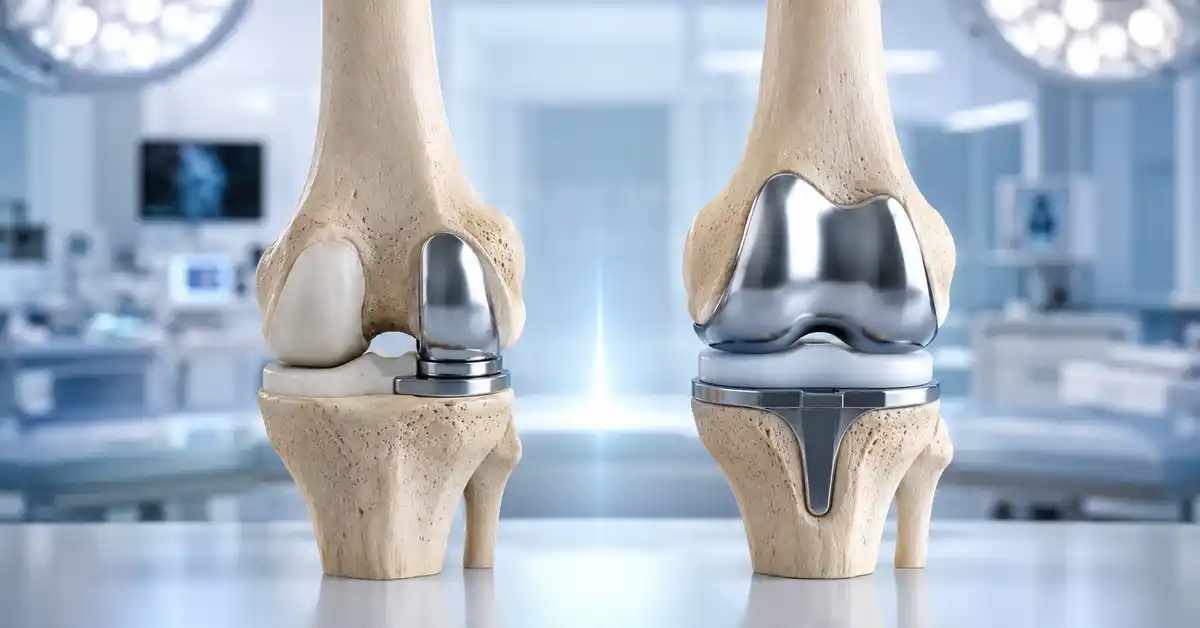
Total knee replacement means replacing the main damaged surfaces of the knee joint, usually when arthritis affects more than one compartment. Partial knee replacement replaces only the damaged part of the knee while preserving healthy areas and ligaments. Therefore, the decision is not based only on patient preference. It depends on X-rays, physical examination, pain location, deformity, ligament stability, range of motion, and activity level.
Choosing the right option affects recovery time, natural feeling, incision size, movement after surgery, and the chance of needing another operation in the future. This is why patients should understand the difference before making a decision with an orthopedic surgeon.
What Is Knee Replacement Surgery?
Knee replacement surgery removes damaged joint surfaces and replaces them with artificial components designed to reduce pain and improve movement. It does not replace the entire leg or every part of the knee. Instead, it resurfaces the areas where cartilage has worn away and painful bone-on-bone friction has developed.
The procedure is usually performed for advanced osteoarthritis, rheumatoid arthritis, severe deformity, or joint damage after previous injury. The type of surgery depends on where the damage is located inside the knee.
Why Does a Patient Need an Artificial Knee Joint?
A patient may need knee replacement when arthritis becomes severe enough to affect daily life and non-surgical treatments are no longer effective. Walking, climbing stairs, standing, sleeping, and daily tasks may become difficult.
Reasons to consider surgery include:
- Severe persistent pain.
- Advanced arthritis on imaging.
- Failed physical therapy and medication.
- Difficulty walking.
- Difficulty climbing stairs.
- Significant stiffness.
- Leg deformity.
- Pain at rest or during sleep.
- Reduced quality of life.
- Loss of daily function.
Knee replacement is not usually the first option for mild arthritis, but it can be very effective in advanced cases.
Do All Arthritis Patients Need the Same Type?
No. Not all knee arthritis patients need total knee replacement. Some patients have arthritis limited to one compartment of the knee, such as the inner side, while the rest of the joint remains healthy. In these cases, partial knee replacement may be suitable.
Other patients have arthritis in multiple compartments, severe deformity, or ligament instability. In these cases, total knee replacement is often more appropriate. X-rays alone may not be enough; symptoms and physical examination are also important.
The right choice depends on:
- Location of arthritis.
- Severity of pain.
- Ligament condition.
- Leg alignment.
- Range of motion.
- Age.
- Weight.
- Activity level.
- Patient expectations.
- Surgeon experience.
Read about: Knee Joint Replacement: When to Opt for Surgery
What Is Total Knee Replacement?
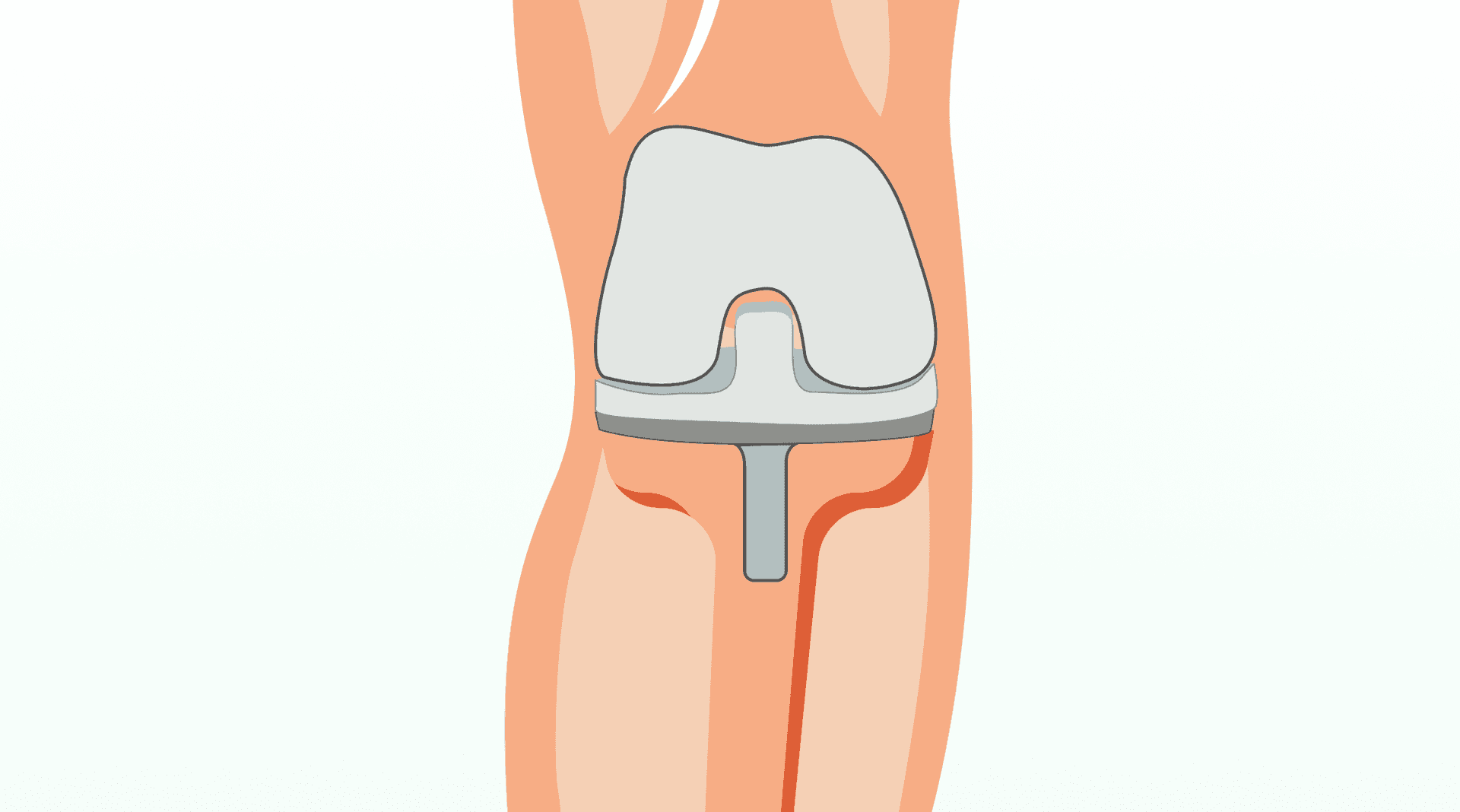
Total knee replacement is a procedure in which the main surfaces of the knee joint are replaced with artificial components. This usually includes the end of the thigh bone, the top of the shin bone, and sometimes the kneecap surface depending on the case. It is used when arthritis affects multiple parts of the knee or when joint damage is severe.
This is the most common option for advanced knee arthritis because it treats the joint more comprehensively. It can provide excellent pain relief and improved walking ability when the patient is suitable and follows rehabilitation properly.
When Is Total Knee Replacement Used?
Total knee replacement is used when damage is not limited to one compartment, or when there is significant deformity, stiffness, or ligament problems. It may also be preferred when partial replacement would not treat all pain sources.
It may be suitable when there is:
- Arthritis in more than one compartment.
- Damage on both inner and outer sides of the knee.
- Symptomatic kneecap joint damage.
- Severe leg deformity.
- Major stiffness.
- Weak or unstable ligaments.
- Inflammatory arthritis.
- Failed previous partial replacement.
- Pain throughout the knee.
- Need for comprehensive joint treatment.
The goal is to treat the knee as a whole and improve pain, stability, and movement.
Benefits of Total Knee Replacement
Total knee replacement is useful when disease is widespread because it addresses most sources of joint pain. It is also a well-established operation with long-term results in properly selected patients.
Benefits may include:
- Comprehensive treatment for advanced arthritis.
- Suitable for widespread damage.
- Suitable for larger deformities.
- Significant pain reduction for many patients.
- Improved walking ability.
- Treatment of more than one joint compartment.
- Useful when kneecap joint damage is symptomatic.
- Less risk of leaving untreated arthritis behind.
Recovery may be longer than partial replacement, and some patients need time to adapt to the new joint feeling.
Read about: Top Knee Replacement Technologies Available in Turkey
What Is Partial Knee Replacement?
Partial knee replacement, also called unicompartmental knee replacement, replaces only the damaged compartment of the knee while preserving the healthy parts. It is most commonly performed for arthritis on the inner side of the knee, but it may also be used for the outer side or kneecap compartment in selected cases.
The idea is that the entire knee does not always need replacement if damage is limited. In the right patient, more natural bone and ligaments can be preserved, which may lead to a more natural feeling and faster recovery.
When Is Partial Knee Replacement Used?
Partial knee replacement is used when arthritis is limited to one compartment and the rest of the knee remains relatively healthy. The ligaments, especially the anterior cruciate ligament in many cases, should be stable for the partial replacement to work properly.
It may be suitable when there is:
- Damage in only one knee compartment.
- Pain limited to one side.
- Stable ligaments.
- Mild correctable deformity.
- Good range of motion.
- No widespread inflammatory arthritis.
- Healthy cartilage in other compartments.
- Suitable weight and activity level.
- Desire for faster recovery when medically appropriate.
- Surgeon confirmation after evaluation.
If arthritis is widespread or ligaments are unstable, partial replacement may not be appropriate.
Benefits of Partial Knee Replacement
The main advantage of partial replacement is preserving as much of the natural knee as possible. Because surgery is limited to the damaged area, the incision may be smaller, blood loss may be lower, and recovery may be faster in selected patients.
Potential benefits include:
- Smaller incision.
- Less pain in some patients.
- Faster recovery.
- More natural knee feeling for some patients.
- Preservation of more ligaments.
- Better range of motion in some cases.
- Shorter hospital stay in some patients.
- Less blood loss in some cases.
- Earlier return to light activity.
- Possibility of conversion to total replacement later if needed.
These benefits are most likely when the patient is truly suitable for partial replacement.
Read about: Knee Replacement: Cost Quality in Turkey vs Germany
Main Difference Between Total and Partial Replacement
The main difference is how much of the knee is replaced. Total knee replacement treats most of the joint, while partial knee replacement treats only the damaged compartment. This affects incision size, recovery, movement, natural feeling, and the risk of future surgery.
There is no universally better option. Partial knee replacement can be excellent when damage is limited, but it may fail if arthritis is more widespread than expected or if the wrong patient is selected. Total knee replacement is more comprehensive but involves a larger surgical intervention.
Surgery Size and Recovery
Partial knee replacement is usually less invasive because only one part of the joint is treated. Recovery may be faster, the incision may be smaller, and early movement may be easier. Total knee replacement is a larger operation and recovery is often longer.
General differences include:
- Partial: usually smaller incision.
- Partial: faster recovery in many suitable patients.
- Partial: less pain in some cases.
- Total: better for widespread arthritis.
- Total: treats more joint compartments.
- Total: more common in severe arthritis.
- Partial: preserves more natural structures.
- Total: less risk of leaving untreated arthritis.
Recovery time depends on age, weight, fitness, surgical technique, and rehabilitation.
Natural Feeling and Movement
Because partial knee replacement preserves more natural knee structures, some patients feel that the knee moves more naturally. Range of motion may also be better in some cases. Total knee replacement changes more of the joint, but it is better when arthritis is widespread.
In terms of feeling:
- Partial may feel more natural.
- Partial may allow faster early movement.
- Total provides stability in widespread disease.
- Total may need more time for adaptation.
- Rehabilitation affects both results.
- Preoperative pain influences recovery.
- Muscle strength is important in both.
A patient should not choose partial replacement only because it sounds more natural. The knee must be suitable for it.
Read about: Knee Joint Replacement Rehab: Steps and Pain Management
Which Option Fits Your Health Condition?
Choosing between total and partial knee replacement requires accurate diagnosis. Pain alone is not enough. Some patients feel pain mainly on one side, but imaging shows arthritis in multiple areas. Others may have limited arthritis on imaging but pain from the hip, back, or soft tissues.
The final decision should balance joint condition, overall health, activity level, expectations, and surgeon expertise.
When Partial Replacement May Be Better
Partial knee replacement may be better when arthritis is limited to one compartment, the knee is stable, movement is good, and deformity is mild. The patient should also be able to follow rehabilitation and follow-up instructions.
Partial replacement may fit if you have:
- Pain mainly on one side of the knee.
- Damage limited to one compartment.
- Good ligaments.
- Mild deformity.
- Good range of motion.
- No widespread inflammatory arthritis.
- Relatively suitable weight.
- Desire for faster recovery.
- Realistic expectations.
- Surgeon confirmation after evaluation.
In this case, preserving healthy parts of the knee can be a major advantage.
When Total Replacement May Be Better
Total knee replacement may be better when arthritis is widespread, the knee is unstable, deformity is significant, or pain is present in several areas of the joint. It may also be preferred when kneecap joint damage is symptomatic or inflammatory arthritis is present.
Total replacement may fit if you have:
- Arthritis in more than one compartment.
- Pain throughout the knee.
- Clear leg deformity.
- Severe stiffness.
- Ligament weakness.
- Kneecap joint damage.
- Rheumatoid or inflammatory arthritis.
- Long-term treatment failure.
- Failed previous partial replacement.
- Need for comprehensive treatment.
In these cases, partial replacement may leave untreated pain sources behind.

Recovery After Total and Partial Knee Replacement
Recovery varies from person to person. Some patients improve quickly within weeks, while others need several months to reach their best result. Rehabilitation is essential after both partial and total replacement.
In general, recovery after partial replacement may be faster in suitable patients, but this does not mean the procedure is simple or that full activity returns immediately.
Recovery After Partial Knee Replacement
After partial knee replacement, patients may move more quickly and may have less early pain. Walking often begins early according to the surgeon’s plan. Exercises are needed to improve motion and strengthen muscles.
Recovery may include:
- Gradual walking.
- Physical therapy.
- Knee bending and straightening exercises.
- Temporary use of crutches.
- Pain medication.
- Blood clot prevention medication.
- Wound monitoring.
- Avoiding excessive stress.
- Gradual return to activities.
- Follow-up with the surgeon.
Even if recovery is faster, patients should not overload the knee before medical approval.
Recovery After Total Knee Replacement
Recovery after total knee replacement may take longer because the surgery is more extensive. Walking and exercises begin early, but regaining strength, confidence, and range of motion can take several months.
Recovery usually includes:
- Regular physical therapy.
- Daily exercises.
- Pain control.
- Blood clot prevention.
- Range of motion improvement.
- Thigh muscle strengthening.
- Swelling monitoring.
- Wound care.
- Follow-up visits.
- Fall prevention.
- Gradual return to work.
- Patience during full recovery.
The final outcome depends heavily on commitment to rehabilitation.
Read about: Home Exercises After Knee Replacement Surgery Recovery
Risks and Possible Complications
Both total and partial knee replacement carry surgical risks, although the procedures are common and successful for many patients. Understanding risks helps patients make informed decisions and prepare for recovery.
Risk may be higher with poorly controlled diabetes, severe obesity, smoking, heart disease, weak immunity, or poor rehabilitation compliance.
Shared Risks
Shared risks include:
- Wound or joint infection.
- Blood clots.
- Knee stiffness.
- Persistent pain.
- Bleeding.
- Swelling.
- Rare nerve or vessel injury.
- Rare instability or dislocation.
- Implant wear over time.
- Need for revision surgery.
- Anesthesia complications.
- Dissatisfaction with the result.
These risks do not mean surgery is unsafe, but they highlight the importance of preparation, surgeon choice, and follow-up.
Risks Specific to Each Option
Partial knee replacement may carry the risk of arthritis progressing later in the parts of the knee that were not replaced. This may require conversion to total knee replacement in the future. It also depends heavily on accurate patient selection.
Total knee replacement is a larger operation and often requires longer recovery. Some patients may feel the knee is less natural compared with a partial replacement.
General comparison:
- Partial: risk of arthritis progression in other compartments.
- Partial: may need conversion to total replacement later.
- Partial: not suitable if patient selection is wrong.
- Total: larger operation.
- Total: usually longer recovery.
- Total: more pain or blood loss in some cases.
- Total: may feel less natural for some patients.
- Both require rehabilitation and follow-up.
Correct selection helps reduce these problems.
Read about: Knee Rehabilitation After Prosthetic Surgery: Exercise Plan
Tests Needed Before Choosing Surgery Type
Before deciding, patients need careful evaluation to identify where arthritis is located and how widespread it is. X-rays may be enough in many cases, but MRI or other tests may be needed, especially when partial replacement is being considered.
Overall health must also be assessed because heart disease, diabetes, obesity, osteoporosis, and smoking can affect surgery choice and recovery.
Knee Evaluation
Knee tests help determine whether damage is limited or widespread. They also show leg alignment, kneecap condition, and joint stability.
Tests may include:
- Standing X-rays.
- Kneecap-view X-rays.
- Leg alignment assessment.
- Range of motion examination.
- Ligament stability testing.
- Pain location assessment.
- MRI when needed.
- Cartilage evaluation in other compartments.
- Review of previous imaging.
- Hip and spine examination when suspected.
These tests help avoid choosing partial replacement for a patient who actually needs total replacement.
General Health Evaluation
Before surgery, doctors must confirm that the patient is ready for anesthesia and recovery. Optimizing chronic diseases reduces complications and improves outcomes.
Patients may need:
- Complete blood count.
- Fasting glucose and HbA1c.
- Kidney and liver function tests.
- ECG.
- Cardiology review when needed.
- Blood pressure assessment.
- Blood-thinner review.
- Weight assessment.
- Screening for dental or skin infections when needed.
- Smoking cessation when possible.
- Physical therapy plan before and after surgery.
Better overall health usually supports safer recovery.
How to Decide With Your Doctor
The decision between total and partial knee replacement should be shared between patient and surgeon. The patient should understand benefits and risks, and the surgeon should explain why one option is preferred based on the findings.
Patients should not choose surgery only because the incision is smaller, recovery sounds faster, or a friend had a good result. Every knee is different.
Important Questions Before Surgery
Before deciding, patients may ask:
- Is my arthritis in one compartment or more?
- Are my knee ligaments stable?
- Am I truly suitable for partial replacement?
- Why do you recommend total replacement?
- What recovery time should I expect?
- Will I need physical therapy?
- What is the chance of conversion to total replacement later?
- What type of implant will be used?
- When can I walk?
- When can I return to work?
- What are the risks in my health condition?
- How can I protect the implant after surgery?
These questions make the decision clearer and reduce surprises.
Importance of Realistic Expectations
Realistic expectations are essential. Knee replacement aims to reduce pain and improve movement, but it does not make the knee exactly like a young healthy knee. Some swelling or unusual sensation may continue for a while, and muscles need time to regain strength.
Patients should know that:
- Improvement is gradual.
- Physical therapy is very important.
- Pain does not disappear completely on day one.
- Walking improves over time.
- Weight affects implant lifespan.
- Falls can cause problems.
- Very high-impact activity may accelerate wear.
- Follow-up remains important after improvement.
Realistic expectations increase satisfaction after surgery.
Conclusion
The difference between total and partial knee replacement depends on how much of the knee is damaged. Partial replacement may be suitable when arthritis is limited to one compartment, ligaments are stable, movement is good, and deformity is mild. Total replacement is usually better when arthritis is widespread, pain affects the whole knee, deformity is significant, or the joint is unstable.
Partial replacement may offer faster recovery and a more natural feeling in the right patient, while total replacement provides broader treatment for advanced arthritis. There is no single best choice for everyone. The best option depends on examination, imaging, overall health, and expectations.
Frequently Asked Questions: Total vs Partial Knee Replacement
What is the difference between total and partial knee replacement?
Total knee replacement treats most of the knee joint, while partial knee replacement replaces only the damaged compartment.
Is partial knee replacement better than total replacement?
Not always. Partial replacement is better only when damage is limited to one compartment and the ligaments and knee structure are suitable.
Is recovery faster after partial knee replacement?
Often yes in suitable patients, because the surgery is less extensive, but recovery still requires physical therapy and follow-up.
When is total knee replacement better?
It is usually better when arthritis affects multiple compartments, pain is widespread, deformity is significant, stiffness is severe, or ligaments are weak.
Can partial knee replacement be converted to total replacement later?
Yes. If arthritis progresses in other parts of the knee or the partial implant fails, conversion to total replacement may be needed.