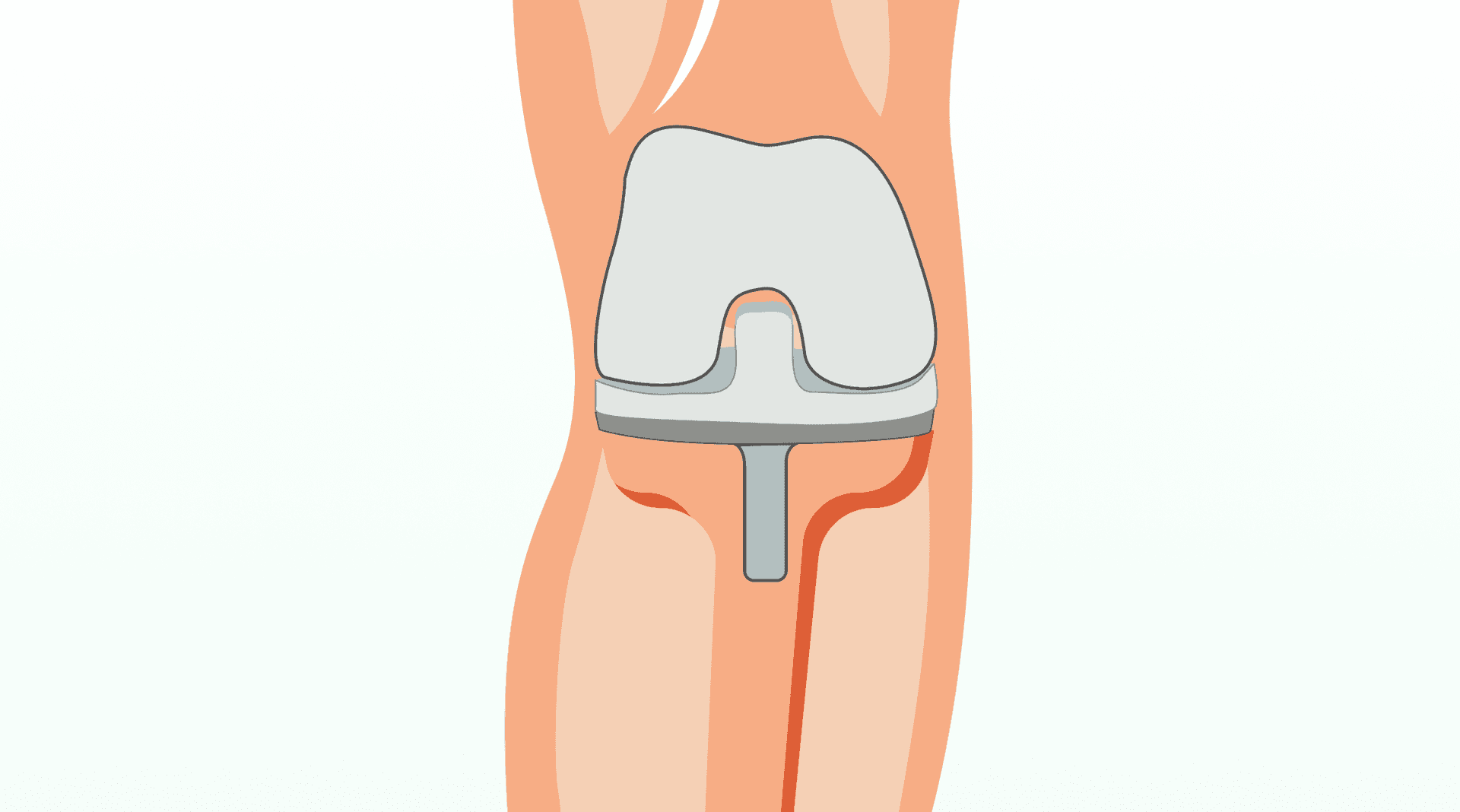






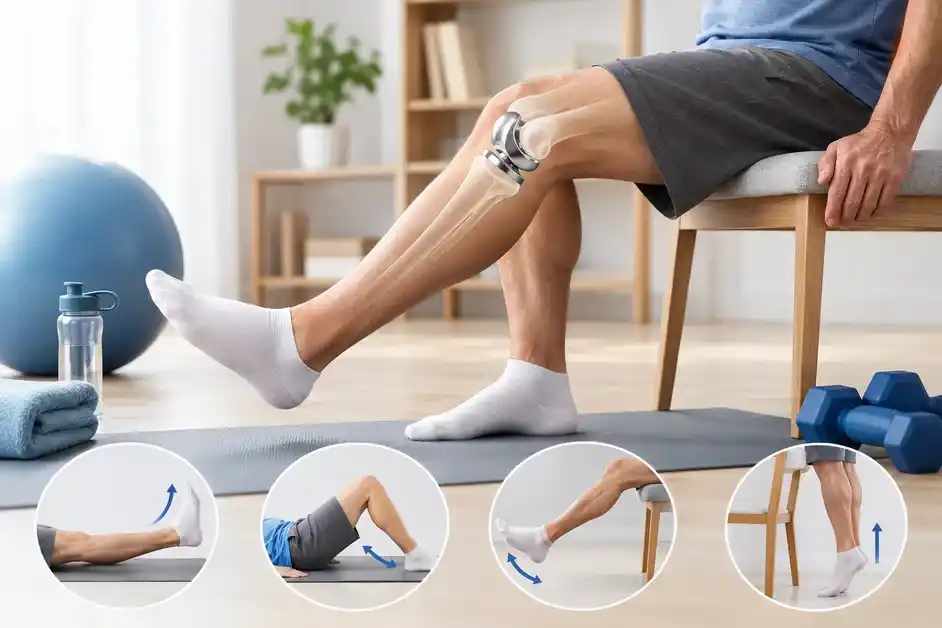
Home exercises after knee replacement surgery recovery are an essential part of regaining movement, strength, balance, and confidence after the operation. A successful knee replacement does not depend on surgery alone. The recovery process also requires a structured knee replacement exercise program, regular physical therapy guidance, safe home practice, and gradual progression.
After knee replacement surgery, many patients experience swelling, stiffness, reduced knee range of motion, weakness in the thigh muscles, and difficulty walking normally. Home knee replacement exercises help the body adapt to the new joint, activate the muscles around the knee, improve circulation, and support a safer return to daily activities.
However, exercises should be performed carefully. The goal is not to force the knee, push through severe pain, or rush recovery. Instead, the goal is to follow safe exercises after knee replacement that match the patient’s stage of healing, pain level, swelling, and surgeon or physical therapist instructions.
Introduction: Importance of Home Knee Replacement Exercises
Home knee replacement exercises help restore the function of the knee after surgery. They support flexibility, muscle activation, circulation, and walking ability. Without regular movement, the knee may become stiff, the thigh muscles may remain weak, and daily activities such as standing, walking, sitting, and using stairs may become more difficult.
A good recovery plan usually includes both supervised knee replacement physical therapy exercises and exercises performed at home. The home program gives the patient a way to continue progress between therapy sessions and maintain the benefits gained during professional rehabilitation.
Why Do Home Exercises Matter After Knee Replacement?
Home exercises matter because the knee needs repeated, controlled movement to recover. After surgery, swelling and pain can make the patient avoid movement, but complete rest can increase stiffness and slow recovery. Gentle and consistent movement helps the joint and muscles gradually return to function.
Benefits of home knee replacement exercises may include:
- Improved knee range of motion.
- Less stiffness.
- Better walking ability.
- Stronger quadriceps muscles.
- Improved circulation.
- Better balance and confidence.
- Reduced swelling over time.
- Easier return to daily activities.
- Better support for physical therapy results.
- Lower risk of prolonged weakness.
The exercises should be comfortable enough to repeat regularly. Mild discomfort or stretching can be expected, but sharp pain, sudden swelling, or worsening symptoms should not be ignored.
When to Start Home Exercises After Surgery
Many patients begin gentle exercises shortly after surgery, often while still in the hospital. The exact timing depends on the surgeon’s instructions, the type of knee replacement, pain control, wound condition, and the patient’s general health.
Early exercises may include:
- Ankle pumps.
- Gentle foot circles.
- Quadriceps tightening.
- Assisted knee bending.
- Knee extension exercises.
- Short walking with support.
- Straight leg raises when allowed.
Some patients progress quickly, while others need more time because of swelling, pain, weakness, age, diabetes, obesity, or other health conditions. The right starting point should always be confirmed by the medical team.
Steps for Safe Home Exercises After Knee Surgery
Safe home exercises after knee surgery should follow a gradual plan. The first stage usually focuses on circulation, gentle movement, and muscle activation. Later stages may include knee range of motion exercises, strengthening exercises, low-impact activities, and progressive resistance.
Before exercising, patients should choose a safe area with good lighting, stable furniture, supportive shoes, and no loose rugs or obstacles. A walker, cane, or chair may be needed for balance, especially during the early recovery period.
Warm-Up Activities Before Knee Rehab Exercises
Warm-up activities prepare the knee and surrounding muscles for movement. After knee replacement, a warm-up does not mean intense exercise. It means gentle movements that increase comfort and reduce stiffness before starting the main knee rehab exercises at home.
Useful warm-up activities may include:
- Sitting on a stable chair.
- Slow ankle pumps.
- Gentle foot circles.
- Light quadriceps tightening.
- Short indoor walking if allowed.
- Deep breathing before exercise.
- Gentle knee bending within comfort.
Patients should avoid sudden movements, deep squats, jumping, twisting, or forcing the knee into a painful position. A safe warm-up should make movement easier, not increase pain.
Initiating Ankle Pumps and Circulation Exercises
Ankle pumps after knee replacement are among the earliest and simplest exercises. They help move the calf muscles, support circulation, and reduce the feeling of heaviness in the leg. They can usually be done while lying down or sitting.
How to do ankle pumps:
- Sit or lie comfortably.
- Keep the leg supported.
- Pull the toes toward the body.
- Then push the foot downward.
- Repeat slowly and rhythmically.
- Perform as instructed by the medical team.
Circulation exercises are especially important during the early days when walking is still limited. However, severe calf pain, sudden swelling, redness, warmth, chest pain, or shortness of breath should be treated as warning signs requiring urgent medical evaluation.
Read about: Knee Joint Replacement: When to Opt for Surgery
Straight Leg Raises and Knee Extension Exercises
Straight leg raises after knee replacement and knee extension exercise at home are important for strengthening the quadriceps and improving control of the operated leg. The quadriceps muscle at the front of the thigh often becomes weak after surgery due to pain, swelling, and reduced activity.
These exercises should be done slowly and only when the patient can control the leg safely. If the knee bends during the movement or pain becomes sharp, the exercise may need to be modified.
How to Perform Straight Leg Raises After Knee Replacement
Straight leg raises after knee replacement help activate the quadriceps without requiring major knee bending. The exercise is usually performed while lying on the back.
General steps:
- Lie on your back.
- Bend the non-operated knee and place that foot on the bed.
- Keep the operated leg straight.
- Tighten the thigh muscle.
- Slowly lift the operated leg several inches.
- Hold for 2 to 3 seconds if comfortable.
- Lower the leg slowly.
- Rest between repetitions.
If the patient cannot lift the leg while keeping the knee straight, they may need more quadriceps activation exercises before trying full straight leg raises. The movement should not be rushed.
Knee Extension Exercise at Home Guidelines
Knee extension exercise at home helps the patient regain the ability to fully straighten the knee. Full knee extension is important for walking efficiently and avoiding a bent-knee walking pattern.
A simple seated knee extension exercise may be done as follows:
- Sit on a firm chair.
- Keep the back supported.
- Place both feet on the floor.
- Slowly straighten the operated knee.
- Hold for a few seconds.
- Lower the foot slowly.
- Repeat as tolerated.
Another common option is a knee-straightening stretch with the heel supported and the knee relaxed toward extension, but this should be done only as instructed. Patients should never place heavy weight directly on the knee to force extension.
Heel Slides and Range of Motion Exercises
Heel slides exercise is one of the most common at-home knee range of motion exercises after knee replacement. It helps improve knee flexion, which is needed for sitting, getting into a car, using stairs, and returning to daily activities.
Range of motion should improve gradually. Trying to bend the knee aggressively can increase pain and swelling, which may actually slow recovery. The goal is controlled progress, not forced movement.
Doing Heel Slides Safely
Heel slides can usually be done on a bed or firm surface. The patient slides the heel toward the body to bend the knee, then slowly returns the leg to a straighter position.
General steps:
- Lie on your back.
- Keep the operated leg relaxed.
- Slowly slide the heel toward your body.
- Bend the knee within a comfortable range.
- Hold briefly if tolerated.
- Slide the heel back down slowly.
- Repeat without forcing the knee.
A towel or strap may help guide the movement, but it should not be used to pull aggressively. The patient should feel controlled stretching, not sharp pain.
Additional Range of Motion Exercises at Home
At home, knee range of motion exercises may also include seated knee bends, gentle assisted flexion, and gradual knee extension work. These exercises help reduce stiffness and improve daily function.
Examples may include:
- Seated knee bending.
- Bed-supported knee bends.
- Assisted heel slides.
- Gentle seated knee extension.
- Short walks to reduce stiffness.
- Controlled movement from sitting to standing.
The correct exercise depends on the healing stage. A patient with significant swelling may need a gentler plan than someone who is moving well with low pain.

Quad Strengthening Exercises at Home
Quad strengthening exercises for knee replacement are essential because the quadriceps muscle helps stabilize the knee, control walking, and support standing from a chair. After surgery, this muscle can become inhibited by swelling and pain.
Strengthening should begin with simple activation and progress slowly. The patient should avoid heavy resistance too early, especially if it causes increased swelling or difficulty walking the next day.
Simple Quad Strengthening Exercises
Simple quadriceps exercises can often begin early, depending on the physical therapist’s instructions. One of the most common is the quadriceps set, which trains the thigh muscle to contract while the leg is straight.
General quadriceps set steps:
- Lie down or sit with the leg supported.
- Tighten the muscle at the front of the thigh.
- Try to press the back of the knee gently toward the bed.
- Hold for 3 to 5 seconds.
- Relax fully.
- Repeat as instructed.
Other simple exercises may include seated knee extension, straight leg raises, and gentle standing weight shifts when allowed. These exercises help the patient regain control of the operated leg.
Progressive Resistance for Quad Strength
Progressive resistance may be added later when pain, swelling, and movement improve. Resistance should be light at first and increased only under guidance. The goal is to build strength without irritating the joint.
Examples of progressive strengthening may include:
- Light resistance bands.
- Seated knee extension with low resistance.
- Sit-to-stand from a higher chair.
- Mini step-ups when allowed.
- Heel raises while holding support.
- Gentle hip strengthening.
- Stationary bike when approved.
If resistance training causes increased swelling, warmth, or pain lasting into the next day, the program may be too intense and should be adjusted.
Read about: Top Knee Replacement Technologies Available in Turkey
Low Impact Gentle Exercises After Knee Replacement
Low-impact exercises after knee replacement help improve movement and endurance without placing excessive stress on the new joint. These activities are usually introduced gradually after the early recovery phase, depending on the surgeon’s and physical therapist’s guidance.
Gentle exercises after knee replacement are especially useful for patients who feel afraid to move. The right exercises can help rebuild trust in the knee while protecting the surgical area.
Best Low-Impact Exercises for Knee Recovery
The best low-impact exercises for knee recovery are those that improve movement, strength, and circulation without twisting or pounding the joint. These exercises should be introduced progressively.
Common low-impact options may include:
- Walking on flat surfaces.
- Stationary cycling when allowed.
- Gentle step practice.
- Water walking after wound healing and approval.
- Seated knee extension.
- Light resistance band exercises.
- Balance practice with support.
- Gentle stretching.
High-impact activities such as running, jumping, deep squats, and sudden twisting are usually avoided in the early recovery period and may not be recommended long term depending on the patient.
Gentle Exercises You Can Do Daily
Daily gentle exercises help maintain progress and reduce stiffness. Short sessions repeated during the day may be better than one long, exhausting session.
Gentle daily exercises may include:
- Ankle pumps.
- Foot circles.
- Quadriceps sets.
- Heel slides.
- Seated knee extension.
- Short walks.
- Gentle calf stretching.
- Controlled sit-to-stand practice.
The patient should monitor how the knee responds. If symptoms worsen after each session, the routine may need to be reduced or modified.
Read about: Knee Replacement: Cost Quality in Turkey vs Germany
Home Exercise Program Workout Plan
A knee replacement recovery workout plan should be gradual and flexible. No single plan fits every patient because healing speed, pain, swelling, strength, and mobility differ. A physical therapist can adjust the plan based on progress.
The safest approach is to begin with circulation and gentle mobility, then add strengthening, walking, balance, and low-impact endurance as recovery improves.
Sample Knee Replacement Recovery Workout Plan
A sample home exercise program may be organized by recovery stage, but it should always be adjusted to medical advice.
Early phase may include:
- Ankle pumps several times daily.
- Foot circles.
- Quadriceps sets.
- Gentle heel slides.
- Seated knee extension.
- Short supported walks.
- Leg elevation and swelling control.
Middle phase may include:
- More heel slides.
- Straight leg raises.
- Sit-to-stand practice.
- Gentle step practice.
- Longer walks.
- Light stretching.
- Early resistance if approved.
Later phase may include:
- Stationary cycling when allowed.
- Resistance band exercises.
- Step-ups.
- Balance exercises.
- Longer walking.
- More advanced strengthening.
- Functional training for stairs and daily movement.
This is a general framework, not a personal prescription.
Adjusting Your Exercise Program Over Time
The exercise program should change as the knee heals. If the patient continues doing only early exercises for too long, strength may progress slowly. If the patient advances too quickly, pain and swelling may increase.
Adjustments may depend on:
- Pain level.
- Swelling.
- Knee flexion.
- Knee extension.
- Walking ability.
- Balance.
- Muscle strength.
- Wound healing.
- Surgeon restrictions.
- Physical therapist assessment.
A good program progresses gradually while respecting the body’s response.
Read about: Knee Joint Replacement Rehab: Steps and Pain Management
Safety Tips Precautions for Post Knee Replacement Workout
Safety is essential during any post knee replacement workout. Exercises should help recovery, not create new problems. Patients should avoid comparing themselves to others because recovery speed varies widely.
Safe exercises after knee replacement should be performed slowly, with stable support when needed, and without sudden twisting. The patient should stop if symptoms become abnormal.
Avoiding Unsafe Movements After Knee Replacement
Some movements can place unnecessary stress on the knee during early recovery. These should be avoided unless the surgeon or therapist specifically allows them.
Avoid:
- Running too early.
- Jumping.
- Deep squats.
- Sudden twisting.
- Kneeling without approval.
- Sitting on very low chairs.
- Carrying heavy weights.
- Fast stair climbing.
- Forcing knee bending.
- Exercising through sharp pain.
Safe movement is controlled, gradual, and stable. More exercise is not always better if the knee becomes irritated.
Listening to Your Body and When to Rest
Mild soreness can happen during recovery, but severe pain is not a goal. Patients should monitor how the knee feels during and after exercise.
Signs you may need rest or program adjustment include:
- Sharp pain during exercise.
- Swelling that increases afterward.
- More difficulty walking the next day.
- Warmth that worsens.
- Fatigue that feels excessive.
- Pain that does not settle with rest.
- Decreased range of motion after exercise.
Rest is part of recovery. Short, frequent sessions may be safer than long sessions that exhaust the knee.
When to Consult Your Physical Therapist
A physical therapist should be consulted if the patient is unsure how to perform an exercise, if progress slows, or if symptoms worsen. Professional supervision helps correct technique and prevent avoidable mistakes.
Consult your physical therapist or doctor if you have:
- Persistent severe pain.
- Rapidly increasing swelling.
- Redness around the wound.
- Wound drainage.
- Fever or chills.
- Calf pain or sudden swelling.
- Shortness of breath.
- Chest pain.
- Sudden weakness.
- A fall onto the operated knee.
- Stiffness that worsens over time.
These signs should not be managed by exercise alone.
Read about: Knee Rehabilitation After Prosthetic Surgery: Exercise Plan
Next Steps
Home exercises after knee replacement surgery recovery help the patient rebuild strength, mobility, and confidence. However, the best results come from a balanced plan that combines home practice, professional physical therapy, safe progression, and medical follow-up.
The patient should continue improving range of motion, walking quality, quadriceps strength, and low-impact endurance. Recovery is a process that often takes weeks to months, and consistency matters more than intensity.
Summary of the Benefits of Consistent Home Exercises
Consistent home exercises after knee replacement can support better recovery and daily function. Improvement may be gradual, but regular safe practice can make a meaningful difference.
Benefits include:
- Improved knee movement.
- Stronger thigh muscles.
- Better walking stability.
- Less stiffness.
- Better circulation.
- More confidence.
- Easier stair use.
- Better daily activity performance.
- Support for long-term joint function.
The most effective program is one the patient can perform safely and consistently.
How to Maintain Progress in Your Knee Rehab
Progress in knee rehab is maintained by continuing exercises after the early recovery period, increasing activity gradually, and avoiding long periods of inactivity. Walking, strengthening, and flexibility work all remain important.
To maintain progress:
- Follow a daily routine.
- Increase activity slowly.
- Continue physical therapy as advised.
- Monitor swelling.
- Use support when needed.
- Eat enough protein.
- Maintain a healthy weight.
- Avoid high-risk movements.
- Ask before adding new exercises.
- Keep follow-up appointments.
Long-term success depends on protecting the new joint while rebuilding strength around it.
Reminder: Follow Your Physical Therapist’s Guidance
Home exercises are valuable, but they should be guided by a physical therapist or medical team. Each patient’s program may differ depending on surgical technique, pain, swelling, range of motion, and overall health.
Frequently Asked Questions: Home Exercises After Knee Replacement Surgery Recovery
When should I start home knee replacement exercises?
Many patients begin gentle exercises soon after surgery, but timing should always follow the surgeon’s or physical therapist’s instructions.
Are knee replacement recovery exercises painful?
Mild discomfort or stretching may occur, but sharp pain, increasing swelling, or worsening movement should be discussed with a professional.
What are the most important after knee replacement exercises?
Common early exercises include ankle pumps, quad sets, heel slides, knee extension exercises, and straight leg raises when allowed.
Can I do knee rehab exercises at home without physical therapy?
Home exercises are important, but they should be guided or reviewed by a physical therapist to ensure safe technique and progression.
When can I start resistance exercises after knee replacement?
Resistance exercises are usually added after mobility and pain improve, and only with approval from the physical therapist or surgeon.