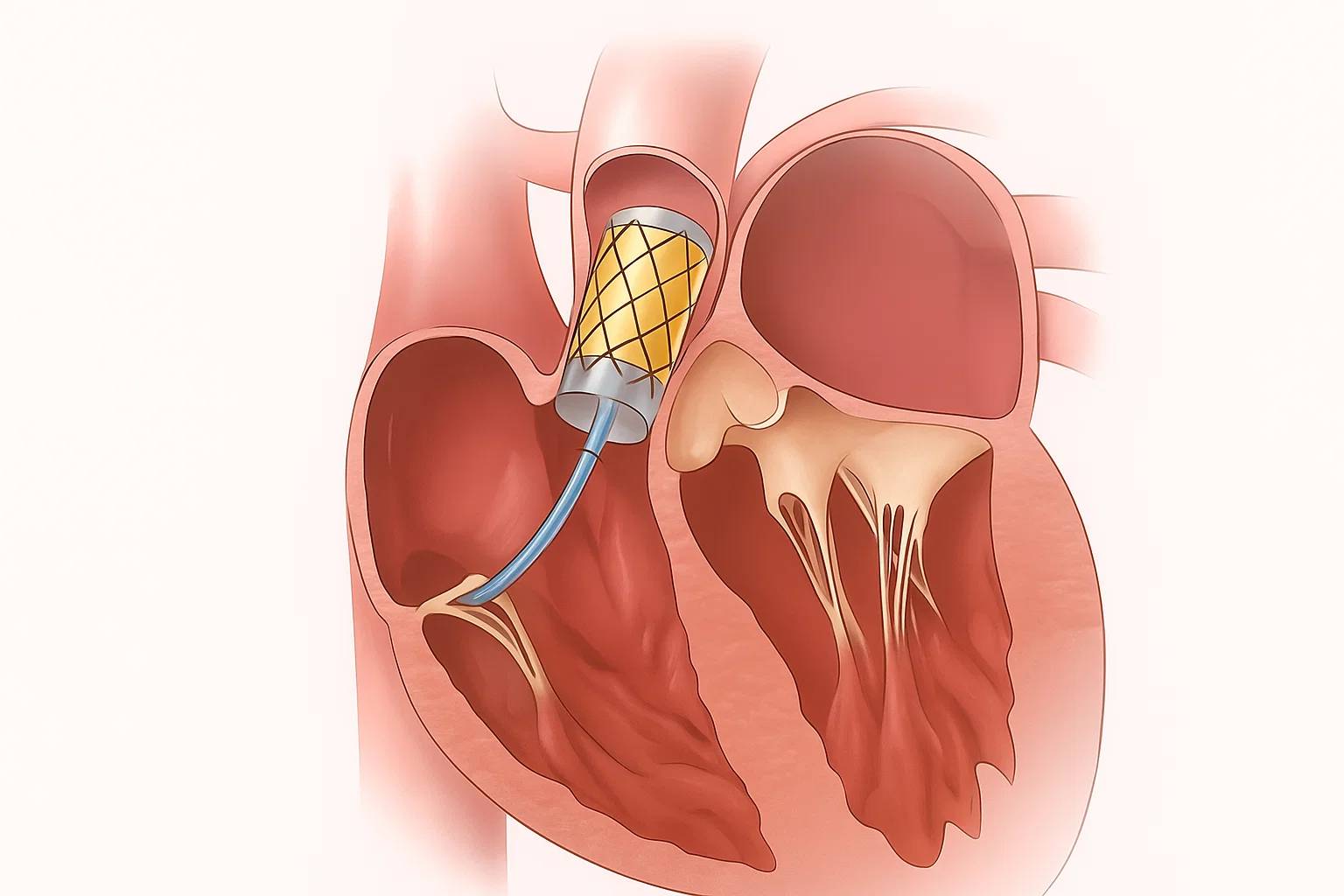








Mitral regurgitation occurs when the valve between the left atrium and left ventricle does not close completely, allowing blood to leak backward during ventricular contraction. Mild regurgitation may require only surveillance, while severe disease can progressively enlarge the heart, raise pulmonary pressures, cause atrial fibrillation, and eventually impair cardiac function.
At Safemedigo, mitral regurgitation is assessed according to its mechanism, severity, symptoms, ventricular function, atrial enlargement, pulmonary pressure, and overall cardiac damage. Treatment has expanded considerably beyond conventional surgery. Surgical repair remains fundamental, while transcatheter edge-to-edge repair, or TEER, is now an established option for selected patients, and transcatheter mitral valve replacement continues to develop for more complex cases.
How Mitral Regurgitation Affects Heart Function and Blood Flow
The mitral valve normally opens to allow blood to move from the left atrium into the left ventricle and closes when the ventricle contracts.
When the leaflets fail to meet properly, some blood returns toward the atrium.
Mild, Moderate, and Severe Mitral Regurgitation
Mitral regurgitation ranges from mild leakage with little hemodynamic effect to severe disease that significantly overloads the heart.
Severity should be interpreted together with ventricular size and function, atrial enlargement, pulmonary pressures, and symptoms rather than from one measurement alone.
How Severe Mitral Regurgitation Enlarges the Heart
Chronic backward flow increases the volume handled by the left atrium and ventricle.
Over time this can lead to:
- Left atrial enlargement.
- Left ventricular dilation.
- Pulmonary hypertension.
- Atrial fibrillation.
- Progressive ventricular dysfunction.
Does Every Mitral Valve Leak Require Treatment?
No.
Mild disease may simply be monitored. Severe regurgitation requires a more detailed assessment to determine whether medical therapy, surgery, or transcatheter intervention is appropriate.
Primary and Secondary Causes of Mitral Valve Regurgitation
Determining why the valve leaks is central to treatment.
Mitral regurgitation is broadly divided into primary disease of the valve itself and secondary regurgitation caused by changes elsewhere in the heart.
Primary Mitral Regurgitation Caused by Valve Disease
Primary causes include:
- Mitral valve prolapse.
- Degenerative leaflet disease.
- Ruptured chordae.
- Valve infection.
- Rheumatic damage in selected populations.
- Other structural abnormalities.
Acute chordal rupture can occasionally cause sudden severe regurgitation and pulmonary congestion.
Secondary Mitral Regurgitation Caused by Heart Failure
In secondary MR, the valve leaflets may be relatively normal.
The ventricle changes shape because of ischemic or nonischemic cardiomyopathy, pulling the supporting structures away from their normal position and preventing complete leaflet closure.
Management therefore begins by treating the underlying heart failure.
Atrial Functional Mitral Regurgitation and Atrial Fibrillation
A separate secondary pattern can develop when the left atrium and mitral annulus enlarge, often in association with longstanding atrial fibrillation despite relatively preserved ventricular function.
Modern treatment planning increasingly distinguishes this atrial phenotype from ventricular secondary MR.
Read about: Symptoms of Coronary Artery Blockage and Treatment Options
Symptoms and Diagnostic Tests for Mitral Regurgitation
Chronic mitral regurgitation can remain asymptomatic for years because the heart initially adapts to the additional volume.
Symptoms of Significant Mitral Valve Leakage
Symptoms can include:
- Shortness of breath with activity.
- Reduced exercise capacity.
- Fatigue.
- Palpitations.
- Breathlessness when lying down.
- Leg swelling in advanced disease.
Sudden severe breathlessness can occur with acute severe regurgitation and requires urgent evaluation.
Echocardiography for Mitral Regurgitation Diagnosis
Transthoracic echocardiography is the primary diagnostic test.
It evaluates valve anatomy, regurgitation mechanism and severity, ventricular function, chamber size, pulmonary pressure, and associated valve disease.
Modern assessment uses multiple complementary echocardiographic parameters rather than relying on one number.
Transesophageal and 3D Echocardiography Before Mitral Valve Repair
Transesophageal echocardiography provides higher-resolution visualization when detailed anatomy is required.
Three-dimensional imaging is particularly useful for identifying the diseased leaflet segment and determining whether surgical or transcatheter repair is feasible.
Read about: Non-Surgical Artery Blockage Treatments: Latest Advances
Medical Treatment and Monitoring for Mitral Regurgitation
Medication cannot usually repair a structurally damaged leaflet, but it plays a central role in managing symptoms and treating secondary MR.
Monitoring Mitral Regurgitation Without Immediate Intervention
Patients without a current indication for intervention can undergo structured follow-up focused on symptoms, ventricular function, chamber size, pulmonary pressure, and new atrial fibrillation.
The goal is to intervene before irreversible cardiac damage develops.
Heart Failure Treatment for Secondary Mitral Regurgitation
For ventricular secondary MR, contemporary heart-failure therapy is the essential first treatment step.
Appropriate patients may also benefit from cardiac resynchronization and treatment of significant coronary disease.
Successful treatment of ventricular dysfunction can reduce MR severity in some patients.
Why Diuretics Do Not Repair the Mitral Valve
Diuretics can reduce congestion and improve breathlessness but do not correct the underlying valve abnormality.
Symptom improvement therefore does not necessarily mean that severe regurgitation has resolved.

Surgical Mitral Valve Repair and Replacement for Severe Regurgitation
Surgery remains a cornerstone of treatment, particularly for severe primary mitral regurgitation when a durable repair can be achieved.
Current recommendations continue to favor surgical valve repair over replacement in suitable primary MR.
When Severe Mitral Regurgitation Requires Surgery
Intervention may be recommended when severe MR is associated with symptoms, ventricular changes, or other evidence of cardiac damage.
Modern practice increasingly aims to treat suitable patients before permanent ventricular dysfunction develops.
Why Mitral Valve Repair Is Preferred When Possible
Repair can involve leaflet reconstruction, replacement of damaged chordae, removal or reshaping of abnormal tissue, and placement of an annuloplasty ring.
Preserving the patient's own valve is generally preferred when a durable result is highly likely.
When Mitral Valve Replacement Becomes Necessary
Replacement may be necessary when severe calcification, extensive destruction, or complex anatomy prevents reliable repair.
Mechanical and biological valves have different advantages and long-term considerations, including anticoagulation requirements.
Selected operations can also be performed through minimally invasive approaches in experienced centers, although the quality and durability of the repair remain more important than incision size.
Read about: Cardiac Catheterization for Artery Blockage Treatment
Modern Transcatheter Treatment With TEER and Mitral Valve Replacement
The greatest recent changes in mitral therapy involve catheter-based interventions for patients who are unsuitable for conventional surgery or have specific forms of secondary MR.
Transcatheter Edge-to-Edge Repair for Primary Mitral Regurgitation
TEER brings selected portions of the mitral leaflets together through a catheter procedure to improve coaptation and reduce leakage.
For symptomatic severe primary MR, it has become an important option when anatomy is suitable and surgical risk is high.
TEER for Secondary Mitral Regurgitation and Heart Failure
One of the major recent developments is the stronger role of TEER in carefully selected patients with severe ventricular secondary MR who remain symptomatic despite optimized heart-failure treatment.
Patient selection evaluates ventricular function and size, pulmonary pressures, right-heart function, coronary disease, and valve anatomy.
Transcatheter Mitral Valve Replacement as an Emerging Therapy
Transcatheter mitral valve replacement, or TMVR, is developing for patients whose anatomy is unsuitable for repair or whose surgical risk is prohibitive.
Recent studies demonstrate strong MR reduction in selected high-risk populations, but the procedure remains technically more complex and less established than TEER for many indications. Careful assessment is required for risks such as left ventricular outflow tract obstruction, bleeding, and vascular or structural complications.
Read about: Treating Coronary Artery Blockage with Non-Surgical Techniques
Conclusion
Mitral regurgitation can originate from the valve itself, ventricular remodeling, or atrial enlargement, and these mechanisms require different treatment strategies. Comprehensive echocardiography remains essential for identifying the cause, determining severity, and assessing cardiac consequences.
Surgical repair remains the preferred treatment for many patients with severe repairable primary MR. Secondary MR begins with optimized heart-failure therapy, while TEER has gained a substantially larger role in carefully selected symptomatic patients. TMVR represents an important emerging option but remains more selective and less established than surgery or TEER.
Frequently Asked Questions: Mitral Regurgitation Causes and Treatment
Is mitral regurgitation dangerous?
It depends on severity and its effect on the heart. Mild leakage may require surveillance, while untreated severe MR can cause heart failure and rhythm problems.
Can mitral regurgitation be treated with medication?
Medication is essential for many patients with secondary MR but generally cannot repair structural leaflet damage.
Is mitral valve repair better than replacement?
When severe primary MR can be repaired reliably, preservation of the native valve is generally preferred.
Can mitral regurgitation be treated without open-heart surgery?
Yes. TEER can treat selected patients, including high-surgical-risk primary MR and carefully selected secondary MR cases.
Is transcatheter mitral valve replacement available for everyone?
No. TMVR remains a highly selected treatment requiring detailed anatomical evaluation and continues to evolve.