






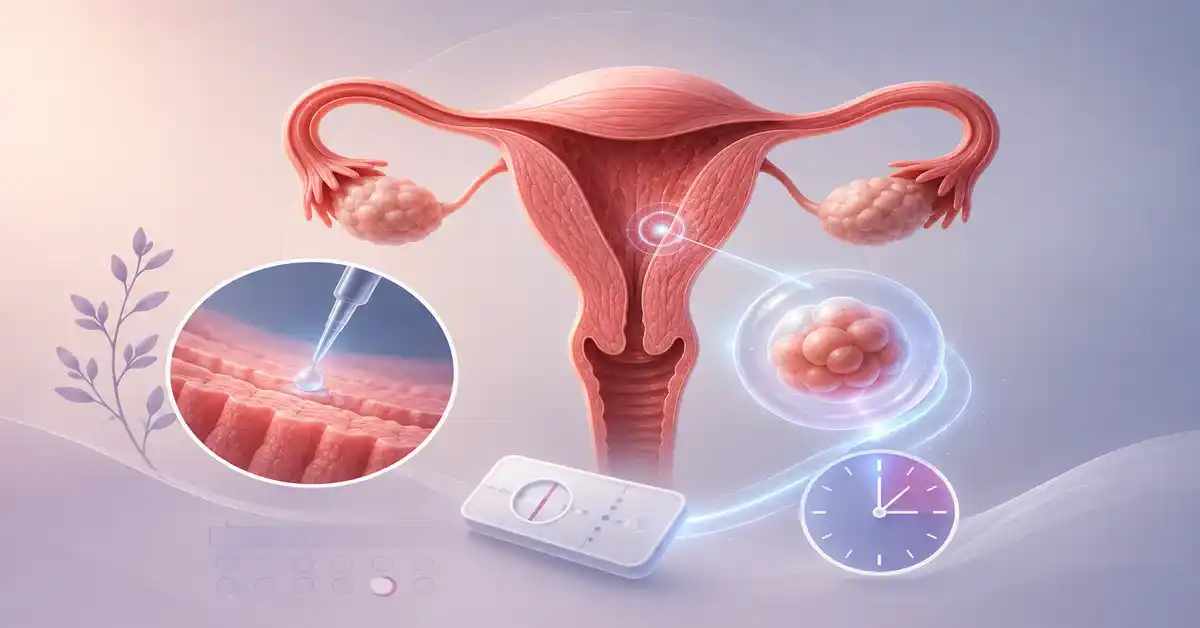
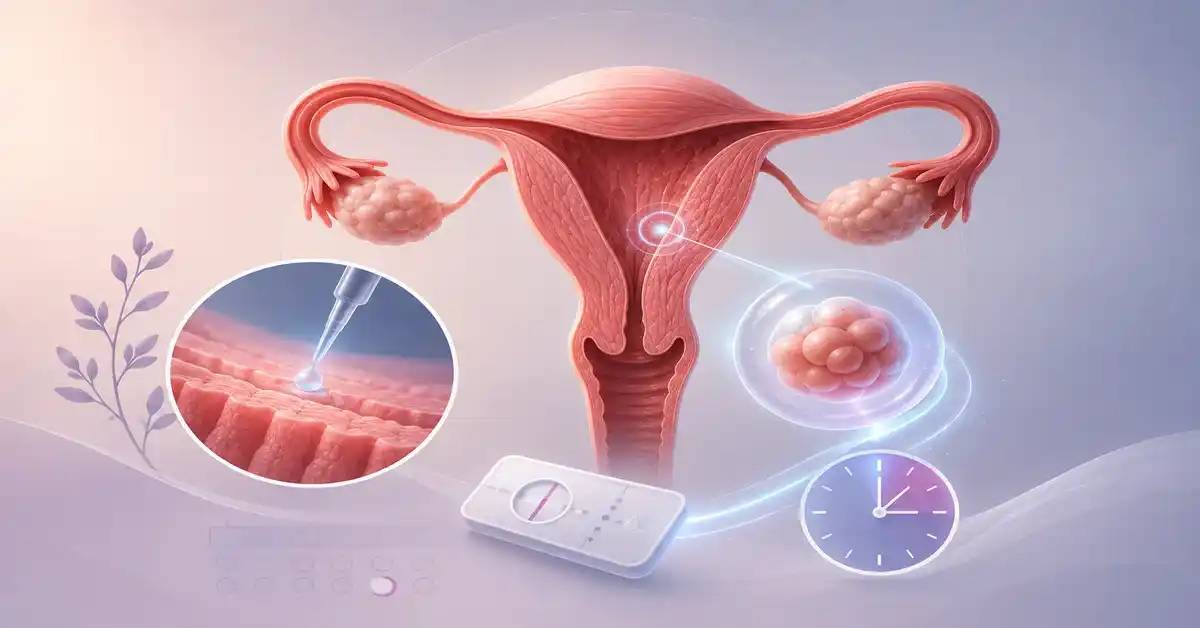
Endometrial receptivity testing uses a small biopsy taken during a mock frozen-transfer cycle to estimate whether the uterine lining has reached a receptive stage. The sample is analyzed to determine whether the lining appears receptive at the standard time or may require shorter or longer progesterone exposure before embryo transfer.
The test is intended to personalize progesterone timing, not to assess embryo quality or guarantee implantation. In a programmed frozen cycle, a blastocyst is commonly transferred after approximately five full days of progesterone exposure. A receptivity report may recommend an hour-based adjustment when the biopsy is classified as earlier or later than the expected receptive stage.
Routine testing before every transfer is not supported by current evidence. A large randomized trial found no improvement in live birth when transfer of a euploid blastocyst was timed according to receptivity testing rather than standard timing. A recent review of trustworthy randomized trials also found no established routine fertility benefit.
How Endometrial Receptivity Testing Assesses the Implantation Window
The test examines molecular changes in the lining after progesterone exposure and classifies the biopsy according to its developmental stage. It does not prove that implantation can occur at only one exact moment; rather, it attempts to estimate when the lining is most closely synchronized with the embryo.
How the Endometrium Becomes Ready for Implantation
Estrogen promotes growth of the lining during the first part of the cycle. After ovulation or the start of progesterone in a programmed cycle, the endometrium changes from a proliferative tissue into a secretory lining prepared for implantation.
The duration of progesterone exposure must correspond with embryo development. A blastocyst requires a later transfer than a cleavage-stage embryo because the younger embryo needs additional time before reaching the stage at which implantation begins.
What Does the Test Analyze?
The biopsy is processed to evaluate the activity pattern of genes associated with endometrial development. The result may classify the sample as:
- Pre-receptive.
- Early receptive.
- Receptive.
- Late receptive.
- Post-receptive.
A receptive result generally leads to repeating the same progesterone duration during the transfer cycle. A pre-receptive or post-receptive result may lead to a longer or shorter interval.
What Does the Test Not Diagnose?
It does not determine whether an embryo is chromosomally normal, exclude polyps or intracavitary fibroids, diagnose hydrosalpinx, or replace evaluation for uterine disease.
A receptive result also does not guarantee pregnancy. Implantation depends on embryo competence, uterine anatomy, progesterone exposure, transfer technique, and additional biological factors.
Read about: Modern Fertility Treatments for Men and Women You Should Know
Ideal Embryo Transfer Timing After Progesterone
Transfer timing is calculated from ovulation or the exact start of progesterone rather than from the menstrual-cycle date alone. A late dose, a different administration route, or an incorrectly recorded start time can make the transfer cycle inconsistent with the biopsy cycle.
Blastocyst Transfer in a Programmed Cycle
In a programmed cycle using estrogen and progesterone, a frozen blastocyst is commonly transferred after approximately five full days of progesterone. The first receptivity biopsy is often taken after about one hundred and twenty hours, while a large randomized trial used standard timing of one hundred and twenty-three hours with a narrow margin.
These figures should not be used to schedule treatment without a clinical plan. The progesterone formulation, route, dose, first-dose convention, embryo age, and laboratory protocol may affect how the timing is calculated.
Transfer Timing in Natural and Modified Natural Cycles
In a natural cycle, timing is based on the hormone surge or confirmed ovulation. In a modified natural cycle, an injection may be used to trigger ovulation before the transfer date is calculated.
A receptivity biopsy is commonly collected seven days after the hormone surge or trigger because the sample is intended to represent the expected implantation period. The same ovulation and progesterone protocol should then be reproduced in the transfer cycle.
Biopsy and Transfer Timing Table
| Cycle or embryo type | Common timing | Main consideration |
|---|---|---|
| Blastocyst in a programmed cycle | Transfer after about five full progesterone days | Record the exact first dose and administration route |
| Receptivity biopsy in a programmed cycle | Around one hundred and twenty progesterone hours | Performed in a mock cycle without transfer |
| Day-three embryo | Transfer after about three progesterone days | The biopsy still evaluates the later implantation stage |
| Natural-cycle blastocyst | Timed according to ovulation | Hormone surge or ovulation must be identified |
| Modified-natural biopsy | Commonly seven days after surge or trigger | The same protocol should be reproduced |
These are general principles. The final transfer time should follow the physician’s protocol and any hour-based recommendation in the report.
How the Endometrial Receptivity Test Is Performed
Testing requires a mock cycle in which no embryo is transferred. The cycle should resemble the future transfer cycle as closely as possible, including the preparation method, estrogen use, progesterone route, dose, and start time.
Preparing for the Mock Cycle
The ovaries and lining are assessed at the beginning of the cycle. In a programmed cycle, estrogen is used until the endometrium reaches an appropriate appearance and thickness. A progesterone blood test may be requested before treatment begins to exclude premature hormone elevation.
Progesterone is then started at a precisely documented time. Every dose should be recorded because delays or switching between vaginal, oral, and injectable routes can reduce the reproducibility of the result.
Steps of the Endometrial Biopsy
The usual process includes:
- Confirming the first progesterone dose and all medications.
- Performing a gynecological assessment.
- Inserting a speculum to visualize the cervix.
- Passing a thin sampling tube through the cervix.
- Collecting a small piece of endometrial tissue.
- Placing the sample in the laboratory container.
- Following instructions on when to stop medication.
- Waiting for a later cycle before embryo transfer.
Brief cramping, light bleeding, or brown discharge may occur after the procedure.
Can Embryo Transfer Be Performed in the Biopsy Cycle?
No. The biopsy disrupts the lining during the expected implantation period, so the transfer must be performed in a later cycle. The preparation protocol is then repeated, with progesterone timing adjusted when indicated by the report.
Major changes in progesterone route, dose, or cycle type may reduce how closely the test result applies to the transfer cycle.
Read about: Do Natural Fertility Vitamins Really Help with Conception?
Understanding the Endometrial Receptivity Report
The report must be interpreted together with the progesterone exposure at biopsy, administration route, embryo age, and recommended timing. Patients should not schedule travel or embryo thawing from the classification word alone.
What Does a Receptive Result Mean?
A receptive result usually means that the future embryo transfer should reproduce the progesterone duration used before the biopsy. The team attempts to repeat:
- Estrogen preparation when applicable.
- Progesterone type and dose.
- First-dose timing.
- Total hours before transfer.
- Embryo developmental stage.
- Relevant supportive medication.
The goal is to reproduce the duration of hormonal exposure, not simply the same clock time on a different calendar date.
What Do Pre-Receptive and Post-Receptive Results Mean?
A pre-receptive result suggests that the lining may require additional progesterone exposure. A post-receptive result may lead to a shorter interval. Reports commonly provide a specific hour adjustment.
The patient should not add or remove a day independently. A recommendation involving several hours may differ substantially from changing the schedule by a full day.
When Is a Repeat Biopsy Needed?
A repeat procedure may be advised when the sample is insufficient, the result is inconclusive, or a large timing change requires confirmation. In the large randomized trial, a small proportion of participants required a second biopsy to obtain an informative result.
Repeat testing adds another mock cycle, more medication, additional cost, and further delay before transfer.

Who May Consider Receptivity Testing?
Testing should not automatically be added to every frozen embryo transfer. Before considering it, the team should review embryo competence, the uterine cavity, progesterone exposure, and transfer technique.
Is Testing Recommended Before a First Transfer?
Current evidence does not support routine testing before a first euploid blastocyst transfer. In a large randomized trial, live birth occurred in approximately fifty-eight and a half percent of receptivity-timed transfers and approximately sixty-two percent of standard-timed transfers, with no significant benefit from testing.
For a good-prognosis patient, testing may therefore add a biopsy cycle and delay without a demonstrated improvement in live birth.
Can It Help After Repeated Failed Transfers?
Testing may be discussed after repeated transfers of good-quality embryos, but evidence in this group remains uncertain. Some observational studies have suggested possible benefit, while stronger evidence has not reliably shown improved live birth.
The major randomized trial excluded patients with recurrent implantation failure, so it cannot fully answer the question for this subgroup.
Before testing, the team should review:
- Embryo quality and chromosomal risk.
- Uterine-cavity findings.
- Polyps, fibroids, or adhesions.
- Possible fluid within the fallopian tubes.
- Progesterone level and timing.
- Endometrial thickness.
- Transfer difficulty or uterine contractions.
- Other uterine or inflammatory conditions.
When May the Test Be Inappropriate?
Testing may be postponed during active vaginal or uterine infection, unexplained bleeding, pregnancy, or an untreated uterine-cavity abnormality.
It is also unlikely to be the first priority when embryo quality has not been evaluated, progesterone errors are suspected, or a treatable anatomical cause of failure has already been identified.
Read about: How Hormones Affect Fertility: Key Tests Couples Should Consider
Evidence, Risks, and Cost of Endometrial Receptivity Testing
The test provides a timing classification from one biopsy cycle; it does not function as a pregnancy guarantee. Its reproducibility depends on using a similar hormonal protocol and accurately following medication timing.
Does Personalized Timing Improve Live Birth?
A multicenter randomized trial found no significant improvement in live birth, biochemical pregnancy, or clinical pregnancy when euploid blastocyst transfer was timed according to receptivity testing rather than standard timing.
A recent review limited to trustworthy randomized evidence also concluded that receptivity testing has no established routine fertility benefit or that evidence remains insufficient in selected groups. The uncertainty should be explained before the test is purchased or treatment is delayed.
Biopsy Risks and Side Effects
Expected effects include brief cramping, light bleeding, and brown discharge. Infection, severe bleeding, fainting, or significant pain are less common.
Medical review is needed for:
- Fever or chills.
- Severe or increasing pelvic pain.
- Heavy bleeding.
- Abnormal-smelling discharge.
- Persistent dizziness or fainting.
- Unexpected delayed menstruation with possible pregnancy.
What Determines the Cost?
The total cost may include:
- Ultrasound monitoring.
- Hormone blood tests.
- Estrogen and progesterone medication.
- The biopsy procedure.
- Sample preparation and molecular analysis.
- Repeat biopsy when required.
- Interpretation consultation.
- A separate embryo-transfer cycle.
The financial and time burden should be weighed against the lack of proven routine benefit, particularly before a first transfer.
Read about: Best Foods to Naturally Boost Fertility in Men and Women
Conclusion
Standard timing for a frozen blastocyst in a programmed cycle is generally around five full days of progesterone exposure. Natural-cycle transfer is instead synchronized with ovulation. Endometrial receptivity testing attempts to identify whether an individual patient may need a shorter or longer interval.
Current evidence does not support routine use before every embryo transfer, and it has not improved live birth in good-prognosis patients undergoing euploid blastocyst transfer. It may be discussed after repeated failure in selected circumstances, but only after embryo factors, uterine anatomy, progesterone exposure, and transfer technique have been reviewed.
Frequently Asked Questions: Endometrial Receptivity Testing: When Is the Ideal Time for Embryo Transfer?
When is the receptivity biopsy performed?
It is commonly performed after about five full progesterone days in a programmed cycle or according to ovulation timing in a natural mock cycle.
Can the embryo be transferred during the biopsy cycle?
No. The biopsy and embryo transfer must occur in separate cycles.
When is a blastocyst transferred after progesterone starts?
The standard interval is approximately five full days, but exact timing depends on the protocol, embryo age, and any personalized report.
Does testing improve the chance of a first transfer?
High-quality evidence has not shown an improvement in live birth from routine testing before euploid blastocyst transfer.
Does a receptive result guarantee implantation?
No. It only indicates that the endometrium was classified as receptive at that time; pregnancy still depends on multiple embryo and uterine factors.