









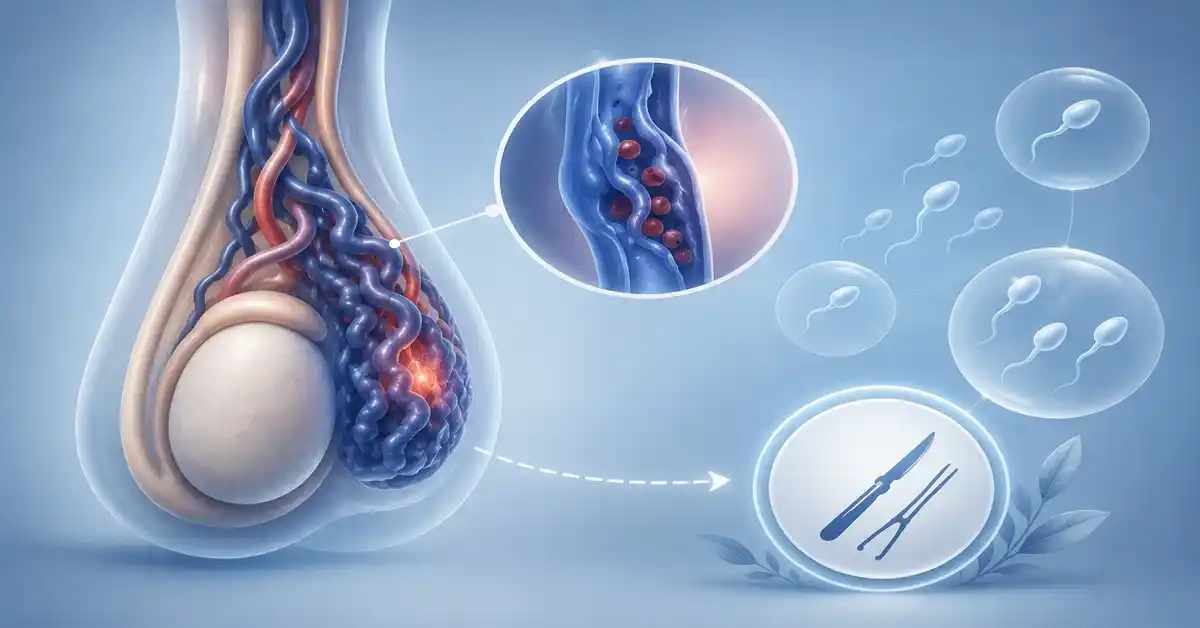
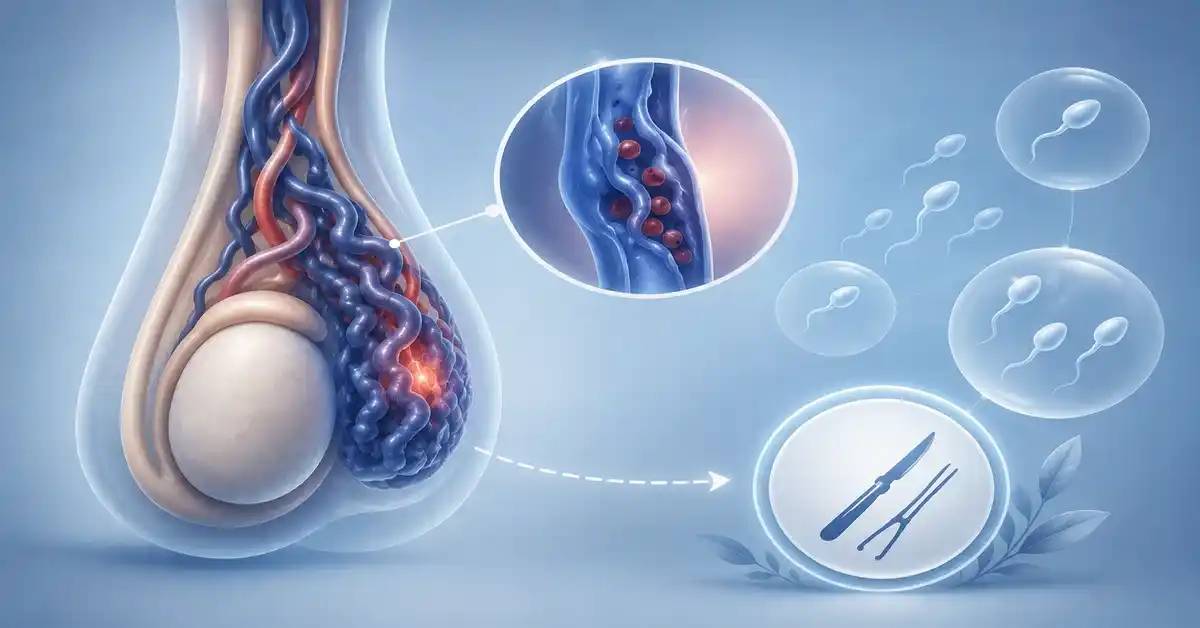
A varicocele is an abnormal enlargement of the veins surrounding the testicle within the scrotum. It most commonly develops on the left side because of the anatomy of testicular venous drainage. Some men have no symptoms, while others experience aching, heaviness, testicular-size changes, or abnormal semen results.
Having a varicocele does not automatically mean that a man is infertile, and not every varicocele requires treatment. The decision depends on whether the varicocele is palpable during physical examination, whether the couple is experiencing infertility, whether semen parameters are abnormal, and whether pain or testicular damage is present.
AUA/ASRM guidance recommends considering surgical varicocelectomy in men who are attempting conception and have a palpable varicocele, infertility, and abnormal semen parameters. Surgery is not generally recommended for a nonpalpable varicocele found only on imaging.
Safemedigo helps couples review semen analyses and fertility investigations, arrange specialist male-infertility assessment, compare microsurgical repair with embolization, and select a plan that reflects both partners’ reproductive circumstances.
What Is a Varicocele?
A varicocele is a dilation of the pampiniform venous plexus within the spermatic cord. These veins drain blood from the testicle and contribute to temperature regulation.
How Does a Varicocele Develop?
Veins contain valves that help blood travel toward the heart. When these valves do not function effectively, blood may reflux and collect around the testicle, enlarging the veins.
Left-sided varicoceles are more common because the left testicular vein follows a different drainage pathway. A new isolated right-sided varicocele, particularly if large or non-reducible, may require further evaluation for abdominal or retroperitoneal causes.
Varicocele Grades
Clinical varicoceles are commonly classified as:
- Grade one: palpable only during the Valsalva maneuver.
- Grade two: palpable while standing without Valsalva.
- Grade three: visible and palpable at rest.
- Subclinical: not palpable but detected by Doppler ultrasound.
Treatment decisions depend more on clinical findings and fertility impact than on ultrasound vein size alone.
Symptoms
Many varicoceles cause no symptoms. Possible complaints include dull aching, scrotal heaviness, discomfort after prolonged standing, and improvement while lying down.
Other cases are discovered during infertility evaluation or after a difference in testicular size is noticed.
How Can Varicocele Affect Fertility?
The exact mechanism is not explained by one factor. Increased temperature, impaired blood flow, oxidative stress, relative oxygen deficiency, and reflux of metabolites may contribute to testicular dysfunction.
Testicular Temperature and Oxidative Stress
Normal sperm production requires a temperature slightly below core body temperature. Dilated veins may interfere with heat exchange and increase the temperature surrounding the testicle.
Varicoceles are also associated with oxidative stress, which can damage sperm membranes, energy production, function, and genetic material.
Semen-Analysis Changes
Varicocele may be associated with reduced sperm concentration, total count, motility, or normal morphology.
EAU guidance indicates that repair in men with a clinical varicocele and abnormal semen parameters may improve sperm concentration and total count. Improvements in motility and morphology are less consistent across studies.
Sperm DNA Fragmentation
Some men with varicocele have increased sperm DNA fragmentation. High fragmentation may be associated with lower natural-conception chances, impaired embryo development, or poorer outcomes in selected assisted-reproduction settings.
Varicocele repair can reduce DNA-fragmentation levels in some patients. It may therefore be considered after counseling in selected couples with elevated fragmentation, unexplained infertility, recurrent pregnancy loss, failed embryo development, or implantation failure after other causes have been assessed.
Why Does Varicocele Not Cause Infertility in Every Man?
Varicoceles also occur in men with normal fertility. They are more frequent among men with abnormal semen analyses and infertility, but the association is not absolute.
The presence of a varicocele is therefore a risk factor rather than proof that it is the sole cause of infertility.
Read about: Varicocele Treatment: Surgery or Modern Catheterization
How Is Varicocele Diagnosed?
Diagnosis combines medical history, physical examination, semen testing, and selective use of ultrasound or hormone analysis.
Physical Examination
The doctor examines the scrotum while the patient is standing and may ask him to perform the Valsalva maneuver.
The examination identifies whether the veins are palpable, determines the clinical grade, compares testicular size, and looks for other causes of pain or swelling.
Semen Analysis
Semen analysis is central to evaluating fertility. It measures semen volume, sperm concentration, total sperm count, motility, morphology, and other features.
Because semen results naturally vary, more than one analysis may be requested before surgery. The WHO laboratory manual provides standardized testing methods, but results must be interpreted within the couple’s complete clinical assessment.
Scrotal Doppler Ultrasound
Ultrasound is useful when examination is inconclusive, difficult, or when persistent or recurrent varicocele is suspected after treatment.
EAU guidance notes that venous diameter above three millimeters in the upright position during Valsalva and reflux lasting over two seconds correlate with clinically significant varicocele. Ultrasound should nevertheless support, not replace, clinical judgment.
Hormones and Additional Fertility Tests
FSH, LH, and testosterone may be measured when sperm numbers are severely reduced, a testicle is small, or hormonal symptoms are present.
Sperm DNA-fragmentation testing may be considered in selected cases of recurrent assisted-reproduction failure or pregnancy loss, but it is not required for every man with varicocele.

When Is Observation More Appropriate Than Surgery?
Varicocele treatment should target men likely to benefit rather than every man with dilated veins.
Subclinical Varicocele
Surgery is not recommended for a varicocele detected only by imaging and not palpable during examination.
Randomized studies have not shown a meaningful fertility benefit from treating subclinical varicoceles.
Normal Semen Parameters
When semen analysis is normal and there is no significant pain or testicular damage, observation is usually more appropriate.
EAU recommendations advise against treating infertility-related varicocele when semen parameters are normal because a fertility benefit has not been established.
No Current Fertility Goal or Symptoms
An asymptomatic man who is not trying to conceive may not require immediate investigation or intervention.
He should seek evaluation if pain develops, testicular size changes, or fertility difficulties occur later.
Adolescents
Most adolescents with varicocele do not require preventive surgery because many will maintain normal fertility.
EAU guidance recommends intervention when there is persistent testicular-size reduction, generally confirmed over repeated examinations, rather than after a single measurement.
When Should Varicocele Surgery Be Considered?
The decision should include both partners because female age, ovarian reserve, tubal status, and reproductive timing can alter the best strategy.
Palpable Varicocele, Infertility, and Abnormal Semen
This is the clearest fertility-related indication.
AUA/ASRM recommends considering surgical repair when a man is trying to conceive and has a palpable varicocele, infertility, and abnormal semen parameters.
EAU also recommends treatment for infertile men with a clinical varicocele, abnormal semen parameters, and otherwise unexplained infertility when the female partner has sufficient ovarian reserve to allow time for improvement.
Persistent Varicocele-Related Pain
Surgery may be discussed when typical varicocele pain persists despite scrotal support, activity modification, and appropriate pain relief.
Other causes such as hernia, epididymal inflammation, neuropathic pain, and musculoskeletal disease must be excluded. Pain improvement after surgery is common but not guaranteed.
Testicular Atrophy or Growth Arrest
In adolescents and younger men, repair may be recommended when the affected testicle remains significantly smaller or shows impaired growth on serial assessment.
Repeated measurements help avoid unnecessary treatment based on temporary or inaccurate size differences.
Elevated DNA Fragmentation or Failed ART
Repair may be considered in selected men with a clinical varicocele and elevated sperm DNA fragmentation, especially after recurrent embryo-development failure, implantation failure, or pregnancy loss.
This remains an individualized indication with weaker evidence than palpable varicocele plus abnormal conventional semen results.
Varicocele and Azoospermia
Azoospermia requires evaluation to distinguish obstructive from non-obstructive causes and may require hormone, genetic, and testicular assessment.
Non-Obstructive Azoospermia
Nonrandomized studies suggest that sperm may appear in the ejaculate after varicocele repair in some men with non-obstructive azoospermia. Repair may also improve the chance of retrieving sperm surgically in selected cases.
The evidence is limited, and surgery cannot guarantee sperm appearance or avoid testicular sperm extraction. Detailed counseling is essential.
Genetic Evaluation
Some causes of non-obstructive azoospermia are genetic and cannot be corrected by varicocele surgery.
Karyotype testing and Y-chromosome microdeletion testing may be required before deciding whether to wait for varicocele-repair results or proceed with sperm retrieval.
Freezing Sperm When It Appears
When small numbers of sperm appear in semen after surgery, cryopreservation may be advised because continued production is not guaranteed.
Varicocele Treatment Options
All treatments aim to interrupt abnormal venous reflux while preserving the testicular artery, lymphatic vessels, and vas deferens.
Microsurgical Subinguinal Repair
The surgeon makes a small incision below the groin and uses an operating microscope to identify veins, arteries, and lymphatic channels.
EAU evidence indicates that microsurgical inguinal or subinguinal repair generally has lower recurrence and complication rates than nonmicrosurgical approaches, although it requires specialist microsurgical training.
Open, Retroperitoneal, and Laparoscopic Surgery
Varicoceles can also be treated through inguinal, high retroperitoneal, or laparoscopic approaches.
These methods remain available but may have higher rates of hydrocele, recurrence, or arterial injury depending on the technique.
Percutaneous Embolization
An interventional radiologist passes a catheter through the venous system and blocks the abnormal veins using coils or other embolic material.
Embolization avoids a groin or scrotal surgical incision and may be useful in selected recurrent cases. Limitations include technical failure, contrast-related risks, coil migration, and recurrence. Evidence comparing surgery and radiological treatment for pregnancy and recurrence remains inconclusive.
How Is Microsurgical Varicocelectomy Performed?
The operation is completed under anesthesia. The surgeon isolates abnormal veins while protecting arterial and lymphatic structures.
Surgical Steps
A small incision is made near the groin or upper scrotum. The spermatic cord is exposed and examined under magnification.
The dilated veins are tied or divided, while the testicular artery, lymphatic vessels, and vas deferens are preserved.
Hospital Stay
Many patients return home on the same day or after a brief observation period, depending on anesthesia and general health.
Transportation and assistance should be arranged after anesthesia.
Pain and Return to Activity
Mild swelling, bruising, and discomfort can occur during the first days.
Office work may resume gradually, while strenuous exercise, lifting, and sexual activity should wait until the surgeon confirms adequate healing.
When Does Fertility Improve After Surgery?
Varicocele repair does not improve sperm production immediately because spermatogenesis and sperm maturation take time.
Repeat Semen Testing
Semen analysis is usually repeated after several months and may be repeated again according to the response.
EAU guidance notes that improvement may require up to two complete spermatogenic cycles.
Natural Pregnancy Timing
Natural pregnancy may occur in the months following repair when semen quality improves and no major female factor prevents conception.
EAU evidence indicates that spontaneous pregnancies after varicocelectomy commonly occur within approximately six to twelve months, although timing varies.
When Waiting May Not Be Appropriate
Waiting may be disadvantageous when the female partner has reduced ovarian reserve, advanced reproductive age, blocked tubes, or another indication for IVF or ICSI.
Guidelines emphasize evaluating the female partner in parallel because ovarian reserve and reproductive timing may favor assisted reproduction rather than delaying treatment for surgery.
Benefits and Limitations of Surgery
Surgery may improve the environment for sperm production, but it cannot reverse every cause of male infertility.
Expected Semen Improvement
Evidence suggests that repair of a clinical varicocele in men with abnormal semen may improve sperm concentration and total count. Motility and morphology may also improve in some men.
No test can accurately guarantee the degree of improvement before surgery.
Does Surgery Guarantee Pregnancy?
No. Pregnancy depends on sperm quality, female age, ovarian reserve, ovulation, tubal status, uterine health, timing, and other factors.
Surgery can improve fertility probability in an appropriately selected couple, but it is not a guarantee of natural conception.
Impact on Assisted Reproduction
Improved semen parameters may allow some couples to use intrauterine insemination instead of ICSI or may improve the sperm available for IVF treatment.
Some studies suggest improved assisted-reproduction outcomes after repair, but the possible benefit must be balanced against treatment delay.
Risks of Varicocele Surgery
Varicocelectomy is generally safe in experienced hands, but potential complications should be discussed.
Recurrence or Persistence
Some abnormal veins may remain untreated or alternative venous pathways may develop.
Microsurgical repair generally has lower recurrence rates because magnification allows more precise identification of the veins.
Hydrocele
A hydrocele is fluid accumulation around the testicle caused by lymphatic disruption.
Preserving lymphatic vessels with microsurgical techniques reduces this risk.
Testicular-Artery Injury
Testicular-artery injury is rare but potentially serious because it can reduce blood supply and cause testicular atrophy.
Microscopic magnification and surgical expertise help protect the artery.
Bleeding, Infection, and Persistent Pain
Bruising, hematoma, wound infection, or continuing pain can occur.
Surgery for pain should only follow careful confirmation that the symptoms are consistent with varicocele-related discomfort.
Choosing the Best Varicocele Specialist
Male infertility management requires expertise in reproductive urology, not simply the technical ability to perform the operation.
Microsurgical Experience
Ask how frequently the surgeon performs microsurgical varicocelectomy, which approach is used, and how the artery and lymphatic vessels are protected.
The follow-up plan should include semen testing and management of recurrence or lack of improvement.
Evaluation of Both Partners
The urologist should coordinate with the fertility or gynecology team so semen results, ovarian reserve, ovulation, tubal status, and reproductive age are reviewed together.
Surgery may be reasonable for the man but not the best immediate strategy for the couple when reproductive time is limited.
Questions Before Surgery
Useful questions include:
- Is the varicocele palpable or seen only on ultrasound?
- Have abnormal semen results been confirmed?
- Are there other causes of infertility?
- Which treatment technique is recommended?
- Is microsurgical repair available?
- What improvement is realistically expected?
- When will semen be retested?
- Should we wait for natural pregnancy or plan ART?
- What are the recurrence and hydrocele risks?
- Should sperm be frozen before treatment?
Read about: Varicocele Treatment for Children and Teens: Modern Options
Conclusion
Varicocele is common, but it does not cause infertility in every man and does not always require surgery. Repair is most strongly considered when a clinical palpable varicocele is present together with infertility and abnormal semen parameters.
A varicocele found only on imaging or accompanied by normal semen results is usually managed without fertility surgery unless pain, testicular atrophy, or another specific indication exists. The couple’s reproductive timeline is equally important because improvement takes months and cannot guarantee pregnancy.
Frequently Asked Questions About Varicocele and Fertility
Does every varicocele cause infertility?
No. Many men with varicocele have normal fertility. The effect depends on testicular function and semen quality.
When is surgery recommended for fertility?
It is mainly considered when a palpable varicocele, infertility, and abnormal semen parameters are present after both partners are evaluated.
Is surgery recommended when semen analysis is normal?
Not usually for fertility purposes, unless persistent pain, testicular shrinkage, or another separate indication exists.
When does semen improve after surgery?
Improvement usually requires several months because sperm production occurs in cycles and should be monitored with repeat analyses.
Is microsurgery better than embolization?
Microsurgery generally has low recurrence and complication rates, while embolization can be suitable for selected patients. The best choice depends on anatomy and specialist expertise.