









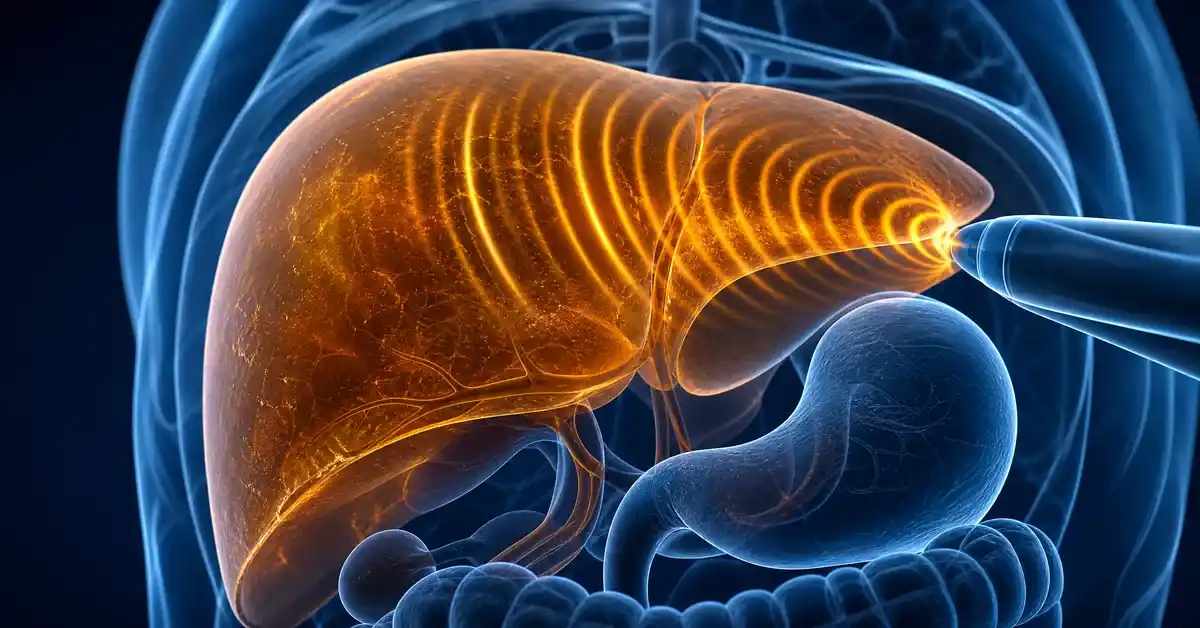
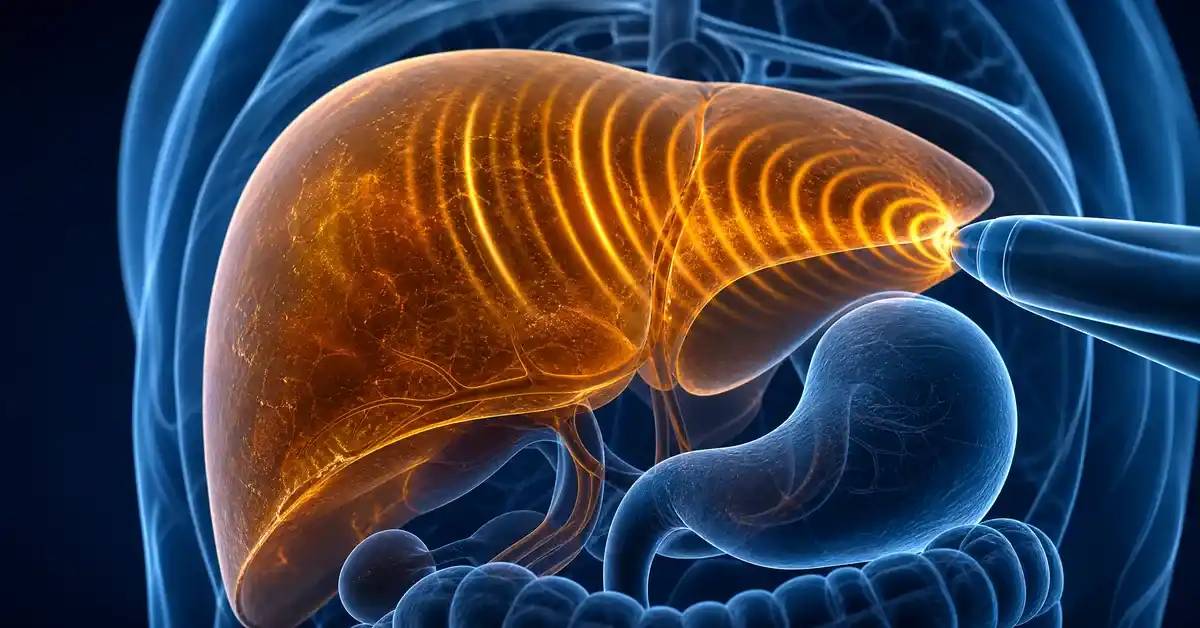
FibroScan is one of the most widely used non-invasive methods for assessing liver fibrosis. It measures liver stiffness within minutes without inserting a needle or removing liver tissue, making it useful in metabolic fatty liver disease, chronic hepatitis, and several other chronic liver disorders.
At Safemedigo, a FibroScan result is not interpreted as a standalone number that automatically equals fibrosis stage F0, F1, F2, F3, or F4. The examination measures liver stiffness, usually in kilopascals, and fibrosis probability is then interpreted according to the cause of liver disease, blood tests, platelet count, imaging, and clinical findings. Large systematic reviews show that elastography performs particularly well for identifying advanced fibrosis and cirrhosis, while discrimination between earlier neighboring stages is less precise.
How FibroScan Measures Liver Stiffness and Estimates Fibrosis
FibroScan uses vibration-controlled transient elastography.
A small mechanical impulse generates a shear wave through the liver, and the device measures how rapidly that wave moves through the tissue.
Liver Stiffness Is Related to Fibrosis but Is Not Identical to Fibrosis
Fibrosis represents accumulation of scar tissue following chronic liver injury.
Liver stiffness is a physical property that usually increases as fibrosis progresses, but it can also rise because of inflammation, congestion, or cholestasis.
FibroScan therefore measures a surrogate marker of fibrosis, not scar tissue directly.
Understanding Fibrosis Stages F0 to F4
The general histological stages are:
| Stage | General interpretation |
|---|---|
| F0 | No significant fibrosis |
| F1 | Mild fibrosis |
| F2 | Significant fibrosis |
| F3 | Advanced fibrosis |
| F4 | Cirrhosis |
There is no universal FibroScan value that converts directly into these stages for every liver disease.
Why FibroScan Has Reduced the Need for Liver Biopsy
Advantages include:
- Non-invasive assessment.
- Rapid outpatient testing.
- No anesthesia.
- Easy repeat testing.
- Assessment of a larger volume of liver tissue than a biopsy sample.
- Useful longitudinal monitoring.
Biopsy nevertheless remains important in selected diagnostic situations.
Read about: Diagnosing Fatty Liver Disease and Modern Treatment Options
How Accurate FibroScan Is for Advanced Fibrosis and Cirrhosis
FibroScan is particularly valuable for separating patients with a low probability of advanced fibrosis from those who require more detailed evaluation.
Large reviews involving tens of thousands of patients show that imaging-based liver stiffness assessment becomes progressively more accurate from significant fibrosis toward advanced fibrosis and cirrhosis.
Accuracy for Detecting Cirrhosis
Cirrhosis generally produces a greater change in liver stiffness than mild fibrosis, which helps explain why diagnostic performance is stronger for F4.
However, sensitivity, specificity, and optimal thresholds vary according to the underlying liver disease and study population.
FibroScan Accuracy in Metabolic Fatty Liver Disease
In metabolic fatty liver disease, transient elastography is particularly well validated.
A liver stiffness measurement below approximately 8 kPa is commonly used to indicate a low probability of advanced fibrosis in this clinical setting, while higher readings require further risk stratification rather than an automatic diagnosis of cirrhosis.
These thresholds should not automatically be applied to viral, autoimmune, or cholestatic liver diseases.
Why Intermediate FibroScan Results Need Additional Interpretation
A middle-range value may not confidently distinguish F2 from F3.
Clinicians may therefore combine the result with:
- Platelet count.
- Liver enzymes.
- FIB-4.
- Age.
- Liver disease cause.
- Imaging.
- Portal-hypertension indicators.
- Serial changes over time.
This sequential approach is generally more reliable than depending on one test alone.
Read about: Fatty Liver Diagnosis: Early Tests and Treatment Tips
How to Read FibroScan kPa and CAP Results
A FibroScan report can provide both liver stiffness measurement and a separate estimate of liver fat.
What the kPa Liver Stiffness Value Means
The kPa value reflects liver stiffness.
In broad terms:
- Lower values make advanced fibrosis less likely.
- Intermediate values require disease-specific interpretation.
- Higher values increase the probability of advanced fibrosis or cirrhosis.
There is no single universal kPa table suitable for every patient.
CAP Measures Liver Fat Rather Than Fibrosis
CAP is a separate measurement designed to estimate hepatic steatosis.
A patient can therefore have:
- Marked fat with little fibrosis.
- Little fat with substantial fibrosis.
- Significant fat and fibrosis together.
CAP and liver stiffness should always be interpreted as different parameters.
Why IQR/Median Matters for FibroScan Reliability
The final median result is not the only number that matters.
Variation among repeated measurements is commonly expressed as the IQR/median ratio.
Excessive variability reduces confidence in a high liver stiffness result, and an IQR/median above approximately 30% is widely used as a warning that a kPa measurement may be less reliable.

Factors That Can Distort FibroScan Liver Stiffness Results
A high FibroScan value does not always represent scar progression.
Several conditions can temporarily increase liver stiffness.
Active Liver Inflammation Can Increase kPa
Marked inflammatory activity can make liver tissue stiffer.
A high reading during active hepatitis may therefore need reassessment after inflammation improves before concluding that fibrosis has significantly progressed.
Cholestasis, Liver Congestion, and Recent Food Intake
Liver stiffness can also rise because of:
- Hepatic congestion.
- Cholestasis.
- Significant inflammatory activity.
- Recent food intake.
Patients should therefore follow the preparation and fasting instructions provided by the testing center.
Obesity and Technical Limitations of FibroScan
Greater tissue depth between the skin and liver can make measurements more difficult.
Specialized probes improve measurement feasibility in patients with higher body weight, but technical quality still needs to be assessed.
Read about: Liver Removal Laparoscopy: Turkey vs USA
FibroScan Versus Blood Tests, MRI Elastography, and Liver Biopsy
FibroScan often works best within a multi-step non-invasive assessment strategy.
Combining FIB-4 With FibroScan
FIB-4 uses age, liver enzymes, and platelet count to estimate fibrosis risk.
Patients with an indeterminate or elevated initial score can then undergo liver stiffness assessment for additional stratification. This reduces unnecessary invasive investigation while identifying higher-risk patients.
MRI Elastography Versus FibroScan
Magnetic resonance elastography can provide excellent diagnostic accuracy and may outperform ultrasound-based techniques in some comparisons.
However, it is more expensive, less widely available, and less convenient for routine serial assessment.
When Liver Biopsy May Still Be Needed
Biopsy can remain useful when:
- Non-invasive tests disagree.
- The cause of liver disease is uncertain.
- Histological inflammation or disease type will alter treatment.
- Several liver disorders may coexist.
- A clinically important decision cannot be made from non-invasive tests.
Biopsy also has limitations, including sampling variability, so it is not automatically required simply because FibroScan is imperfect.
Read about: Laparoscopic Gallbladder Removal: Procedure Recovery
Monitoring Liver Fibrosis With Repeated FibroScan Testing
The ability to repeat FibroScan makes it particularly useful for monitoring chronic liver disease.
Does a Lower FibroScan Result Mean Fibrosis Has Reversed?
Liver stiffness may fall after:
- Successful treatment of liver inflammation.
- Weight loss and metabolic improvement.
- Reduced hepatic congestion.
- Improvement in chronic liver disease.
- Genuine regression of fibrosis over time.
A rapid fall, however, may partly reflect reduced inflammation rather than disappearance of scar tissue.
Does an Increasing kPa Value Mean Fibrosis Is Progressing?
A consistent upward trend deserves evaluation, particularly when accompanied by changes in laboratory results or platelet count.
A single difference between two examinations may reflect measurement conditions rather than true disease progression. Significant sustained changes in liver stiffness can provide prognostic information when technical quality and clinical context are considered.
What Happens When FibroScan Suggests Advanced Fibrosis?
Further assessment may focus on:
- Liver function.
- Platelet count.
- Portal-hypertension risk.
- Variceal assessment when indicated.
- Liver-cancer surveillance when appropriate.
- Treatment of the underlying liver disease.
- Weight, metabolic health, alcohol, and medication.
- Specialist follow-up.
A high FibroScan value should therefore trigger appropriate clinical assessment rather than being treated as an isolated diagnosis.
Read about: Preventive Colonoscopy for Early Detection of Bowel Cancer
Conclusion
FibroScan provides a rapid, repeatable, and non-invasive estimate of liver stiffness and is particularly useful for identifying advanced fibrosis and cirrhosis. Its diagnostic performance is generally stronger at the advanced end of the fibrosis spectrum than for precisely distinguishing early F1 from F2 disease.
A kPa value does not automatically equal one universal fibrosis stage. The result depends on the underlying liver disease and can be influenced by inflammation, congestion, cholestasis, recent food intake, obesity, and measurement quality. Interpretation is therefore strongest when FibroScan is combined with blood tests, platelet count, FIB-4, imaging, and clinical findings.
Frequently Asked Questions: FibroScan and Liver Fibrosis
Is FibroScan 100% accurate for determining fibrosis stage?
No. It estimates fibrosis from liver stiffness and is generally more accurate for advanced fibrosis and cirrhosis than for separating early stages.
Does a high FibroScan result always mean cirrhosis?
No. Inflammation, congestion, cholestasis, and other factors can temporarily increase liver stiffness.
What is the difference between kPa and CAP?
kPa measures liver stiffness related to fibrosis risk, while CAP estimates liver fat.
Can FibroScan replace liver biopsy?
It can avoid biopsy in many patients, but biopsy remains useful when non-invasive findings are conflicting or tissue diagnosis would change treatment.
Can FibroScan monitor improvement in liver disease?
Yes. Serial measurements can help monitor trends, although changes must be interpreted together with liver inflammation, laboratory results, and treatment.
.png&w=1920&q=70)