






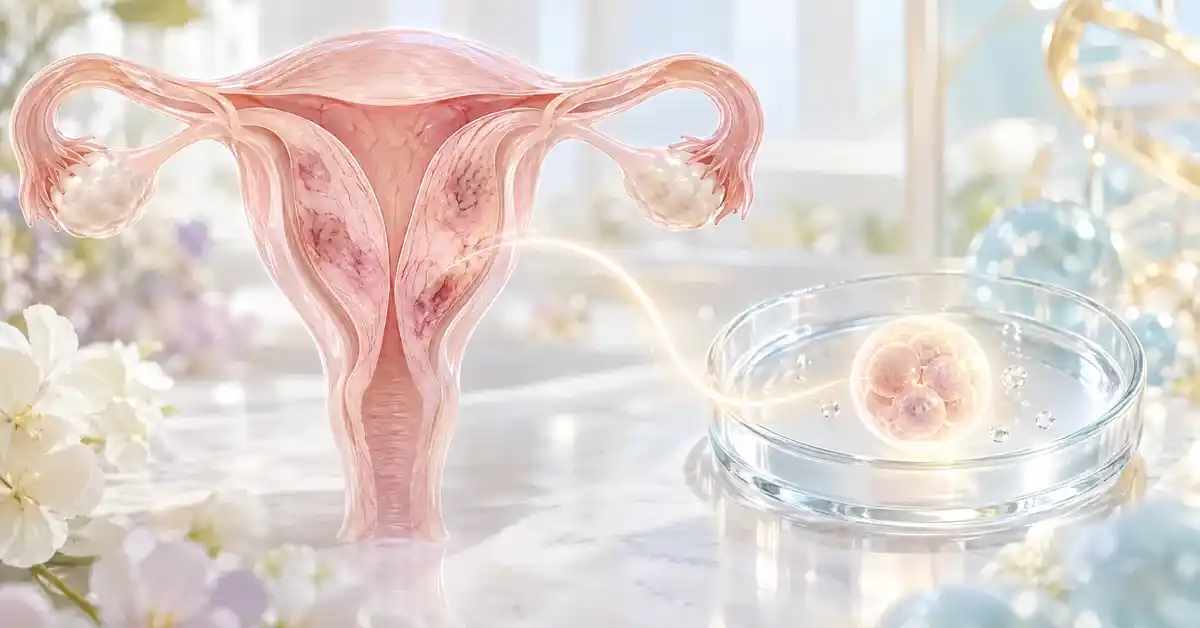
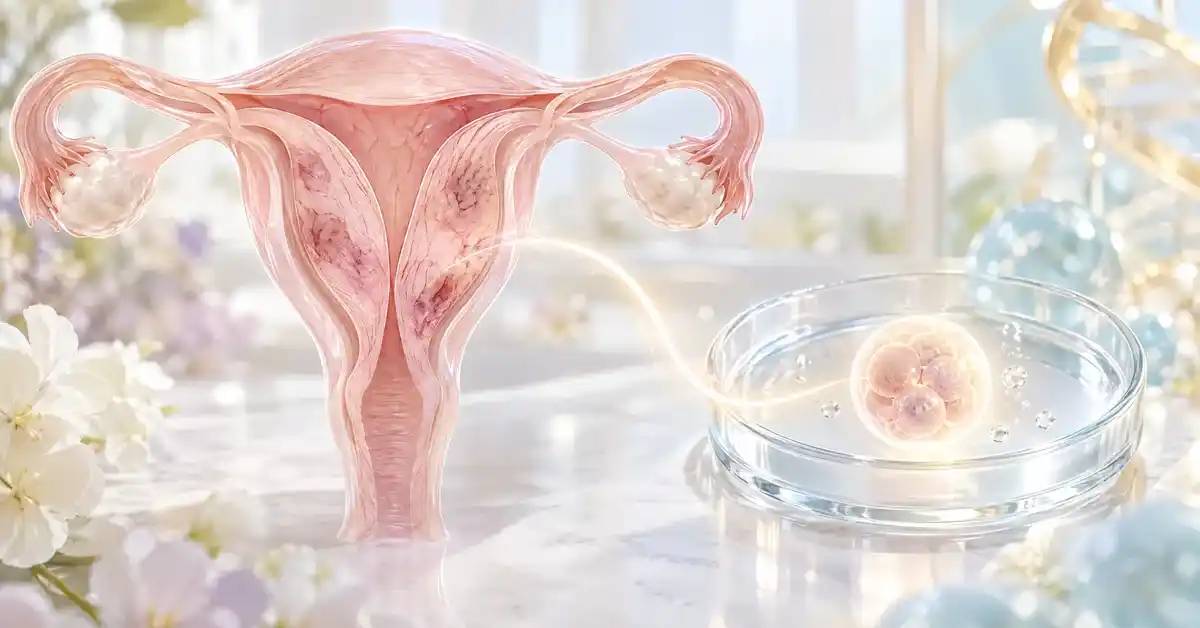
Adenomyosis is a condition in which endometrium-like tissue is found within the muscular wall of the uterus. It may be associated with painful periods, heavy menstrual bleeding and an enlarged uterus, but some women have few symptoms and first learn about it during infertility evaluation or before IVF.
Adenomyosis does not make natural pregnancy impossible, and its presence does not mean that every woman needs IVF, surgery or several months of hormonal suppression before embryo transfer.
However, modern observational evidence and meta-analyses suggest that adenomyosis can be associated with lower implantation, clinical-pregnancy and live-birth rates and with a higher risk of miscarriage in some women, including those undergoing assisted reproduction. The magnitude of that effect varies considerably between patients and studies.
The most useful question is therefore not simply:
Does adenomyosis reduce IVF success?
It is:
How clinically important is the adenomyosis in this particular patient, and is there an intervention before conception or embryo transfer that has a realistic chance of improving outcome?
What is adenomyosis?
Adenomyosis occurs when endometrium-like tissue is present within the myometrium.
It can be associated with:
Painful menstruation.
Heavy or prolonged bleeding.
Chronic pelvic discomfort.
Uterine enlargement.
Or no obvious symptoms.
Disease may be diffuse, involving a broader area of the myometrium, or focal, affecting a more limited region.
These distinctions may matter because adenomyosis is not biologically identical in every patient. Recent fertility research suggests that different ultrasound phenotypes may carry different reproductive prognoses, but available evidence is still insufficient to prescribe a separate standard treatment for each subtype.
How is adenomyosis different from endometriosis?
The conditions are related but distinct.
Adenomyosis
Endometrium-like tissue is found within the uterine muscle.
Endometriosis
Endometrium-like tissue is found outside the uterus, such as on the ovaries or elsewhere in the pelvis.
The two can coexist.
From a fertility perspective, endometriosis can affect the ovaries, fallopian tubes and pelvic anatomy, while adenomyosis raises more direct questions about the uterus, implantation and pregnancy.
See Endometriosis and Infertility.
Does adenomyosis cause infertility?
It is associated with infertility but should not automatically be considered the sole explanation.
Systematic reviews have reported lower clinical-pregnancy and live-birth rates and higher miscarriage rates among women with adenomyosis compared with controls.
However, these studies differ in diagnostic methods, patient age, coexisting endometriosis and disease phenotype.
Adenomyosis should therefore be interpreted as a potential contributor to reproductive prognosis, not proof that the uterus cannot support pregnancy.
How might adenomyosis affect fertility?
Several mechanisms have been proposed, including:
Altered uterine contractions.
Changes in the junctional zone.
Inflammatory and immune changes.
Altered vascular or endometrial environment.
Changes in implantation-related biology.
Distortion of uterine architecture in more extensive disease.
These mechanisms are biologically plausible.
They do not mean that every abnormal pathway has a clinically useful test or an evidence-based add-on treatment.
Does adenomyosis reduce egg quality?
Adenomyosis primarily involves the uterus.
It should therefore not automatically be assumed to directly reduce oocyte quality.
Some affected women also have endometriosis, advancing reproductive age or reduced ovarian reserve, and these need to be assessed separately.
A low AMH result in a woman with adenomyosis should not automatically be attributed to the uterine disease itself.
How is adenomyosis diagnosed?
Adenomyosis can now usually be evaluated without surgery.
The main imaging tools are:
Transvaginal ultrasound.
MRI in selected patients.
Current clinical guidance recognises both transvaginal ultrasound and MRI as important diagnostic options.
What does ultrasound look for?
The revised MUSA consensus standardised ultrasound descriptions of adenomyosis.
Direct features include:
Myometrial cysts.
Hyperechogenic islands.
Echogenic subendometrial lines and buds.
Indirect features include:
Globular uterus.
Asymmetrical myometrial thickening.
Fan-shaped shadowing.
Translesional vascularity.
Irregular junctional zone.
Interrupted junctional zone.
Experts also recommended three-dimensional ultrasound when useful for optimising assessment of the junctional zone.
Does one ultrasound feature prove adenomyosis?
Not necessarily.
Recent studies show that individual MUSA features differ in sensitivity and specificity and no single sign performs perfectly in every patient.
The examination therefore benefits from experienced interpretation rather than diagnosis from one isolated feature.
When is MRI useful?
MRI can be helpful when:
Ultrasound is inconclusive.
The extent of myometrial involvement requires clarification.
Focal disease needs better characterisation.
Deep endometriosis is also suspected.
Surgical planning requires additional anatomical information.
It is not automatically necessary when high-quality ultrasound already provides an adequate assessment.
Is hysteroscopy used to diagnose adenomyosis?
Not usually.
Hysteroscopy examines the uterine cavity, whereas adenomyosis principally involves the myometrium.
Hysteroscopy may still be useful when another cavity abnormality is suspected, such as:
A polyp.
Submucosal fibroid.
Intrauterine adhesions.
but it is not the primary diagnostic test for adenomyosis.
Can natural pregnancy occur with adenomyosis?
Yes.
Natural conception remains possible.
The individual probability depends on factors including:
Female age.
Infertility duration.
Tubal function.
Ovulation.
Ovarian reserve.
Semen parameters.
Adenomyosis extent.
Coexisting endometriosis.
Previous pregnancies.
A younger woman with limited disease and no major additional infertility factor may therefore still reasonably attempt natural conception for an appropriate, defined period.

When does IVF become appropriate?
IVF may become increasingly reasonable when there is:
Advancing reproductive age.
Long-standing infertility.
Reduced ovarian reserve.
Tubal disease.
Male-factor infertility.
Significant endometriosis.
Failed previous treatment.
Or a need to avoid further reproductive delay.
Adenomyosis alone does not automatically require IVF.
The decision should still be based on the couple's overall fertility picture.
Does adenomyosis reduce IVF success?
Overall, meta-analyses suggest that women with adenomyosis have poorer IVF outcomes on average than controls.
A recent systematic review reported lower clinical-pregnancy and live-birth rates and higher miscarriage rates among women with adenomyosis, although the included studies were mostly observational and heterogeneous.
Another meta-analysis similarly reported lower live birth and higher miscarriage but highlighted a major limitation: most studies did not distinguish focal from diffuse adenomyosis.
The diagnosis should therefore be used for counselling about prognosis rather than as a prediction that IVF will fail.
Does the adenomyosis subtype matter?
Possibly.
Recent data suggest that some ultrasound-defined subtypes, particularly internal and mixed adenomyosis, may be associated with lower live-birth rates and higher early pregnancy loss after frozen embryo transfer.
These findings are observational and need prospective validation before they can dictate standard subtype-specific therapy.
Is frozen embryo transfer better than fresh transfer?
Not automatically.
Some fertility teams may prefer a strategy of:
Ovarian stimulation and embryo creation.
Cryopreservation.
Uterine preparation in a later cycle.
Frozen embryo transfer.
This can be clinically useful in selected patients, but adenomyosis itself does not prove that frozen transfer is always superior.
The decision may depend on:
Stimulation response.
Endometrial preparation.
Hormonal environment.
PGT.
OHSS risk.
Disease severity.
Whether pretreatment is being considered.
See Frozen vs Fresh Embryo Transfer.
Is GnRH-agonist treatment needed before IVF?
This remains one of the most debated questions.
Longer GnRH-agonist downregulation has been used in an attempt to suppress adenomyosis before IVF or embryo transfer.
A recent systematic review found higher implantation and clinical-pregnancy rates in some studies following prolonged downregulation, but no statistically significant live-birth benefit, with substantial heterogeneity and predominantly retrospective evidence.
A newer systematic review focused on GnRH agonists before embryo transfer concluded that there is currently no clear evidence that pretreatment improves reproductive outcomes before FET in women with adenomyosis.
Therefore:
adenomyosis = several months of GnRH agonist before every FET
is not a universal evidence-based rule.
When might suppression before transfer be discussed?
It may be considered selectively according to:
Extent of adenomyosis.
Symptoms.
Uterine size.
Disease phenotype.
Previous embryo-transfer history.
Recurrent implantation failure.
ASRM's 2026 RIF opinion states that evidence supporting GnRH agonists or surgery before embryo transfer in women with adenomyosis is limited.
It allows GnRH-agonist treatment, with or without an aromatase inhibitor, to be considered in selected patients with known or suspected adenomyosis or endometriosis and recurrent implantation failure.
What if several embryo transfers have failed?
Adenomyosis should not automatically become the only explanation.
The review should include:
Oocyte age.
Embryo number and development.
Embryo ploidy when known.
Transfer technique.
Uterine cavity.
Endometrial preparation.
Progesterone exposure.
Endometriosis.
Possible hydrosalpinx.
Other infertility factors.
See Recurrent Implantation Failure After IVF.
Does adenomyosis mean ERA testing is needed?
No.
Adenomyosis alone is not a routine indication for an endometrial receptivity assay.
ERA addresses a proposed timing issue in endometrial receptivity, while adenomyosis is a structural and biological myometrial condition.
Repeated transfer failure should not automatically be redefined as an abnormal implantation window.
What about surgery?
Fertility-preserving surgery for adenomyosis is more complex than removing an ovarian endometrioma because the disease is within the uterine muscle.
Focal adenomyosis
In selected patients, excision of a focal adenomyotic lesion may be considered while preserving the uterus.
Diffuse adenomyosis
Conservative surgery is more difficult because disease is distributed more broadly through the myometrium.
Any uterine surgery also needs to consider future obstetric risks.
ASRM's 2026 RIF guidance states that evidence supporting surgery before embryo transfer is limited.
Is hysterectomy a treatment?
Hysterectomy is definitive treatment for adenomyosis when future fertility is not desired.
It is obviously incompatible with future pregnancy.
Management of adenomyosis in a fertility patient must therefore be fundamentally different from management in someone who has completed childbearing.
Do hormonal medications treat adenomyosis-related infertility?
Hormonal medications such as:
Progestins.
Combined hormonal contraception.
GnRH analogues.
can be useful for controlling pain and bleeding.
Many also suppress fertility while being used.
It is therefore essential to distinguish between:
treating adenomyosis symptoms
and
improving the chance of pregnancy.
Those goals can overlap in selected fertility protocols but are not identical.
Does adenomyosis increase miscarriage risk?
Meta-analyses consistently report an association between adenomyosis and higher miscarriage rates, including among women undergoing assisted reproduction.
This is a population-level association, not a certainty for an individual patient.
Adenomyosis should not automatically be considered the cause of every pregnancy loss.
When losses are recurrent, evaluation should follow recurrent-pregnancy-loss principles.
See Recurrent Miscarriage: Advanced Testing and IVF Options.
Does pregnancy with adenomyosis need closer monitoring?
Recent evidence associates adenomyosis with increased risks of several obstetric outcomes, including:
Preterm birth.
Pre-eclampsia.
Placenta previa.
Low birth weight.
Hypertensive disorders of pregnancy.
The individual magnitude of risk depends on many factors, and diagnosis does not mean these complications will occur.
Nevertheless, the diagnosis may be relevant when planning pregnancy surveillance.
Should more embryos be transferred because implantation may be lower?
No.
Using multiple embryos to compensate for potentially lower implantation can increase multiple-pregnancy risk.
Embryo number should be chosen according to age, embryo quality, treatment history and embryo-transfer guidance rather than adenomyosis alone.
Is PGT-A useful because of adenomyosis?
Adenomyosis is not an automatic indication for PGT-A.
PGT-A evaluates chromosome copy number in biopsied embryo cells; adenomyosis is a uterine disorder.
PGT-A may still be discussed when there are independent clinical reasons, but it is not a treatment for adenomyosis.
See PGT Embryo Testing.
What information is important before fertility treatment?
A useful review includes:
Female age.
Duration of infertility.
Previous pregnancy history.
Bleeding and pain symptoms.
Detailed ultrasound findings.
Focal versus diffuse disease.
Uterine size.
Coexisting endometriosis.
Fibroids.
AMH and AFC.
Tubal status.
Semen analysis.
Previous IVF cycles.
Previous embryo transfers and outcomes.
Previous miscarriage.
This is far more informative than simply listing “adenomyosis” on a scan report.
A practical decision framework
Natural conception may remain reasonable when:
Age is favourable.
Infertility duration is short.
There are no major additional infertility factors.
Disease appears limited.
The fertility team does not see a reason for immediate ART.
IVF may become more appropriate when:
Age is advancing.
Other infertility factors coexist.
Infertility has been prolonged.
Previous treatment failed.
Reproductive time is important.
Pretreatment before FET may be discussed when:
Disease is substantial.
Repeated transfers have failed.
The fertility specialist believes suppression has a reasonable biological and clinical rationale.
Patients should nevertheless understand that a consistent live-birth benefit has not been proven.
Surgery may be discussed when:
Focal disease is selected for conservative treatment.
Symptoms are severe.
Important uterine anatomy is affected.
There is another strong clinical indication.
It should not be an automatic step before IVF.
Conclusion
Adenomyosis is a myometrial condition that can be associated with lower fertility, lower implantation and live-birth rates and a higher risk of miscarriage in some women, but its reproductive effect varies substantially between patients.
Diagnosis now relies largely on high-quality transvaginal ultrasound using structured imaging criteria, with MRI reserved for selected situations.
There is no single evidence-based pretreatment protocol that should be applied to every woman before IVF or embryo transfer. Recent systematic reviews remain inconsistent regarding GnRH-agonist suppression, and a clear live-birth benefit has not been demonstrated for all patients.
Treatment decisions should therefore consider age, adenomyosis phenotype and extent, symptoms, embryo history, coexisting endometriosis and previous transfers, rather than treating adenomyosis as an automatic indication for prolonged suppression or surgery.
If you have adenomyosis and are considering pregnancy or IVF, Safemedigo can coordinate review of your ultrasound, fertility history and previous treatment results with the fertility team to determine whether immediate treatment, frozen embryo transfer, selected pretreatment or additional evaluation is appropriate. Contact Safemedigo on WhatsApp.
Frequently Asked Questions
Does adenomyosis make natural pregnancy impossible?
No. Natural pregnancy can occur. The chance depends on age, disease extent and the presence of other fertility factors.
Does adenomyosis always need treatment before IVF?
No. Some patients can proceed directly with IVF, while selected patients may discuss pretreatment before transfer. There is no single proven protocol for everyone.
Do I need several months of GnRH agonist before embryo transfer?
Not routinely. Some studies suggest possible improvements in implantation or clinical pregnancy, but current meta-analyses have not shown a consistent live-birth benefit for all women with adenomyosis.
Does adenomyosis increase miscarriage risk?
Studies associate adenomyosis with a higher miscarriage rate, but it does not mean miscarriage will occur, and it should not automatically be considered the cause of every pregnancy loss.
What is the difference between adenomyosis and endometriosis?
Adenomyosis involves endometrium-like tissue within the uterine muscle, while endometriosis occurs outside the uterus. They can coexist but are distinct conditions.