


Finding a uterine fibroid during infertility evaluation often leads to an immediate question:
Is this fibroid causing the fertility problem, and should it be removed before IVF?
The presence of a fibroid alone cannot answer that question.
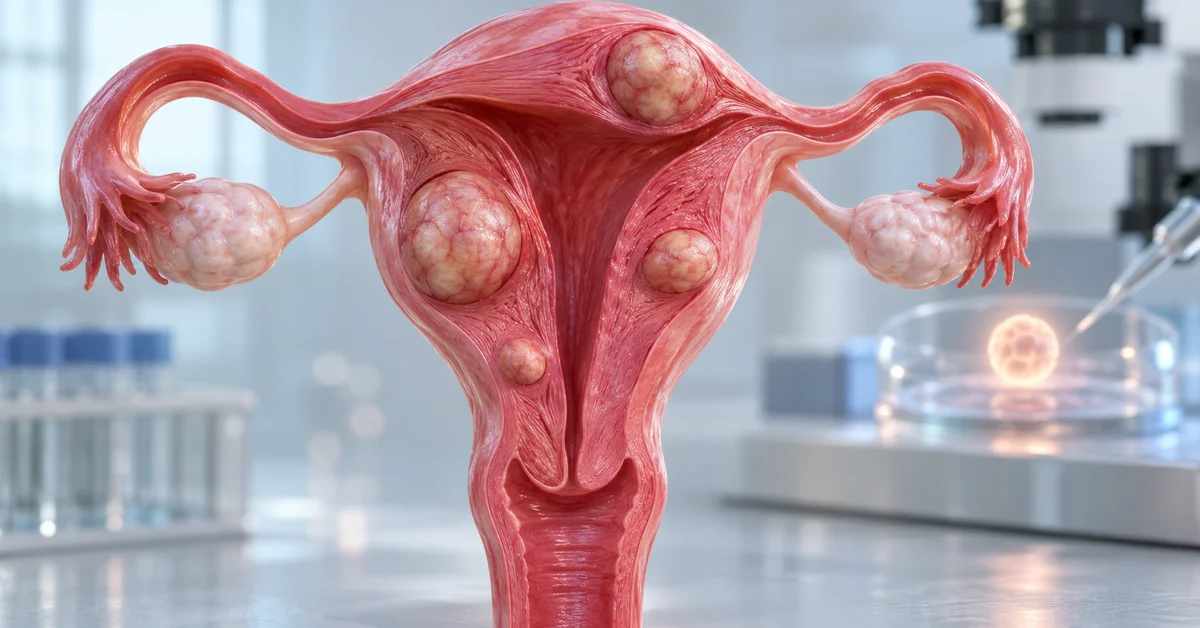
Uterine fibroids, or leiomyomas, are common benign tumors arising from the muscular wall of the uterus. They vary greatly in size, number and, most importantly for fertility, location.
Fibroids that enter or distort the uterine cavity have the clearest association with impaired implantation and reduced pregnancy potential.
Fibroids growing mainly toward the outside of the uterus generally have much less effect on fertility.
Intramural fibroids that remain within the uterine muscle without distorting the cavity represent the most difficult group: some studies associate them with poorer IVF outcomes, but evidence does not support routine removal of every such fibroid before treatment.
The more useful question is therefore not:
“Do I have a fibroid?”
It is:
“Where is the fibroid, does it distort the uterine cavity, how large is it, how many are present, and what other fertility factors exist?”
What Are Uterine Fibroids?
Fibroids are benign tumors composed mainly of smooth-muscle cells and connective tissue.
Many women have fibroids without symptoms.
They can be:
Very small.
Large enough to distort the uterus.
Single.
Multiple.
Symptoms, when present, may include:
Heavy menstrual bleeding.
Bleeding between periods.
Pelvic pressure.
Pelvic pain.
Bladder or bowel pressure.
However, many fibroids are discovered incidentally during fertility ultrasound.
Why Does Fibroid Location Matter?
Location strongly influences reproductive significance.
Submucosal Fibroids
These project into the uterine cavity.
This group has the strongest evidence for an adverse effect on implantation and fertility.
Intramural Fibroids
These lie within the uterine muscle.
Some distort the endometrial cavity; others do not.
That distinction is central when deciding whether treatment is appropriate.
Subserosal Fibroids
These grow predominantly toward the outside of the uterus.
When they do not distort the cavity or pelvic anatomy, they generally have little demonstrated effect on fertility.
What Is the FIGO Fibroid Classification?
The FIGO system describes the relationship of a fibroid to the endometrial cavity and outer uterine surface.
In simplified terms:
Type 0 lies entirely within the cavity on a stalk.
Type 1 projects mostly into the cavity.
Type 2 has a substantial intramural component but still projects into the cavity.
Type 3 is intramural but directly contacts the endometrium.
Type 4 is completely intramural.
Types 5–7 extend increasingly toward the outer uterine surface.
Type 8 describes other locations, such as cervical fibroids.
This classification helps clinicians determine reproductive relevance and the most appropriate surgical route when treatment is needed.
How Can Fibroids Affect Fertility?
Several mechanisms have been proposed.
A fibroid may:
Distort the uterine cavity.
Reduce the area available for implantation.
Alter uterine contractility.
Influence local blood flow.
Change the endometrial environment.
Interfere with the tubal openings in certain locations.
However, the importance of these mechanisms varies substantially according to fibroid location.
A fibroid should therefore not automatically be labelled the cause of infertility.
Do Submucosal Fibroids Affect Fertility?
This is the clearest category.
Fibroids projecting into the uterine cavity can reduce embryo implantation and clinical pregnancy rates.
ASRM considers there to be fair evidence that hysteroscopic removal of cavity-distorting submucosal fibroids improves clinical pregnancy rates in selected infertile women.
For this reason, treatment is commonly discussed before natural conception attempts or embryo transfer when a clinically significant submucosal fibroid is identified.
Do All Intramural Fibroids Affect IVF?
No.
Non-cavity-distorting intramural fibroids are one of the most debated areas in reproductive medicine.
Some studies associate them with lower implantation, pregnancy or live-birth rates.
However, available studies include fibroids of different sizes, numbers and FIGO types, and many are retrospective.
There is therefore no scientific basis for routinely removing every intramural fibroid before IVF.
Does Size Alone Determine Treatment?
No.
Size matters, but location often matters more.
A relatively small fibroid that distorts the uterine cavity may be more relevant to implantation than a larger fibroid growing completely outward.
Conversely, a very large intramural fibroid can still be clinically important when it:
Severely alters uterine anatomy.
Causes significant symptoms.
Makes ovarian access for egg retrieval difficult.
Or occurs as part of multiple large fibroids.
There is no universal 3-, 4- or 5-cm cutoff that automatically means surgery is required.
What Does Research Say About Intramural Fibroids?
Recent meta-analyses suggest that women with non-cavity-distorting intramural fibroids may experience lower fertility or live-birth outcomes compared with women without fibroids.
However, another important question is whether removing those fibroids improves the outcome.
Evidence for that remains inconsistent.
Some recent non-randomized studies suggest a benefit of myomectomy before IVF, while other analyses have not demonstrated a clear reproductive advantage from removing intramural fibroids.
This distinction is crucial:
An association between a fibroid and reduced success does not prove that surgery will reverse the effect.
Individualized decision-making remains necessary.
Do Subserosal Fibroids Affect Fertility?
Usually much less.
Subserosal fibroids grow mainly away from the uterine cavity.
Available evidence does not show a clear fertility benefit from removing an asymptomatic subserosal fibroid solely to improve conception.
Treatment may still be needed for other reasons such as:
Pain.
Pressure.
Large size.
Distorted pelvic anatomy.
But fertility alone is usually not a sufficient reason for surgery.
How Do We Determine Whether a Fibroid Distorts the Cavity?
Transvaginal ultrasound is usually the first investigation.
It can assess:
Fibroid number.
Size.
Location.
Relationship to the endometrium.
Additional imaging may be required when the relationship to the cavity is unclear.
What Is the Role of 3D Ultrasound?
Three-dimensional ultrasound can provide a clearer view of uterine anatomy and the relationship between an intramural fibroid and the endometrial cavity.
It can be especially helpful when conventional ultrasound cannot determine whether the cavity is being distorted.
When Is Saline Infusion Sonography Useful?
During saline infusion sonography, fluid is placed inside the uterine cavity while ultrasound is performed.
This outlines the cavity and can help identify:
Submucosal fibroids.
Polyps.
Adhesions.
The amount of a fibroid protruding into the cavity.
ASRM notes that sonohysterography has high diagnostic accuracy for intrauterine pathology.
Is HSG Enough to Evaluate Fibroids?
Not usually.
HSG can show filling defects or distortion of the uterine cavity.
It is also useful when tubal patency must be assessed.
However, it is less accurate than dedicated uterine imaging for characterizing fibroids.
A surgical decision should generally not be based on HSG alone.
When Is MRI Needed?
MRI is not required for every fibroid.
It may be useful when:
Multiple fibroids are present.
The uterus is markedly enlarged.
Ultrasound anatomy is difficult to interpret.
Fibroids need to be distinguished from adenomyosis.
Complex surgery is being planned.
MRI provides detailed mapping of uterine anatomy.
Fibroids vs Adenomyosis
These are different uterine conditions.
Fibroids are discrete benign tumors arising from the uterine muscle.
Adenomyosis involves endometrial-like tissue within the myometrium.
They can coexist.
Both may affect reproductive outcomes through different mechanisms.
For more information, see Adenomyosis and Infertility: How Does It Affect Fertility and IVF Success?.
Should Fibroids Be Removed Before Trying Naturally?
Not always.
Treatment is more likely to be discussed when a fibroid is:
Submucosal.
Or intramural and clearly distorting the uterine cavity.
A small asymptomatic fibroid that does not alter the cavity may often be monitored.
The remainder of the fertility evaluation should also be completed rather than assuming the fibroid is the only explanation.
Should Fibroids Be Removed Before IVF?
There is no universal answer.
Important factors include:
Location.
Cavity distortion.
Size.
Number.
Symptoms.
Maternal age.
Ovarian reserve.
Previous IVF outcomes.
Availability of frozen embryos.
Accessibility of the ovaries for retrieval.
Recovery time after surgery.
Cavity-distorting fibroids have the strongest rationale for treatment before embryo transfer.
Non-cavity-distorting intramural fibroids require a more individualized discussion.

Can Eggs Be Retrieved Before Myomectomy?
Yes, in selected patients.
This can be particularly important when:
Maternal age is advancing.
AMH is low.
AFC is limited.
Delay from surgery could reduce future reproductive opportunity.
A possible strategy is:
Ovarian stimulation.
Egg retrieval.
Embryo creation.
Embryo freezing.
Myomectomy.
Frozen embryo transfer after adequate recovery.
This approach preserves reproductive time while still allowing treatment of a clinically significant fibroid before embryo transfer.
Why Does Ovarian Reserve Matter?
Myomectomy may delay conception or IVF for a period while the uterus heals.
That delay has different significance at different reproductive ages.
A younger woman with reassuring ovarian reserve may tolerate waiting more easily.
A woman with diminished ovarian reserve may benefit from preserving oocytes or embryos before surgery.
See Diminished Ovarian Reserve: Does Low AMH Mean Poor Egg Quality and When Is IVF Needed?.
How Are Fibroids Surgically Removed?
The route depends primarily on location, size and number.
Hysteroscopic Myomectomy
Performed through the cervix without an abdominal incision.
It is primarily used for fibroids projecting into the uterine cavity.
Laparoscopic Myomectomy
Performed through small abdominal incisions.
It may be appropriate for selected intramural or subserosal fibroids.
Open Myomectomy
This may be required when fibroids are very large, numerous or surgically complex.
The least invasive operation is not automatically the best operation; the goal is safe removal while preserving uterine function.
Is Hysteroscopy Appropriate for Every Fibroid?
No.
Hysteroscopy treats fibroids that lie within or protrude into the uterine cavity.
A fibroid located entirely in the myometrium or toward the outer surface cannot usually be removed hysteroscopically.
Laparoscopic or open surgery may be required instead.
Does Myomectomy Improve IVF Success?
The answer depends on fibroid type.
For cavity-distorting fibroids, evidence supporting removal is stronger.
For non-cavity-distorting intramural fibroids, the evidence remains uncertain.
Some newer observational studies suggest higher ongoing pregnancy or live-birth rates after myomectomy before IVF.
However, these studies are not randomized and include heterogeneous fibroid populations.
Routine surgery for every intramural fibroid therefore remains unsupported.
Does a 4- or 5-cm Fibroid Automatically Need Surgery?
No.
There is no universal diameter that mandates myomectomy.
Clinicians need to know:
Where the fibroid is located.
Whether it contacts or distorts the endometrium.
How many fibroids exist.
Whether symptoms are present.
Whether IVF has failed previously.
Whether ovarian retrieval is technically affected.
A smaller cavity-distorting fibroid can matter more than a larger completely external fibroid.
What if There Are Multiple Fibroids?
Number can also matter.
Several intramural fibroids may alter uterine anatomy more than one small isolated lesion.
Recent data suggest that multiple fibroids may be associated with poorer reproductive outcomes.
However, surgery becomes more extensive as the number of fibroids increases.
Potential consequences include:
Longer surgery.
More blood loss.
More uterine incisions.
Postoperative adhesions.
Longer recovery.
The benefits and risks therefore need careful balancing.
Can Myomectomy Itself Affect Fertility?
Yes.
Myomectomy is not risk-free.
Potential complications include:
Bleeding.
Infection.
Pelvic adhesions.
Intrauterine adhesions after selected procedures.
Uterine scarring.
Delay before pregnancy.
Surgery should therefore have a clear indication.
Removing a fibroid that is unlikely to affect fertility may not be better than monitoring it.
Can Hysteroscopic Myomectomy Cause Adhesions?
It can.
Intrauterine adhesions may occur after some hysteroscopic procedures, particularly when treatment is extensive or multiple opposing uterine surfaces are involved.
Selected patients may therefore require postoperative cavity reassessment before embryo transfer.
How Long Should You Wait After Myomectomy Before Pregnancy or FET?
There is no single waiting period suitable for everyone.
The interval depends on:
Surgical route.
Depth of the uterine incision.
Number and size of fibroids removed.
How the uterine wall was repaired.
Postoperative healing.
Recovery may be relatively short after uncomplicated hysteroscopic surgery.
A deeper laparoscopic or open myomectomy may require a longer healing interval.
The operating surgeon and fertility specialist should determine timing from the actual surgical findings.
Can Egg Retrieval Be Difficult Because of Fibroids?
Yes.
A large fibroid can alter pelvic anatomy enough to make transvaginal access to an ovary more difficult.
This is a separate consideration from implantation.
ASRM recognizes severe distortion of pelvic anatomy that complicates oocyte retrieval as a circumstance in which myomectomy may reasonably be considered even when the fibroid does not distort the uterine cavity.
Can Medication Treat Fibroids to Improve Fertility?
Some medications can temporarily reduce fibroid size or bleeding.
However, they are not generally long-term fertility-restoring treatments.
Some suppress ovulation or prevent attempts at conception while being used.
Their role in fertility treatment is therefore different from their role in symptom control.
They may occasionally be used before surgery.
What About Uterine Artery Embolization?
Uterine artery embolization reduces blood supply to fibroids and can shrink them.
However, it is not generally the preferred fertility-preserving treatment in women actively planning future pregnancy.
Concerns remain regarding reproductive and pregnancy outcomes and possible ovarian effects.
When a fibroid requires treatment in a woman seeking pregnancy, myomectomy has a much longer reproductive track record.
What About Radiofrequency Ablation?
Radiofrequency ablation is increasingly used for selected fibroids.
Pregnancies after treatment have been reported, and the evidence base is developing.
However, fertility-specific and long-term live-birth data remain less established than for myomectomy.
It should therefore be discussed carefully when future pregnancy is a major goal.
Can Fibroids Cause Recurrent Implantation Failure?
Cavity-distorting fibroids may represent an important structural factor.
The role of non-cavity-distorting intramural fibroids is less certain.
When recurrent implantation failure and fibroids coexist, evaluation should consider:
Fibroid location.
Cavity distortion.
Embryo factors.
Maternal age.
Other uterine conditions.
Fibroids should not automatically be blamed for every failed transfer.
For the broader evaluation, see Recurrent Implantation Failure After IVF: Causes, Tests and What Actually Helps.
Do Fibroids Cause Miscarriage?
Some fibroids, particularly those affecting the uterine cavity, may be associated with adverse reproductive outcomes.
However, miscarriage has many causes.
Evidence does not support removing every fibroid simply to prevent miscarriage.
Location and cavity distortion need to be considered before recommending surgery.
Can You Become Pregnant With Fibroids?
Yes.
Many women conceive naturally despite having uterine fibroids.
The presence of a fibroid does not equal infertility.
The clinical task is to determine whether the fibroid is an incidental finding or is actually affecting:
The uterine cavity.
Tubal anatomy.
Implantation.
Or access during fertility treatment.
What if the Fibroid Is Small and Asymptomatic?
Monitoring may be more appropriate when the fibroid does not distort the cavity and there is no other indication for surgery.
Myomectomy should not be viewed as preventive treatment for every fibroid.
It is also important not to delay treatment of another clear infertility factor while focusing on an incidental myoma.
What if Fibroids and Adenomyosis Are Both Present?
This is possible and can complicate interpretation.
Removing the fibroid treats the fibroid.
It does not treat adenomyosis within the myometrium.
The reproductive contribution of each condition should therefore be evaluated separately.
What Should Be Reviewed Before Deciding on Surgery?
Before fertility-related myomectomy, clinicians should review:
Maternal age.
Duration of infertility.
AMH and AFC when appropriate.
FIGO fibroid type.
Fibroid size.
Number.
Cavity distortion.
Symptoms.
Tubal status.
Semen findings.
Previous IVF treatment.
Frozen embryo availability.
Planned surgical route.
Expected recovery interval.
The complete picture is more useful than any single ultrasound measurement.
Common Mistakes in Fibroid and Fertility Management
Common errors include:
Assuming every fibroid causes infertility.
Choosing surgery based on size alone.
Removing every intramural fibroid before IVF.
Ignoring a small submucosal fibroid because it is “too small to matter.”
Using uterine artery embolization in a fertility patient without careful discussion of reproductive alternatives.
Ignoring ovarian reserve and reproductive timing before surgery.
Transferring embryos without adequately evaluating a cavity-distorting fibroid.
Presenting myomectomy as a guarantee of IVF success.
Attributing every failed implantation to a fibroid.
Conclusion
Not all uterine fibroids have the same reproductive significance.
Their relationship to the uterine cavity is often more important than the simple fact that a fibroid exists.
Submucosal fibroids and intramural fibroids that distort the cavity have the strongest evidence for impairing implantation and fertility, making treatment before conception or embryo transfer more reasonable.
Subserosal fibroids generally do not require removal solely to improve fertility.
Non-cavity-distorting intramural fibroids remain the most controversial category. They may be associated with poorer IVF outcomes in some studies, but current evidence does not support routine myomectomy for every patient.
The decision should therefore consider location, size, number, symptoms, maternal age, ovarian reserve and previous fertility treatment.
In selected patients with limited ovarian reserve or advancing reproductive age, embryo creation and freezing before myomectomy may help protect reproductive time, followed by surgery and frozen embryo transfer after recovery.
If uterine fibroids have been identified during infertility evaluation or before IVF, you can contact Safemedigo on WhatsApp for a preliminary review of your imaging, fibroid location, ovarian reserve and previous fertility treatment.
Frequently Asked Questions
Does every uterine fibroid cause infertility?
No. Reproductive impact depends strongly on location, cavity distortion, size, number and other fertility factors.
Should fibroids always be removed before IVF?
No. Treatment is most clearly considered for cavity-distorting fibroids. Non-cavity-distorting fibroids require individualized assessment.
Does a 4- or 5-cm fibroid automatically require surgery?
No. There is no universal size threshold. Location, symptoms, cavity distortion and reproductive circumstances are more informative.
Can eggs be retrieved before fibroid surgery?
Yes, in selected patients, particularly when age or diminished ovarian reserve makes reproductive timing important.
Can I become pregnant naturally with fibroids?
Yes. Many women conceive with fibroids, particularly when the uterine cavity and reproductive anatomy remain unaffected.