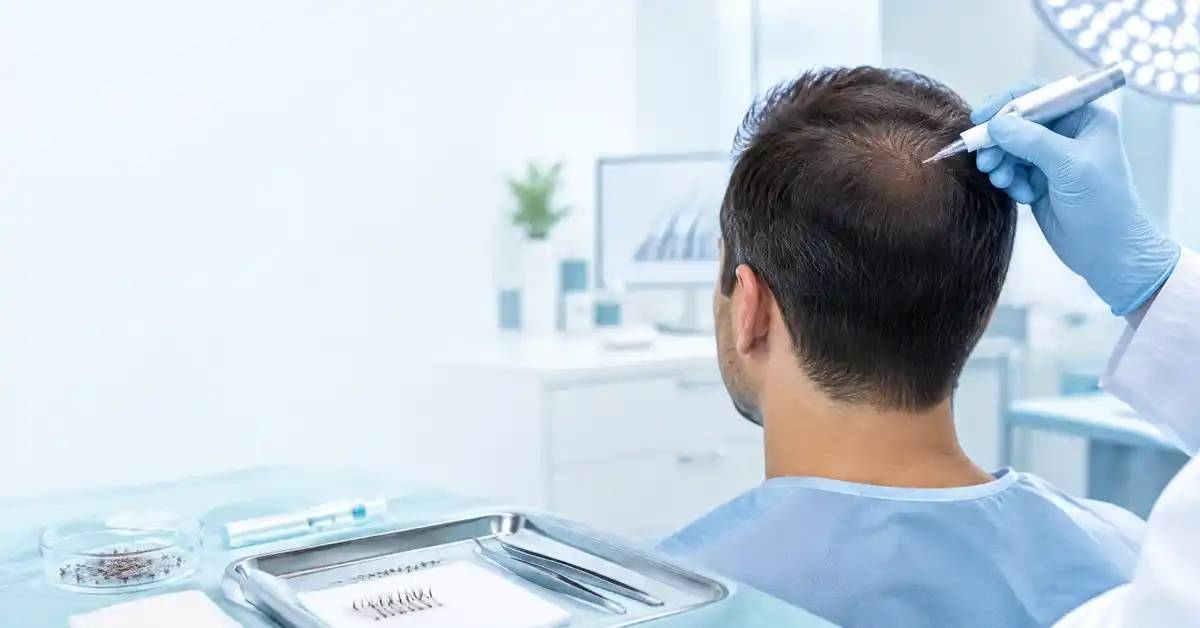








Seeing hair fall after a hair transplant can be alarming, particularly when you have been waiting for growth since the day of surgery. However, shedding after transplantation does not automatically mean that the follicles have failed.
Several forms of hair loss may occur during the early recovery period. The visible shafts of transplanted hairs can shed, while some of the patient's pre-existing native hairs surrounding the transplanted area can temporarily enter a shedding phase known as shock loss or recipient-site effluvium. Temporary shedding may occasionally also affect the donor area.
The important question is therefore not simply whether hair is falling, but which hair is shedding, when it started, how the scalp looks and whether any warning symptoms are present.
This Safemedigo guide explains what shock loss is, when it occurs, when regrowth usually begins and when postoperative hair loss needs medical assessment.
What is shock loss after a hair transplant?
Shock loss describes temporary shedding associated with the effect of hair-transplant surgery on the hair cycle.
Which hairs can be affected?
Hair loss after transplantation may involve:
Native hair around the recipient area.
Hair in the donor region.
The visible shafts of transplanted grafts.
These are related but not identical events.
Does shock loss mean the follicle is dead?
Usually not.
The visible hair shaft can fall while the follicle remains within the scalp and later enters another growth cycle.
Transplanted-hair shedding versus true shock loss
This distinction helps explain much of the anxiety after surgery.
Shedding of transplanted hairs
The visible hairs carried within transplanted grafts frequently shed after surgery.
This does not necessarily mean the graft itself was lost.
Shock loss of native hair
Pre-existing hairs located close to the treated recipient area may temporarily shed after the surgical procedure.
Why do they look similar?
Both can occur during the same general postoperative period and temporarily reduce visible density.
When does shock loss occur?
Recipient-site shock loss commonly develops during the first several weeks after surgery.
Some patients notice it within the first month, while others see more obvious shedding later during the early postoperative period.
Does everyone experience it?
No.
The extent varies considerably between patients.
Why does shock loss happen?
The mechanism can involve several factors.
Surgical trauma
Creating recipient sites and working between existing hairs can temporarily alter the hair cycle.
Local inflammation and swelling
Postoperative tissue changes may influence surrounding follicles.
Temporary vascular changes
Local changes in blood supply have also been proposed as contributing factors.
Pre-existing miniaturized hair
Weak hairs already affected by androgenetic alopecia can be particularly vulnerable.
Why can women be more susceptible?
Female hair loss is often diffuse rather than forming completely bald recipient zones.
This means grafts may be implanted between a relatively large number of existing native hairs.
If some of these hairs are already miniaturized, postoperative shedding can become more noticeable.
What is hair miniaturization?
Miniaturization means hairs progressively become thinner, shorter and weaker.
Why does it matter before surgery?
Miniaturized native hairs may be more vulnerable to shock loss.
Some may recover, while hairs already severely compromised may not regain their previous calibre.
This is one reason preoperative evaluation should assess existing recipient hair as well as the donor area.
Is it normal for transplanted hair to shed during the first month?
It can be part of the expected postoperative course.
What is shedding?
Usually the visible shaft above the skin.
What remains?
The follicular structure can remain within the scalp.
Does new growth start immediately?
No.
Follicles generally pass through a resting phase before visible growth begins gradually over the following months.
How can I tell whether the graft itself was lost?
A fallen hair is not the same as a dislodged graft.
Later shedding usually does not mean graft loss
Once grafts have stabilised and the skin has progressed through early healing, visible hair shedding does not normally indicate that the entire follicular unit has fallen out.
Early trauma is different
During the immediate postoperative period, forceful scratching, rubbing or direct injury can potentially damage grafts.
If there is obvious bleeding or concern about a dislodged graft, contact the treating team rather than attempting to replace anything yourself.

Can shock loss affect the donor area?
Yes.
Temporary donor-area effluvium can occur, although it is discussed less commonly than recipient-site shock loss.
What might it look like?
A temporary area of reduced density at the back or sides of the scalp.
Does it automatically mean overharvesting?
No.
Temporary effluvium must be distinguished from permanent donor thinning caused by excessive harvesting.
Read our donor area and overharvesting guide.
How long does shock loss last?
The course varies.
Shedding phase
Usually occurs during the early weeks after surgery.
Resting phase
Visible regrowth may not begin immediately when shedding stops.
Regrowth
New hairs typically emerge progressively over the following months.
Hair transplantation should therefore be assessed over months rather than week by week.
When does hair grow back after shock loss?
Temporary shock loss usually improves gradually.
Patients may initially notice:
Very short new hairs.
Uneven growth between regions.
Fine hairs that progressively become thicker.
Not all follicles restart at exactly the same time.
Can shock loss be permanent?
Most postoperative shock loss is temporary, but permanent loss can occur in some vulnerable native hairs.
Which hairs are at higher risk?
Particularly those that were already severely:
Miniaturized.
Weak.
Advanced in androgenetic hair loss.
Surgery may reveal loss in follicles that already had limited long-term viability.
Does shock loss mean the transplant failed?
No.
Shock loss and transplant failure are different concepts.
A failed or unsatisfactory transplant is assessed later and may involve problems such as:
Poor graft growth.
Unnatural design.
Incorrect direction.
Low mature density.
Donor-area problems.
Read our failed hair transplant and revision guide.
When is postoperative shedding not normal?
The number of hairs alone does not define a complication.
Associated symptoms matter.
Increasing pain
Pain that becomes worse rather than gradually improving deserves assessment.
Severe or spreading redness
Particularly when accompanied by warmth or tenderness.
Pus or drainage
Should not be interpreted as normal shock loss.
Increasing swelling
Especially when combined with other concerning symptoms.
Abnormal skin colour
Very dark, grey, black or ulcerated skin needs prompt medical review.
Fever or systemic illness
Requires clinical assessment rather than remote observation alone.
What about pimples after a hair transplant?
Folliculitis can occur during recovery and new hair growth.
Mild lesions may occur, but repeated pus-filled, painful or spreading lesions should be assessed.
Avoid squeezing or repeatedly manipulating them.
When should you contact the clinic?
Contact the treating team if you notice:
Unexpected sudden shedding.
A clearly defined area of concern.
Persistent inflammation.
Increasing pain.
Unusual swelling.
Donor-area changes.
Send clear photographs in consistent lighting and include the date of surgery.
When do you need direct medical assessment?
Do not rely only on WhatsApp or photographs if severe symptoms are present.
Seek in-person medical care for:
Severe or worsening pain.
Pus or significant drainage.
Fever or systemic infection symptoms.
Persistent bleeding.
Marked swelling.
Dark or ulcerated skin.
Rapid deterioration of a wound.
Patients who have already returned home may need assessment by a local physician or emergency service depending on severity.
Can shock loss be completely prevented?
No method can guarantee complete prevention.
Risk may be reduced through:
Appropriate candidate selection.
Assessment of existing native hair.
Careful recipient-site planning.
Appropriate implantation density.
Refined surgical technique.
Good postoperative follow-up.
Can very dense implantation increase risk?
High density should not be pursued without considering the existing scalp and native hair.
Every recipient site introduces local surgical trauma, so transplantation between weak native hairs requires careful planning.
Can poor aftercare cause shock loss?
Shock loss itself is mainly related to the hair cycle response to surgery, but poor postoperative care can cause other problems such as:
Graft trauma.
Skin irritation.
Infection.
Delayed healing.
Following washing and activity instructions is therefore important.
Does washing make transplanted follicles fall out?
Once washing has been permitted by the treating team, appropriate washing is part of postoperative care.
Patients may see hairs come away during washing because shafts already entering the shedding phase detach at that time.
That does not automatically mean graft loss.
What about crusts?
Crusting is common during early healing.
Do not aggressively pick or scratch crusts.
Follow the centre's instructions regarding washing and gradual removal.
Does minoxidil prevent shock loss?
Minoxidil may be part of a treatment plan for selected patients, but it should not be started or stopped automatically after surgery.
Timing depends on:
Scalp healing.
Formulation.
Tolerance.
Physician plan.
Minoxidil can itself cause temporary initial shedding in some patients, making unsupervised changes particularly confusing.
What about finasteride?
Finasteride may be appropriate for some men with androgenetic alopecia.
Its role is mainly long-term preservation of susceptible native hair rather than an immediate treatment for postoperative shock loss.
Medical suitability, benefits and possible adverse effects should be discussed with the treating physician.
Can PRP prevent shock loss?
PRP should not be presented as a guaranteed method for preventing postoperative shedding.
It may be offered as an adjunct for selected patients, but protocols and evidence vary.
Read our PRP for hair loss guide.
Is shock loss different in men and women?
The underlying concept is similar, but the surrounding hair pattern may differ.
In men
The recipient region may contain a combination of bald areas and miniaturized native hair.
In women
Hair loss is often more diffuse, so transplantation may take place among more existing native follicles.
This makes preoperative assessment particularly important.
What if hair has not returned after several months?
Do not make a decision from a single photograph.
Assessment should consider:
Which hair was lost.
Location of shedding.
Timing.
Whether new hairs are appearing.
Preoperative miniaturization.
Donor-area status.
If concern continues as the transplant approaches its mature evaluation period, the physician can determine whether growth is delayed or another problem is present.
Does shock loss mean you need a second transplant?
No.
A second procedure should not be planned simply because shedding occurred.
The first transplant needs time to mature before additional donor resources are used.
How should hair growth be monitored?
Standardised photographs are more useful than checking the mirror every day.
Use similar:
Lighting.
Camera distance.
Angles.
Hair length when possible.
Photograph the front, top, crown, sides and donor area.
What should you avoid during the shedding period?
Avoid:
Changing medications without advice.
Applying multiple new products out of anxiety.
Scratching the scalp.
Squeezing inflammatory lesions.
Judging the final result at two or three months.
Booking another transplant prematurely.
When is shedding more reassuring?
The course is more consistent with expected recovery when:
Shedding occurs during the expected postoperative period.
Pain is improving.
There is no pus or spreading redness.
The scalp is healing normally.
Gradual regrowth subsequently appears.
However, individual evaluation is preferable whenever the course is unclear.
Conclusion
Shock loss after hair transplantation does not automatically mean that transplanted follicles have died or that the procedure has failed. Transplanted hair shafts can shed as part of the expected postoperative cycle, while surrounding native hair can also temporarily enter an effluvium phase.
The important approach is to monitor recovery over months rather than judging the transplant too early. Increasing pain, pus, spreading redness, fever, abnormal skin colour or delayed wound healing are different from shock loss and require medical assessment.
Safemedigo can help review your postoperative photographs and coordinate an assessment if you are unsure whether your shedding is within the expected recovery pattern or requires medical review. Contact Safemedigo on WhatsApp.
Frequently Asked Questions About Shock Loss After Hair Transplant
Is it normal for transplanted hair to fall out?
Yes. The visible transplanted hair shafts can shed during the early postoperative period while follicles remain in the scalp and later begin a new growth cycle.
When does shock loss usually happen?
It most commonly becomes noticeable during the first several weeks after transplantation.
Does hair grow back after shock loss?
Temporary shock loss commonly regrows gradually, although severely miniaturized native hairs may not always regain their previous strength.
When should postoperative shedding worry me?
Seek medical review if it occurs with worsening pain, pus, severe redness, fever, marked swelling, persistent bleeding or abnormal skin colour.
Does shock loss mean I need another hair transplant?
No. The transplant should be allowed to mature before considering another procedure or using additional donor grafts.