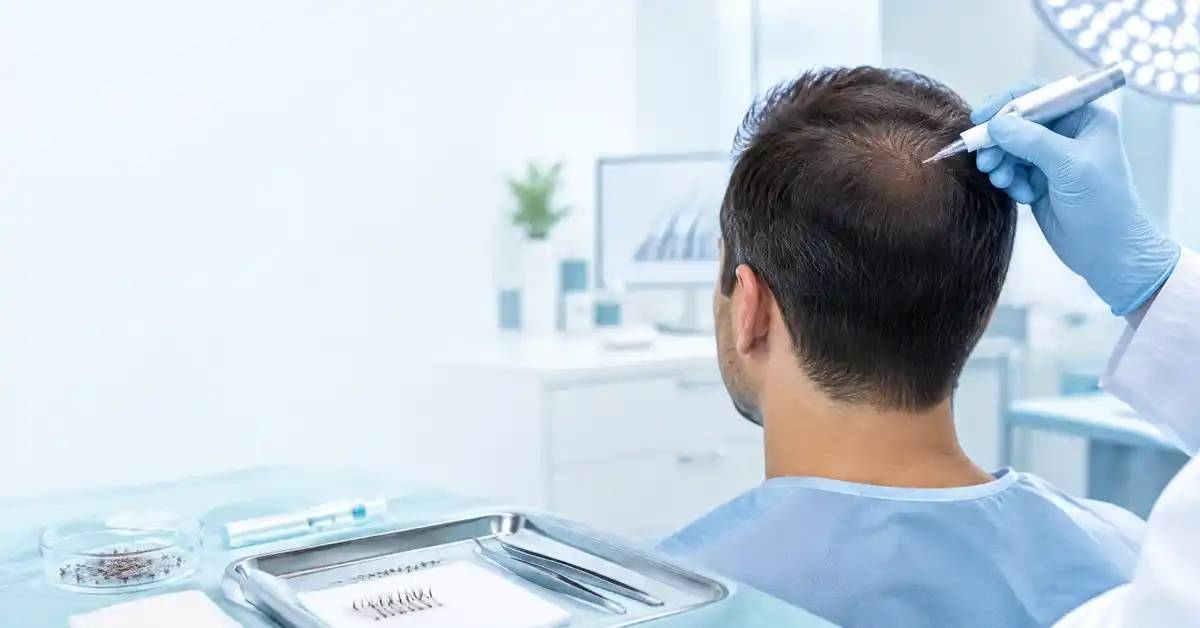







Being unhappy with a hair transplant does not automatically mean the procedure has failed. Density can look poor during the early months, transplanted hairs may shed temporarily, native hair around the transplanted area can also undergo temporary shedding, and some scalp regions take longer than others to mature.
However, dissatisfaction can also reflect a genuine problem, such as limited growth, an unnatural hairline, incorrect hair direction, poor density distribution, continued loss of native hair or donor depletion caused by excessive harvesting.
For this reason, deciding on a second hair transplant or revision hair transplant should not be based only on early photographs. The first step is to identify what is actually wrong, assess the remaining donor supply and understand what was performed previously.
This Safemedigo guide explains the difference between delayed growth, a second-stage transplant and true corrective surgery.
When can a hair transplant be considered unsuccessful?
There is no single date that applies to every patient.
Results should not be judged in the early months
Transplanted hair frequently passes through shedding and resting phases before new visible growth develops.
Sparse areas at month three or four therefore do not prove failure.
Maturation takes time
Growth and calibre generally continue developing over many months.
For many scalp transplants, the result is assessed more reliably around the end of the first year.
The crown may mature later
The crown or vertex can progress more slowly than the frontal scalp in some patients.
Read our hair transplant results timeline for a separate explanation of the growth stages.
Delayed result or failed transplant?
A key question is whether there is continuing improvement.
Delayed maturation may show
Progressive new growth.
Different growth rates across areas.
Fine new hairs gradually becoming more visible.
Density that continues to improve.
A genuinely unsatisfactory result may involve
Large areas of limited growth after adequate maturation time.
An unnatural design.
Incorrect hair direction.
Severe donor depletion.
Significant scarring.
Markedly uneven density.
The problem therefore needs to be classified rather than simply labelled as “failure.”
What can cause an unsatisfactory hair transplant?
Several categories are possible.
Poor candidate selection
The original problem may have begun before surgery.
Examples include:
Rapidly progressive hair loss.
Weak donor area.
Diffuse thinning.
Active inflammatory scalp disease.
Unrealistic expectations.
Poor planning
This may include:
An excessively low hairline.
Spending too many grafts in the frontal area.
Ignoring future hair loss.
Attempting to cover more scalp than the donor supply can support.
Technical problems
These may involve:
Graft handling.
Placement angle.
Hair direction.
Distribution.
Recipient-site design.
Complications
Significant complications can occasionally affect scalp tissue or hair growth.
Does low density mean the transplant failed?
Not necessarily.
Donor supply may have been limited
A patient may receive reasonable coverage without achieving very high density.
The recipient area may be large
Spreading a limited number of grafts over a large bald area reduces density per square centimetre.
Hair may be very fine
Hair calibre has a major impact on visual coverage.
Genuine poor growth is also possible
If the mature result is considerably below reasonable expectations, the cause should be investigated before simply adding more grafts.
Why might transplanted grafts show poor growth?
The reason cannot always be determined from photographs alone.
Outcome may be affected by:
Graft quality.
Harvesting.
Handling outside the scalp.
Recipient-site preparation.
Implantation.
Blood supply.
Previous scarring.
Complications.
Individual healing.
Repeating surgery without identifying the likely problem may repeat the same outcome.
Does shedding after surgery mean the grafts died?
No.
The visible hair shaft can shed while the follicular structure remains within the scalp.
A new cycle of growth may subsequently begin.
Shock loss deserves separate discussion because it can involve transplanted or surrounding native hair.
Does continued baldness mean the transplant failed?
Not always.
Hair transplantation does not stop androgenetic alopecia
Transplanted hairs may remain while untreated native hair continues to thin.
This can create
A gap behind the transplanted hairline.
Loss of mid-scalp density.
Expansion of crown thinning.
An isolated transplanted frontal zone.
The problem may therefore be progression of the original condition rather than failure of the transplanted follicles.
What makes a transplanted hairline look unnatural?
Hair may grow successfully while the design remains cosmetically unsatisfactory.
An excessively low hairline
Can consume a large donor supply and become less age-appropriate over time.
An overly straight line
Natural hairlines usually contain subtle irregularity.
Incorrect frontotemporal design
The frontal-temporal relationship has a major influence on natural appearance.
Heavy grafts at the leading edge
Using multi-hair follicular units too prominently at the front can create a coarse appearance.
What about incorrect hair direction?
The angle and direction in which hairs emerge are crucial.
Problems may include
Hairs standing too upright.
Growth against the natural direction.
Inconsistent angles across neighbouring areas.
Why can this be difficult to correct?
The follicles have already healed in their previous orientation.
Correction may require camouflage with new grafts, removal of selected grafts or a combination of techniques.
What is a pluggy or doll-hair appearance?
It describes visible clusters of hair at the frontal edge rather than a gradual natural transition.
Historically this was associated with older transplantation methods, although poor modern follicular-unit distribution can also produce an unnatural appearance.
Repair may involve
Removing selected large grafts.
Reusing suitable grafts where possible.
Adding single-hair follicular units.
Redesigning the frontal transition.
What if the hairline was placed too low?
Low hairlines can be among the more challenging revision problems.
Why?
Adding more hair alone does not correct an inappropriate position.
Selected cases may require:
Removal of grafts.
FUE extraction of transplanted follicles.
Redesign.
More complex corrective approaches.
Repair surgery is therefore not simply another density session.
Second session or revision surgery?
These are different situations.
Second hair transplant
May be considered when the first procedure has an acceptable design but the patient needs:
Additional density.
Treatment of another area.
Management of progressive hair loss.
Completion of a planned multi-stage restoration.
Revision or repair surgery
Addresses a specific problem such as:
Unnatural hairline.
Wrong angulation.
Poor growth.
Uneven distribution.
Donor overharvesting.
Scarring.
A revision may involve more than one corrective technique.
When should a second session be considered?
The first transplant should generally be allowed enough time to mature unless a medical complication requires earlier assessment.
Why wait?
A useful decision requires knowing:
Which grafts ultimately grew.
The true mature density.
How the recipient skin healed.
Whether native hair stabilised.
How much donor supply remains.
Planning another surgery at month four can therefore be premature.
Is waiting one year an absolute rule?
No.
It is a useful practical timeframe for assessing many cosmetic outcomes, but different problems require different timing.
Earlier medical assessment is needed for
Infection.
Severe inflammation.
Abnormal pain.
Skin injury.
Necrosis.
Poor donor wound healing.
These are medical issues rather than cosmetic maturation questions.
How is a failed transplant assessed before repair?
Both the recipient and donor areas must be evaluated.
Details of the first surgery
Useful information includes:
Surgery date.
Technique.
Known graft count.
Previous procedures.
Recovery course.
Preoperative photographs
Help establish the original pattern of hair loss.
Postoperative photographs
Help reconstruct how the result evolved.
Recipient examination
Assesses:
Density.
Angulation.
Hairline design.
Scarring.
Skin condition.
Donor examination
Determines whether enough safe donor hair remains.
Why is donor assessment especially important in revision surgery?
Because part of the donor supply has already been used.
Some patients retain good reserves
Giving the surgeon more options.
Others have limited supply
Particularly after:
Large sessions.
Multiple procedures.
Overharvesting.
Weak baseline donor density.
Read our donor-area and overharvesting guide.
What if the donor area has been overharvested?
Simply taking more grafts may worsen the problem.
Assessment should consider:
Remaining density.
Pattern of depletion.
Scarring.
Safe donor boundaries.
Alternative hair sources where appropriate.
Sometimes repair must address the donor area itself as well as the recipient area.
Can depleted donor areas be transplanted?
This may be discussed in selected patients, but it is not a simple solution because donor hair used to repair the donor region must come from another suitable source.
Options depend heavily on remaining resources.
Can beard hair be used for repair?
It may provide supplementary grafts in selected cases when scalp donor supply is limited.
However, beard hair differs from scalp hair in calibre, texture and growth behaviour.
Its placement therefore needs careful planning.
Can wrongly placed transplanted follicles be removed?
In selected cases, yes.
Precise extraction techniques may be used
To remove grafts from:
An excessively low hairline.
Unnatural locations.
Incorrectly angled areas.
Extraction can be more difficult than normal donor harvesting
Because of:
Scar tissue.
Altered follicular paths.
Risk of follicular transection.
Revision surgery therefore requires different planning from a primary transplant.
Can removed grafts be reused?
Some successfully extracted grafts may potentially be replanted if they remain suitable.
However, this cannot be guaranteed for every extracted follicle.
What about hair transplant scars?
The problem differs according to technique.
FUT scar
May be fine and concealed or may become wide and noticeable in some patients.
FUE marks
Can become more visible with:
Dense harvesting.
Short hairstyles.
Pigment contrast.
Donor depletion.
Management depends on the type and severity of the scar.
Can PRP repair a failed hair transplant?
PRP should not be presented as a substitute for revision surgery.
It may have a role in selected hair-loss treatment plans, but it does not:
Replace lost follicles.
Correct a poorly positioned hairline.
Reverse donor overharvesting.
Correct abnormal angles.
Read our PRP hair treatment guide.
Is DHI better for revision surgery?
There is no single technique name that is best for every repair.
A case may require:
FUE.
Implanter devices.
Graft removal.
New graft placement.
Hairline redesign.
Several techniques together.
The anatomy of the problem should determine the treatment—not the package name.
What if continued native hair loss is the problem?
Before another transplant, determine:
Is hair loss still active?
Is medical treatment appropriate?
What is the likely future pattern?
Can the donor supply support the complete plan?
Adding grafts without answering these questions may repeat the same problem.
Can every failed hair transplant be fully repaired?
No.
Some problems can often be significantly improved
Such as selected density deficits or hairline irregularities.
Other cases are more difficult
Particularly with:
Severe donor depletion.
Extensive scarring.
Very low hairlines.
Several previous procedures.
Active scalp disease.
Expectations exceeding available donor resources.
The realistic objective may be meaningful improvement rather than a perfect restoration.
What mistakes should be avoided after an unsatisfactory result?
Rushing into another operation
Can consume additional donor hair before the original problem is understood.
Choosing by graft number alone
Repair surgery requires planning more than maximum numbers.
Adding density without diagnosing the problem
More grafts are not always the correct answer.
Ignoring future loss
Revision should fit the long-term hair-loss pattern.
What should you send for a revision assessment?
Useful information includes:
Preoperative photographs if available.
Immediate postoperative photographs.
Progress photographs.
Current clear photographs.
Donor-area images.
Previous surgical report or details.
Graft count if known.
Current medications.
Any complications experienced.
Photographs should include the front, sides, top, crown and donor area.
Questions to ask before revision surgery
Ask:
What went wrong with the previous transplant?
Do I actually need another operation?
Has the first result matured enough to judge?
How much donor supply remains?
Will grafts be added, removed or both?
What is the realistic objective?
Could correction require more than one stage?
What happens if my native hair continues to thin?
How can the need for revision be reduced from the beginning?
Prevention starts with planning.
Diagnose the hair loss
Before surgery.
Assess the donor area
Not only the frontal scalp.
Use an age-appropriate design
That remains sensible as hair loss progresses.
Avoid overharvesting
To preserve future options.
Maintain realistic expectations
Hair transplantation redistributes a limited hair supply; it does not recreate unlimited natural density.
Read our complete hair transplant in Turkey guide.
Conclusion
An unsatisfactory hair transplant does not automatically mean another procedure is necessary. The first step is to determine whether the problem is delayed maturation, limited density, progressive native hair loss, an unnatural hairline, poor angulation, scarring or donor depletion.
Revision surgery can be more complex than a primary transplant because the surgeon is working with previously transplanted hair and a donor supply that has already been partially used.
Safemedigo can help review your previous hair transplant photographs and coordinate an assessment to determine whether waiting, a second session or a revision plan may be appropriate. Contact Safemedigo on WhatsApp.
Frequently Asked Questions About Failed Hair Transplants
When can I tell whether my hair transplant failed?
Early months are too soon for most cosmetic judgments. Growth develops over many months, with mature assessment commonly becoming more meaningful toward the end of the first year.
Does low density mean I need a second transplant?
Not necessarily. Donor supply, graft number, hair calibre, growth stage and ongoing native hair loss should be evaluated first.
Can an unnatural hairline be corrected?
Many cases can be improved through additional grafting, selective graft removal or redesign, depending on the donor supply and existing scars.
Can I have another transplant after a failed procedure?
Possibly, if adequate donor hair remains, but the cause of the previous result should be investigated before additional grafts are used.
Can revision surgery guarantee a perfect result?
No. The achievable improvement depends on the problem, remaining donor hair, scarring, skin condition and previous procedures.