





Patients considering a hair transplant often focus on how many grafts can be placed in the hairline or crown. A more important question may be: How many grafts can the donor area provide safely?
Donor hair is a finite resource. Follicular units removed during transplantation are redistributed rather than replaced with newly created follicles, so each procedure uses part of the patient's available donor supply.
This makes donor assessment, conservative harvesting and long-term planning particularly important for patients whose hair loss may continue and who could require another procedure in the future.
This Safemedigo guide explains how the donor area is assessed, what determines its capacity, what overharvesting means and why preserving donor hair is fundamental to long-term hair transplant planning.
What is the donor area?
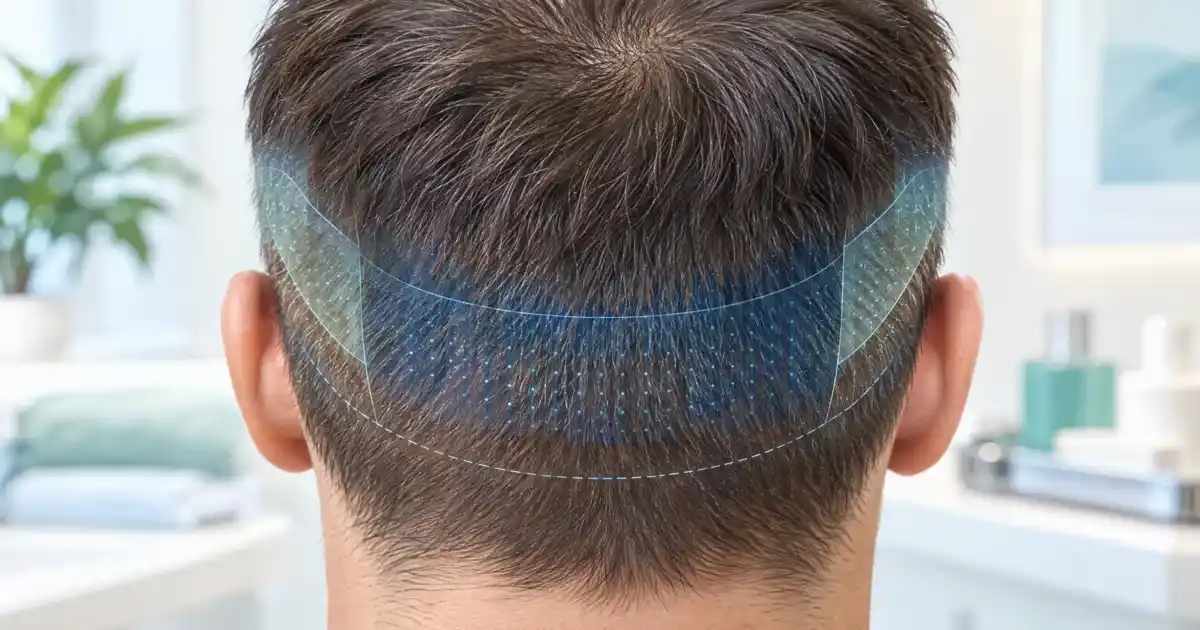
The donor area is the region from which follicular units are harvested for transplantation into areas affected by hair loss.
Where is it usually located?
For scalp hair transplantation, it is commonly concentrated around:
The back of the scalp.
The sides.
Areas expected to remain relatively stable as pattern hair loss progresses.
Its precise boundaries vary between individuals.
Why is this hair used?
Some follicles at the back and sides of the scalp are relatively more resistant to androgenetic hair loss than follicles at the front and crown.
When transplanted, they tend to retain characteristics of their donor origin.
Is all hair at the back permanent?
No.
Hair simply being located on the back of the scalp does not automatically make it a permanently safe donor source.
Some patterns of thinning may progressively involve lateral or occipital areas.
Why is donor hair a limited resource?
Hair transplantation redistributes existing follicles rather than creating new ones.
What happens after an FUE graft is removed?
Once a complete follicular unit has been extracted, that same follicular unit is not expected to regenerate at the extraction site.
Donor density therefore decreases as grafts are harvested.
Why can't every follicle be removed?
Enough hair must remain to provide visual coverage across the donor scalp.
Removing too much can make scalp visibility and extraction scarring more noticeable.
Why does future hair loss matter?
A patient may require only frontal restoration today but develop additional baldness later.
Using too much donor hair in the first procedure may limit options for future restoration.
How is the donor area assessed?
Proper evaluation involves more than looking at one photograph of the back of the head.
Follicular-unit density
The number of follicular units in a defined area is assessed.
Higher starting density may provide greater harvesting flexibility, but density alone is not sufficient.
Hairs per follicular unit
Not every graft contains the same number of hairs.
A follicular unit may contain:
One hair.
Two hairs.
Three hairs.
Occasionally more.
Therefore, graft count and hair count are not identical.
Hair calibre
Thicker hair usually creates more visual coverage than very fine hair with an equivalent graft count.
Hair-to-skin contrast
Lower or higher contrast can influence how dense the hair appears.
Hair characteristics
Straight, wavy and curly hair provide different patterns of visual coverage.
Why is donor miniaturization important?
Miniaturization is an important part of donor assessment.
What does miniaturization mean?
In androgenetic alopecia, affected hairs can progressively become thinner, shorter and less robust.
Why look for it in the donor area?
If a presumed donor region contains significant miniaturization, it may not be as stable as it appears.
Transplanting hair from an unstable area does not guarantee that those follicles will remain strong indefinitely.
When is this particularly important?
For example:
Diffuse hair loss.
Atypical patterns.
Lateral or occipital thinning.
Younger patients with an uncertain long-term pattern.

Can the donor area be assessed from photographs?
Photographs are useful for preliminary evaluation but cannot replace every aspect of direct examination.
Photographs can help show
Overall donor coverage.
Obvious thinning.
Scars.
Previous harvesting.
Hair-loss pattern.
Examination may provide additional information
Such as:
More precise density.
Miniaturization.
Hair calibre.
Scalp characteristics.
Follicular exit angles.
The recommended graft number can therefore change after physical assessment.
What is a safe donor area?
It is the region expected to provide relatively stable hair for long-term transplantation.
Are its boundaries identical for everyone?
No.
Age, hair-loss pattern, family history and donor characteristics all influence planning.
Why should the boundaries be conservative?
Harvesting from areas that later become affected by hair loss may compromise the long-term durability of transplanted follicles.
What is overharvesting?
Overharvesting occurs when the number or distribution of extracted follicular units exceeds what the donor region can tolerate cosmetically.
It is not only about total numbers
It may result from:
Excessive total harvesting.
Extractions placed too close together.
Concentrating harvesting in a small area.
Repeatedly harvesting the same region over several procedures.
Expanding beyond stable donor boundaries to reach a target number.
What can an overharvested donor area look like?
The appearance can vary.
Patchy thinning
Some areas may look noticeably less dense than others.
Increased scalp visibility
Especially with short hairstyles or bright lighting.
Uneven donor density
Parts of the back or sides may appear depleted.
More visible extraction marks
Tiny FUE scars can become easier to see when surrounding hair density falls.
Reduced options for future surgery
The donor region may no longer have enough safe supply for another procedure.
Can overharvesting cause permanent damage?
Severe overharvesting may produce lasting donor depletion and scarring.
Because removed follicles cannot simply be returned after being used elsewhere, prevention is considerably easier than repair.
Is there one safe graft number for everyone?
No.
Two patients with similar donor surface area may differ greatly in:
Follicular density.
Hair calibre.
Hairs per follicular unit.
Hair-loss pattern.
Age.
Previous procedures.
Planning should therefore not begin with a marketing number
A promise such as a fixed very-high graft count should not replace individual donor assessment.
Read our guide to how many grafts a hair transplant requires.
Is a larger session always better?
No.
Maximum graft count should not be the objective
The goal is effective use of the donor supply.
Frontal restoration may sometimes take priority
In advanced loss, concentrating resources on areas with greater visual impact may be more sensible than spreading limited grafts too thinly.
Crown restoration can consume substantial donor resources
Its size and spiral pattern should therefore be considered within the total long-term plan.
How does age affect donor planning?
Age does not determine suitability alone, but it changes the long-term context.
Younger patients
May experience considerably more future progression.
Using many grafts to create a very low juvenile hairline may leave insufficient donor supply for later loss.
Older patients
May have a more established pattern, although their donor region still requires full assessment.
How does the pattern of baldness affect donor use?
The greater the potential recipient area, the more important donor conservation becomes.
Limited loss
May require fewer grafts.
Advanced loss
Often requires prioritising coverage rather than attempting maximum density everywhere.
Diffuse loss
Requires additional caution because donor regions themselves may be affected.
What if you have already had a transplant?
Every previous procedure has used part of the donor supply.
Previous extraction must be evaluated
Even if the patient does not know the original graft count.
Assessment may include
Remaining density.
FUE extraction distribution.
Visible depletion.
Scarring.
Areas that can still be harvested.
This becomes particularly important during repair surgery.
Is FUE safer for the donor area than FUT?
They use donor resources differently.
FUE
Removes individual units from a wider surface area and reduces density throughout that harvested area.
FUT
Removes a defined strip that is then closed, leaving a linear scar.
Which preserves more lifetime donor hair?
There is no universal answer.
For selected patients, FUT or a combined long-term harvesting strategy may be worth discussing when maximising donor utilisation is important.
Read our FUT hair transplant guide.
Does DHI protect the donor area better than FUE?
Not inherently.
DHI usually describes the implantation stage, while the grafts themselves may still be harvested with FUE.
Donor safety therefore depends primarily on the extraction plan, distribution and technique rather than the implanter used in the recipient area.
Read our FUE vs DHI comparison.
Can beard or body hair replace scalp donor hair?
Non-scalp hair can be considered in selected cases, but it is not identical to scalp hair.
Beard hair
May differ in:
Calibre.
Texture.
Growth behaviour.
Body hair
Can differ even more substantially.
It may sometimes be used as a supplementary resource rather than a direct substitute.
Why should a possible second transplant be considered from the beginning?
Even if only one procedure is planned, future progression should be anticipated.
New areas may lose hair
A second session could eventually be required.
Repair may become necessary
Maintaining a donor reserve preserves options.
Long-term planning protects future choices
Rather than spending most donor resources for maximum short-term density.
How does hairline design protect donor resources?
A very low hairline generally requires more surface coverage and more grafts.
Conservative does not mean unattractive
A good hairline should:
Fit facial proportions.
Suit the patient's age.
Match available donor resources.
Remain sensible as hair loss progresses.
Read our complete hair transplant in Turkey guide.
What should you ask before agreeing to graft harvesting?
Useful questions include:
Has my complete donor region been assessed?
Is there donor miniaturization?
How many grafts are being proposed?
Why is that number appropriate?
Am I likely to need another transplant?
Are grafts being taken from stable donor regions?
How will FUE extraction points be distributed?
Who performs the harvesting stage?
Can an overharvested donor area be repaired?
It depends on the severity of depletion and what donor resources remain.
Possible strategies in selected cases may involve camouflage, hairstyle modification, limited transplantation into depleted areas or alternative donor sources.
However, repair can be considerably more difficult than preventing the problem.
Why should a clinic not be chosen by graft count alone?
A promise of the “maximum number of grafts” may sound attractive but says little about whether that number is safe for your donor area.
A better question is:
How many grafts can be used while preserving an acceptable donor appearance and future treatment options?
This should also be considered when comparing hair transplant costs in Turkey.
What does a donor-preserving hair transplant plan look like?
A long-term plan connects three questions:
Donor area
What resources are available?
Recipient area
What coverage is needed?
Future
What resources may be required later?
The three should be planned together.
Conclusion
The donor area is one of the most valuable resources in hair transplantation. Success is not determined by how many grafts can be removed today, but by how effectively they can be used while preserving an acceptable donor appearance and future treatment options.
Assessment should consider density, hair calibre, hairs per follicular unit, miniaturization, pattern of hair loss, age, previous surgery and the potential need for future transplantation.
Safemedigo can help review your donor-area photographs and coordinate an assessment before you decide on hair transplantation in Turkey. Contact Safemedigo on WhatsApp.
Frequently Asked Questions About the Hair Transplant Donor Area
Does hair grow back where an FUE graft was removed?
A completely removed follicular unit is not expected to regenerate at the same extraction site.
Is there one maximum safe number of donor grafts?
No. Safe harvesting capacity varies according to density, hair calibre, donor size, hair-loss pattern and previous procedures.
How do I know whether my donor area is strong?
Assessment considers density, hair calibre, follicular-unit distribution, miniaturization and whether the region is expected to remain stable.
Can the same donor area be used for a second transplant?
Often yes, if sufficient safe donor supply remains after the first procedure.
Can an overharvested donor area be repaired?
Some cases can be improved, but options may be limited, making conservative prevention more important than later correction.