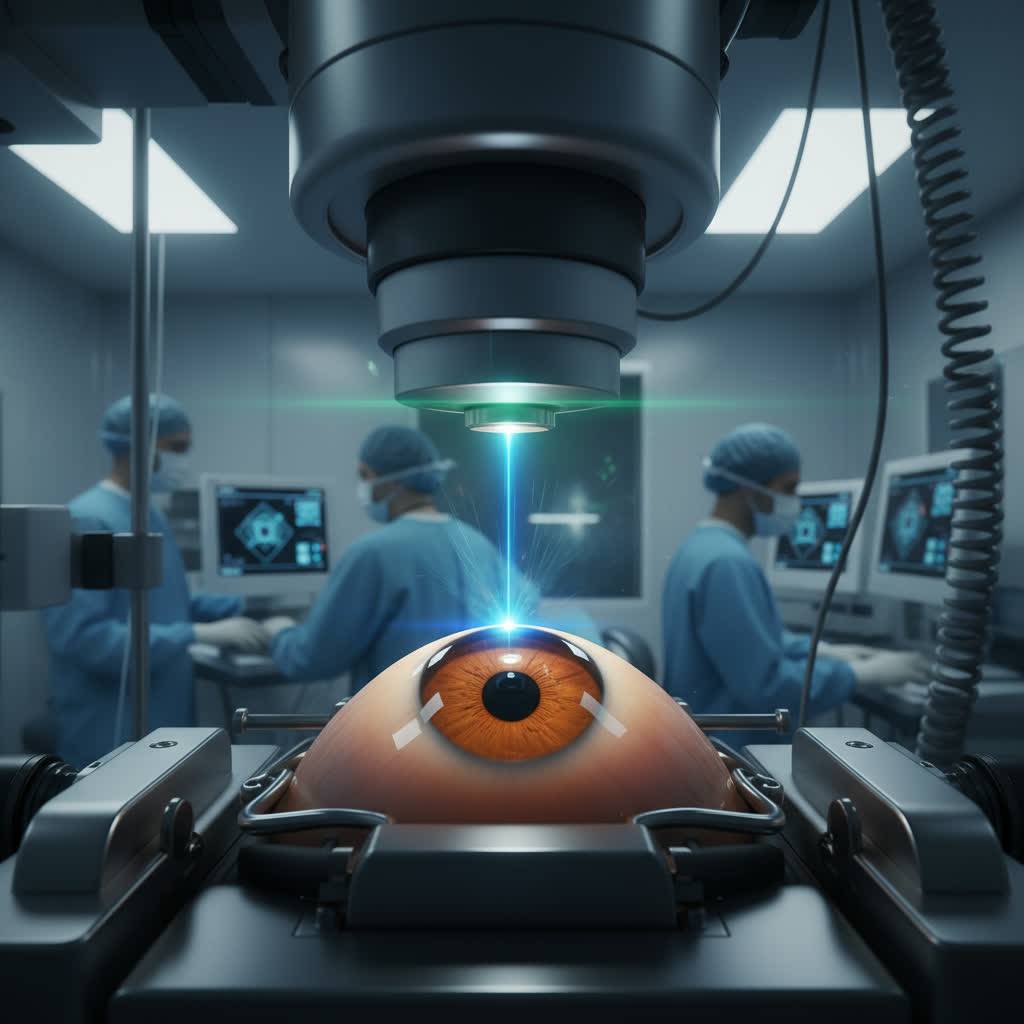







Femto-LASIK is a widely used form of laser vision correction for myopia, hyperopia, and astigmatism. Its main distinction from traditional LASIK is the way the corneal flap is created before the underlying cornea is reshaped.
Instead of using a mechanical microkeratome, Femto-LASIK uses a femtosecond laser to create the flap. This gives the surgeon greater control over its thickness, diameter, and geometry. However, Femto-LASIK is not automatically the newest or best procedure for every patient. SMILE, PRK, and customized laser treatments remain important alternatives.
At Safemedigo, the appropriate procedure is selected after evaluating corneal shape, thickness, ocular surface health, refractive error, and lifestyle rather than choosing a procedure by name alone.
How Does Femto-LASIK Work?
Femto-LASIK uses two different lasers with separate functions.
Creating the Corneal Flap
A femtosecond laser creates a thin flap within the front of the cornea using extremely short laser pulses.
The surgeon lifts this flap to expose the stromal tissue underneath.
Excimer Laser Correction
An excimer laser then reshapes the cornea according to the refractive error.
For myopia, tissue is removed to flatten the central cornea. Hyperopia and astigmatism require different ablation patterns.
The flap is then repositioned without stitches in most cases.
Fast Visual Recovery
One of LASIK's major practical advantages is rapid visual recovery.
Many patients notice substantial improvement within the first day or several days, although vision and ocular-surface comfort can continue to stabilize over the following weeks.
Femto-LASIK vs Traditional LASIK
The principal difference is how the flap is created.
Mechanical LASIK
Traditional LASIK uses a mechanical microkeratome to cut the corneal flap.
This technique has produced good outcomes for many years, but flap thickness can be less predictable than with modern femtosecond systems.
Greater Flap Predictability
Femtosecond technology allows more precise planning of flap thickness, diameter, and configuration.
Flap thickness is generally more predictable than with mechanical microkeratomes, providing greater control over how much stromal tissue remains after surgery.
This does not mean every Femto-LASIK patient will achieve better vision than every conventional-LASIK patient. Both techniques can provide excellent refractive outcomes with appropriate selection.
Why It Is Called Bladeless LASIK
Femto-LASIK is sometimes called bladeless LASIK because a mechanical blade is not used to create the flap.
It remains corneal surgery, however, and still creates a flap. “Bladeless” should therefore not be interpreted as risk-free.
Read about: LASIK vs Femto LASIK: How to Choose the Best Vision Correction
Why Some Surgeons Prefer Femto-LASIK
The main advantage is greater control over flap creation rather than simply using a more modern device.
Customized Flap Design
The intended flap thickness, diameter, hinge location, and other characteristics can be planned before treatment.
This can make the procedure more predictable and help preserve corneal tissue.
Fewer Mechanical-Flap Problems
Clinically significant femtosecond flap complications are generally uncommon, while several complications historically associated with mechanical flap creation occur less frequently with femtosecond technology.
Femto-LASIK also has unique potential events, including opaque bubble formation, suction loss, and interface inflammation, so it is not free of technique-specific complications.
Customized Laser Correction
Femto-LASIK can be combined with wavefront-guided or topography-guided excimer treatments when appropriate.
These systems can incorporate additional information about corneal shape or optical aberrations rather than correcting only the spectacle prescription.
Customized treatment is useful in selected patients but does not guarantee superior vision in everyone.

The Ideal Femto-LASIK Candidate
Good screening matters more than the name of the laser platform.
Stable Vision Prescription
The refractive error should be reasonably stable before surgery.
An eye that is still changing can develop additional myopia or astigmatism after an initially successful correction.
Corneal Shape and Thickness
Corneal thickness alone is not enough.
Topography and tomography help detect keratoconus and suspicious corneal patterns. Planning must also consider the amount of tissue removed, flap thickness, and the remaining structural cornea.
A relatively thin cornea does not always prevent laser correction, but PRK or another technique may sometimes be safer than LASIK.
Dry Eye and Pregnancy
Significant ocular-surface disease should be identified and treated before surgery because LASIK can temporarily worsen dry-eye symptoms and, in some patients, symptoms may persist.
Elective refractive surgery is also generally postponed during pregnancy and until pregnancy- and breastfeeding-related changes have settled and the prescription is stable.
Read about: Latest Femtolasik Techniques for Sensitive Eyes in Turkey
Femto-LASIK vs SMILE vs PRK
No refractive procedure is best for every eye.
Femto-LASIK vs SMILE
SMILE removes a small lenticule from within the cornea through a small incision rather than creating a large LASIK flap.
Both techniques provide excellent and broadly comparable outcomes for appropriately selected myopia and astigmatism. SMILE may cause less early dry eye and avoids flap-related complications, while Femto-LASIK generally provides faster visual recovery and greater flexibility for some customized treatments.
Femto-LASIK vs PRK
PRK reshapes the cornea without creating a flap.
Early visual recovery is slower and the first few days are generally less comfortable, but PRK preserves more of the anterior corneal structure and can be preferable in selected thin corneas or patients at higher risk of eye trauma.
Lifestyle Matters
Contact sports and occupations with a significant risk of direct eye injury may influence the choice of procedure because LASIK creates a permanent flap interface.
Flap-free options such as PRK or SMILE may therefore deserve consideration in selected patients.
Read about: Femtosecond LASIK: Turkey vs Germany
Risks and Expected Results
Femto-LASIK has excellent visual outcomes in suitable candidates, but no refractive procedure should be described as completely risk-free or guaranteed.
Dry Eye, Glare, and Halos
Temporary dryness, burning, foreign-body sensation, glare, halos, or altered night vision can occur.
Many symptoms improve over time, although persistent problems are possible in a minority of patients.
Flap-Related Complications
Microstriae, epithelial ingrowth, interface inflammation, and other flap events can occur.
A recent review involving more than 28,000 eyes found that visually significant long-term flap complications were uncommon, while several transient intraoperative and postoperative findings occurred more frequently and were usually manageable.
Corneal Ectasia
Post-LASIK ectasia is rare but important.
Risk increases with keratoconus or suspicious tomography, thin corneas, higher tissue removal, and inadequate residual stromal tissue. Detailed preoperative corneal assessment is therefore central to modern refractive-surgery safety.
Patients should also understand that the goal is to reduce dependence on glasses or contact lenses rather than guarantee perfect unaided vision for life. Presbyopia can still develop with age, and reading glasses may eventually be required.
Read about: LASIK Eye Surgery: Turkey vs USA
Conclusion
Femto-LASIK represents an important evolution of LASIK because a femtosecond laser replaces the mechanical blade for flap creation, providing greater control over flap thickness and geometry.
However, it is not automatically the best refractive procedure for every patient. SMILE may offer advantages for certain eyes, while PRK may be preferable when corneal structure or lifestyle makes a flap less desirable.
Frequently Asked Questions: Femto-LASIK
Is Femto-LASIK better than traditional LASIK?
It offers more predictable flap creation and avoids a mechanical blade, although both techniques can provide excellent visual outcomes in appropriate candidates.
Is Femto-LASIK painful?
Numbing drops are used. Patients may feel pressure during part of the procedure, followed by temporary burning, watering, or irritation afterward.
How quickly does vision improve?
Many patients notice significant improvement within the first day or several days, although full stabilization takes longer.
Does Femto-LASIK cause dry eye?
Dry-eye symptoms can occur or temporarily worsen after treatment, making preoperative ocular-surface assessment important.
Is Femto-LASIK better than SMILE?
Neither is universally superior. SMILE may offer less dry eye and no flap, while Femto-LASIK offers rapid recovery and greater flexibility for some customized corrections.