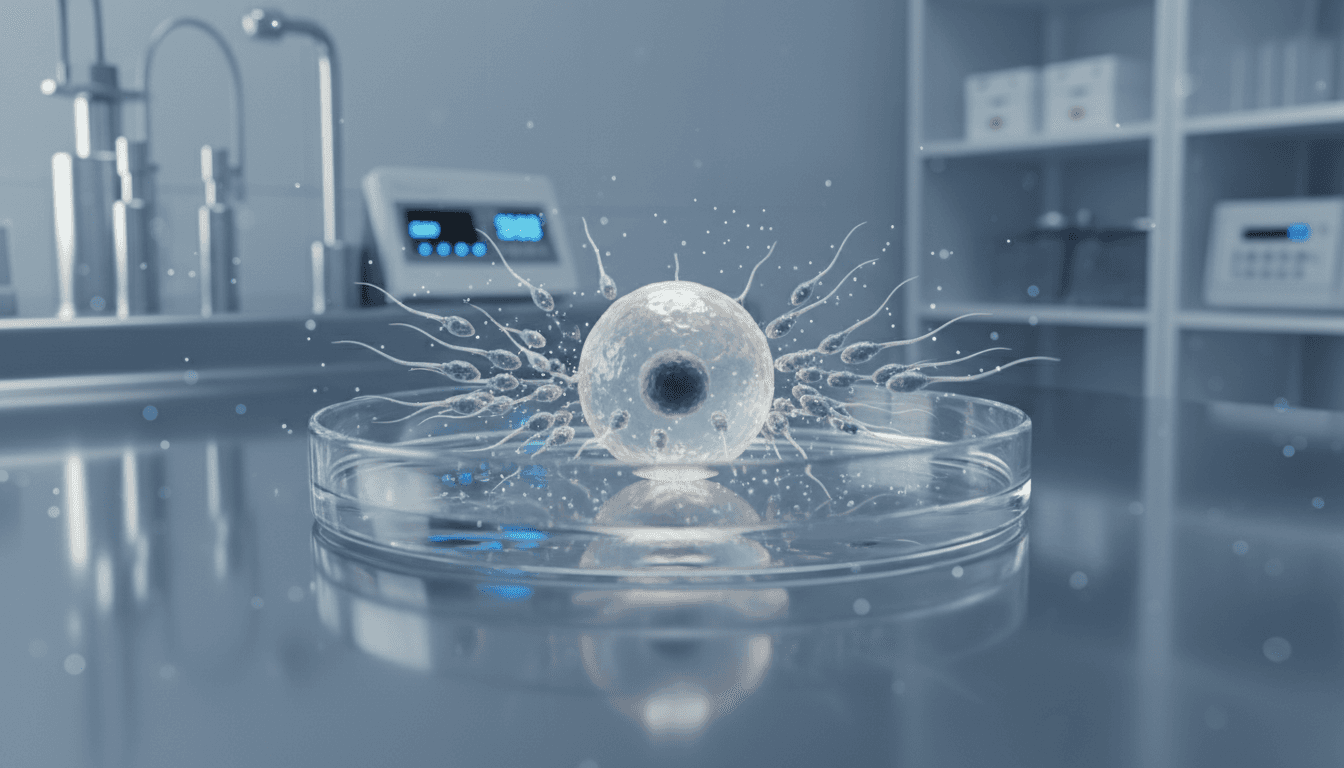



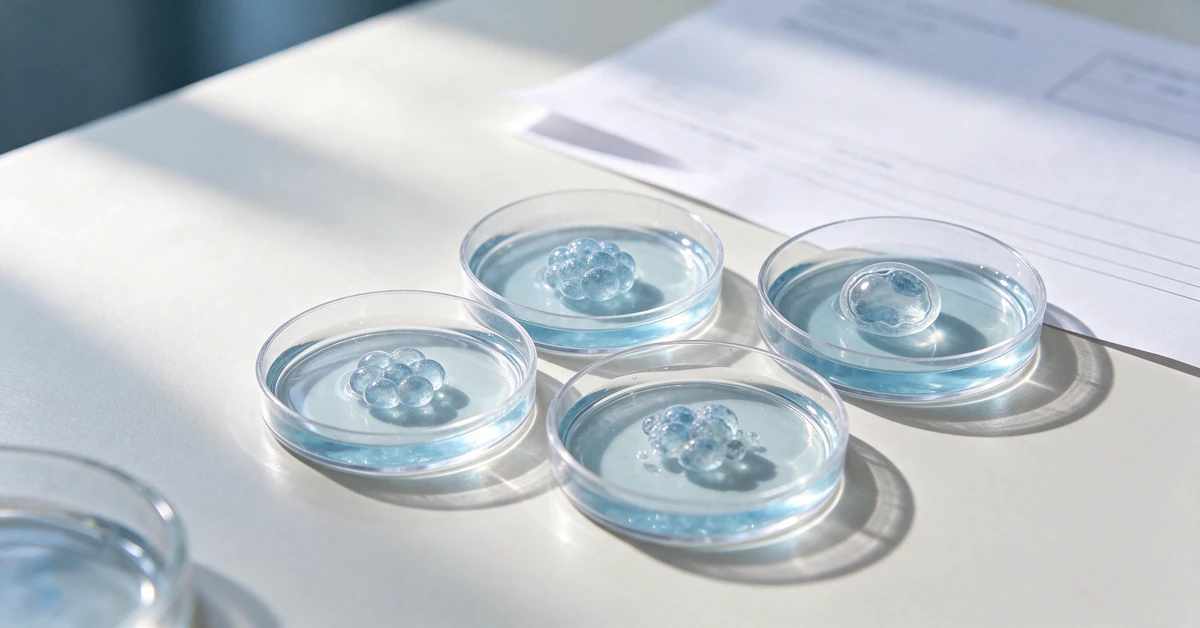
An IVF cycle may initially appear to be progressing well.
Eggs are retrieved.
Mature oocytes are identified.
Fertilization occurs.
Several embryos begin dividing.
Then development slows.
Some embryos stop on day 2 or 3.
Others compact but fail to become blastocysts on day 5 or 6.
This is known as preimplantation embryo developmental arrest.
Embryo arrest does not automatically mean the IVF laboratory made a mistake, nor does it prove that the problem always comes from the egg or always from the sperm.
Development from a fertilized oocyte to a blastocyst requires highly coordinated cell division, chromosome segregation, embryo-genome activation, energy production and cell communication.
Failure in any of these systems can prevent further development.
Fertilization Failure vs Embryo Arrest
These are different problems.
Fertilization Failure
The oocyte does not show normal fertilization after IVF or ICSI.
Read Safemedigo's guide to fertilization failure after ICSI.
Embryo Arrest
Fertilization occurred.
The embryo began to divide.
Development then stopped before reaching a later stage.
The problem therefore occurs after fertilization.
How Does a Normal Early Embryo Develop?
In broad terms:
Day 1: fertilization is assessed.
Day 2: cleavage divisions continue.
Day 3: many embryos are at the cleavage stage.
Day 4: compaction and morula formation occur.
Day 5–6: suitable embryos may become blastocysts.
Development is not perfectly synchronized between embryos.
Some viable blastocysts develop on day 6 rather than day 5.
Should Every Fertilized Egg Become a Blastocyst?
No.
Attrition between stages is expected.
The numbers normally decrease between:
Retrieved oocytes.
Mature oocytes.
Normally fertilized oocytes.
Cleavage-stage embryos.
Blastocysts.
Transferable or cryopreservable embryos.
Eight fertilized oocytes do not imply that eight blastocysts should develop.
What Exactly Does “Embryo Arrest” Mean?
An embryo is considered arrested when it stops showing appropriate developmental progression.
Arrest may occur:
Before the four-cell stage.
Between four and eight cells.
During morula formation.
Or during blastocyst development.
Some embryos may develop slowly rather than being permanently arrested, so embryologists assess progression over time rather than judging from a single image.
Why Are the First Cell Divisions So Important?
Early embryonic divisions require chromosomes to be distributed accurately into daughter cells.
Major 2026 research showed that early human embryonic mitotic divisions can be particularly vulnerable to abnormalities involving spindle organisation and chromosome segregation.
These errors can produce:
Abnormal chromosome distribution.
Micronuclei.
Multipolar divisions.
Loss of cellular viability.
Developmental arrest.
An embryo may therefore look reasonably normal initially but lose developmental competence during the next divisions.
What Happens Around Day 3?
During the earliest stages, the embryo relies heavily on molecules, proteins and RNA that were stored inside the oocyte.
Later, control increasingly shifts toward the embryo's own genome.
This transition is known as embryonic genome activation.
Failure to activate or coordinate the embryonic genetic program appropriately may contribute to developmental arrest around the cleavage or post-cleavage stages.
How Important Is the Egg?
The oocyte contributes much more than half of the chromosomes.
It also provides:
Mitochondria.
Energy-related machinery.
Proteins controlling cell division.
Spindle-regulating factors.
Maternal RNA and molecular machinery needed before embryonic genome activation.
Oocyte competence therefore has a major influence on early embryo development.
How Does Female Age Affect Embryo Development?
With increasing oocyte age, chromosome abnormalities and mitotic problems become more common.
Blastocyst development and the proportion of chromosomally suitable embryos generally decline with age.
However, age is a probability factor rather than a verdict on an individual embryo.
Young patients can also experience embryo arrest.
Does Low AMH Cause Embryo Arrest?
Not directly.
AMH mainly predicts ovarian response and the expected number of recruitable follicles.
A patient with diminished ovarian reserve may obtain fewer oocytes and therefore fewer embryos from which a blastocyst can emerge.
Low AMH alone does not prove poor embryo developmental competence.
Are Immature Eggs the Same Problem?
No.
An immature oocyte has been retrieved but has not reached the expected maturation stage.
An arrested embryo has already fertilized and begun developing.
However, underlying oocyte competence can influence both maturation and subsequent embryonic development.
Read Safemedigo's guide to immature eggs in IVF.
Can Sperm Affect Embryo Development After Fertilization?
Yes.
Sperm contributes half of the embryo's nuclear DNA, and paternal DNA integrity may influence development after fertilization.
Recent studies have associated elevated sperm DNA fragmentation with modestly poorer day-3 embryo development and reduced blastocyst formation.
However, the association is not absolute.
Sperm DNA fragmentation cannot independently predict what will happen to every embryo.

When Might Sperm DNA Fragmentation Testing Be Considered?
It may be discussed in selected contexts such as:
Repeated poor embryo development.
Recurrent pregnancy loss.
Clear male-factor infertility.
Selected varicocele cases.
Repeated unexplained ART failure.
It should not automatically be assumed that every case of embryo arrest is caused by sperm DNA damage.
Read more about sperm DNA fragmentation testing.
Does ICSI Prevent Embryo Arrest?
No.
ICSI helps sperm enter the oocyte.
It can overcome selected fertilization barriers.
Once fertilization has occurred, however, the embryo still requires sufficient biological competence to continue dividing.
ICSI cannot correct chromosome segregation errors, intrinsic embryo abnormalities or defective cell-division machinery.
Normal fertilization after ICSI can therefore still be followed by embryo arrest.
Should Conventional IVF Be Changed to ICSI Next Time?
Not automatically.
If embryo development failed after successful fertilization, changing to ICSI does not guarantee better blastocyst formation.
ICSI may be appropriate if there is an independent male-factor or fertilization indication.
It should not be treated as a universal solution for post-fertilization arrest.
Are Chromosome Abnormalities Always the Main Cause?
No.
Chromosome biology is important, but embryo arrest is more complex.
A major 2026 review highlighted early mitotic errors, chromosome segregation defects and abnormal cleavage patterns as contributors to developmental arrest.
It also noted that meiotic aneuploidy does not explain all in-vitro arrest and may instead manifest later as implantation failure or miscarriage.
Other mechanisms include maternal-effect genes, cellular stress, metabolic dysfunction and impaired developmental signalling.
Can an Aneuploid Embryo Still Reach Blastocyst?
Yes.
Many chromosomally abnormal embryos are capable of reaching the blastocyst stage.
Conversely, an embryo that arrests before blastocyst is not necessarily explained by a single chromosome abnormality.
Developmental competence and chromosome status overlap, but they are not identical concepts.
What About Rare Genetic Causes?
Rare variants affecting maternal-effect genes, cell division or early embryonic development can produce severe recurrent developmental arrest.
They become more relevant when:
The problem occurs repeatedly.
Many mature oocytes fertilize normally.
Most or all embryos stop at a similar stage.
Common explanations do not adequately account for the pattern.
Broad genetic testing is not normally the first step after one affected cycle.
Can the IVF Laboratory Cause Embryo Arrest?
Laboratory conditions can influence embryo development.
Embryos are sensitive to:
Temperature.
pH.
Gas concentrations.
Oxygen tension.
Osmolality.
Culture-medium quality.
Handling outside the incubator.
ESHRE's 2026 good-practice recommendations for IVF laboratories emphasize minimizing fluctuations in temperature, pH and osmolality and systematically monitoring incubator gas concentrations and culture conditions.
Does Embryo Arrest Prove the Laboratory Is Poor?
No.
Even excellent IVF laboratories do not produce blastocysts from every fertilized oocyte.
Biological attrition is expected.
Laboratory quality becomes a more reasonable question when unexpectedly poor development is seen repeatedly or when a laboratory's overall performance indicators fall outside appropriate benchmarks.
Quality programs should monitor outcomes including:
Fertilization rates.
Cleavage rates.
Blastocyst formation.
Cryopreservation outcomes.
Pregnancy outcomes.
Equipment and environmental performance.
Does the Incubator Brand Matter?
The goal is a stable, validated culture environment.
There is no evidence that one commercial incubator name can prevent embryo arrest in every patient.
What matters more is:
Stable temperature.
Controlled gases.
Appropriate oxygen.
Minimal disturbance.
Equipment validation.
Quality control.
What About Time-Lapse Incubators?
Time-lapse systems allow embryos to be monitored repeatedly without frequent removal from the incubator.
They can reveal unusual division patterns and provide detailed developmental timing.
However, time-lapse imaging does not treat an embryo.
It is an observation and selection tool rather than a method that guarantees blastocyst development.
Is One Type of Culture Medium Better?
Laboratories should use validated media suitable for human embryo development.
However, ESHRE's 2026 laboratory guidance states that current evidence is insufficient to conclude that sequential culture media are universally superior to single-step media, or vice versa, for ongoing pregnancy, live birth or neonatal outcomes.
Culture medium choice therefore cannot be used as a simplistic explanation for every arrested embryo.
Why Do Some Embryos Stop on Day 2?
Very early arrest may reflect problems involving:
Initial mitotic divisions.
Spindle formation.
Chromosome segregation.
Oocyte-derived molecular machinery.
The biological problem may have begun before or during the first embryonic division.
Why Do Embryos Arrest Around Day 3?
Around this period, embryonic genome activation becomes increasingly important.
Development may fail if there are problems with:
Gene activation.
Cell division.
Energy metabolism.
Chromosome organisation.
Cellular communication.
It is incorrect to say that day-3 arrest automatically proves a sperm problem.
Why Do Some Embryos Stop on Day 4?
Day 4 involves compaction and morula formation.
Cells must reorganize, adhere and communicate in a coordinated way.
An embryo can successfully complete its earliest cleavage divisions but still fail during this architectural transition.
Why Can an Embryo Reach Morula but Not Become a Blastocyst?
Blastocyst formation requires:
Cavity formation.
Differentiation of the inner cell mass.
Development of trophectoderm.
Fluid transport.
Cell polarity.
Strong intercellular junctions.
Recent 2026 research suggests that some later developmental arrest is associated with cellular stress pathways and impaired expression of proteins involved in junction formation and cell polarity, rather than simply chromosome missegregation.
Is Growing Every Embryo to Day 5 Always Better?
No.
Blastocyst culture has important advantages.
It provides additional biological selection and can produce higher implantation and live-birth rates per fresh transfer in good-prognosis patients.
However, extended culture also increases the chance that no embryo remains available for transfer.
The 2026 Cochrane review found that blastocyst-stage transfer probably improves live birth per fresh transfer, but it also increases failure-to-transfer rates and reduces the number of patients with surplus embryos available for cryopreservation.
Does Day-3 Transfer Prevent Embryo Arrest?
Not necessarily.
Moving an embryo into the uterus on day 3 does not correct an intrinsic developmental defect.
If an embryo lacks the biological competence to continue, transfer does not guarantee that it will progress in vivo.
However, in a patient with very few embryos, cleavage-stage transfer may reduce the risk of ending the treatment cycle with no embryo transfer at all.
That is a strategic decision, not a biological rescue treatment.
Read Safemedigo's guide to day-3 versus day-5 embryo transfer.
Is Blastocyst Transfer Better for Every Patient?
No.
A 2026 meta-analysis found that cumulative live-birth outcomes from blastocyst-stage and cleavage-stage strategies were broadly comparable overall, although blastocyst transfer can provide advantages in selected good-prognosis populations.
The best strategy therefore depends on:
Embryo number.
Day-3 embryo quality.
Female age.
Previous cycle history.
Laboratory performance.
Cryopreservation strategy.
What if There Is Only One Embryo on Day 3?
The advantage of extended culture as a selection method becomes smaller when there is only one embryo to select from.
Some clinics may consider cleavage-stage transfer.
Others may continue culture according to their laboratory results and treatment strategy.
There is no universal answer for every patient.
What if There Are Eight Good Day-3 Embryos?
When several embryos are developing, extended culture can be particularly useful because it provides additional information about which embryos continue to blastocyst.
Patients should nevertheless expect attrition in embryo number between day 3 and day 5–6.
Can Day-3 Grading Predict Blastocyst Formation?
It helps, but prediction is imperfect.
Embryologists assess factors such as:
Cell number.
Cell symmetry.
Fragmentation.
Multinucleation.
Division timing.
Some excellent-looking day-3 embryos arrest later.
Some average-looking embryos become good blastocysts.
What Does Blastocyst Grading Tell Us?
Blastocyst assessment generally considers:
Expansion.
Inner cell mass.
Trophectoderm.
Morphology helps rank embryos, but it does not directly prove chromosome normality or guarantee a live birth.
Read Safemedigo's embryo grading guide.
Can PGT-A Explain Why an Embryo Arrested?
Usually not.
Standard PGT-A requires an embryo to reach a suitable blastocyst stage for biopsy.
Embryos that arrest earlier cannot usually be tested in the routine way.
PGT-A therefore cannot directly explain why every non-blastulating embryo stopped developing.
Can an Arrested Embryo Be “Restarted”?
There is currently no established clinical treatment that reliably restarts permanently arrested human embryos.
Research is investigating chromosome segregation, cellular stress, mitotic control and metabolism.
These experimental findings should not be confused with proven clinical therapies.
Patients should be cautious about claims that a supplement or laboratory additive can guarantee recovery of arrested embryos.
Does Changing the Stimulation Protocol Fix Embryo Arrest?
Not necessarily.
A major 2026 study evaluated patients who had complete embryo developmental arrest in one cycle and returned for another IVF cycle.
Previous complete arrest was associated with lower blastocyst formation in the next cycle.
However, changing the stimulation protocol or trigger type was not associated with a significant improvement in blastulation.
Simply changing medication is therefore not a proven solution.
Does Previous Complete Arrest Mean the Next Cycle Will Fail?
No.
Many patients with zero blastocysts in one cycle did produce blastocysts in a subsequent cycle.
However, their average risk of another cycle without blastocyst formation remained higher than in patients who had previously produced blastocysts.
Previous arrest is therefore prognostic information, not a certainty.
What Should Be Reviewed After Complete Embryo Arrest?
Do not settle for the statement “the embryos stopped.”
Ask for the complete embryology timeline:
Number of oocytes retrieved.
Number of mature oocytes.
Normally fertilized oocytes.
Day-2 and day-3 embryo numbers.
Embryo grades.
When development slowed.
How many reached morula.
Whether any formed an early blastocyst.
Fertilization method.
Abnormal cleavage observations.
This helps identify where developmental attrition occurred.
What Should Be Reviewed on the Female Side?
Depending on the case:
Female age.
Ovarian reserve.
Ovarian response.
Oocyte maturity.
Previous stimulation history.
But embryo arrest should not automatically be labelled “poor egg quality” without considering the full picture.
What Should Be Reviewed on the Male Side?
Basic semen analysis.
Severity of male-factor infertility.
Fertilization pattern.
In selected recurrent cases, sperm DNA fragmentation or a broader andrology assessment may be reasonable.
Not every advanced sperm test is necessary after one cycle.
Should Testicular Sperm Be Used Because Embryos Arrested?
Not routinely.
Surgically retrieved sperm is not a standard treatment for embryo arrest.
It may have a role in narrowly selected male-factor situations, but embryo arrest alone is not sufficient reason to proceed directly to testicular sperm retrieval.
Do Supplements Improve Blastocyst Formation?
Correcting genuine deficiencies and improving general health before treatment can be appropriate.
However, no supplement can guarantee that a biologically incompetent embryo will become a blastocyst.
Claims that a vitamin or proprietary protocol can prevent all embryo arrest should be treated cautiously.
Should We Change IVF Laboratories?
Not automatically after one cycle.
Before changing centres, review:
Was fertilization normal?
Did all embryos arrest or only some?
Has the pattern occurred before?
How does the laboratory monitor blastocyst formation and quality indicators?
Were there any unusual technical events?
Repeated unexpectedly poor outcomes may justify an independent embryology review.
When Is Deeper Investigation Reasonable?
A broader evaluation becomes more reasonable when:
Most or all embryos arrest repeatedly.
There are several normally fertilized embryos in each cycle.
Arrest repeatedly occurs at a similar developmental stage.
Age and severe male-factor infertility do not adequately explain the pattern.
There is a suggestive reproductive or family history.
In such situations, specialist genetic or reproductive evaluation may be considered.
Questions to Ask After an Arrested-Embryo Cycle
Ask:
How many oocytes were mature?
How many fertilized normally?
At what stage did each embryo slow or stop?
Was arrest mainly before or after day 3?
Were abnormal cleavage patterns observed?
Did any embryo reach morula or early blastocyst?
Is additional male-factor assessment justified?
Would changing fertilization method have a real indication?
If embryo numbers are low next time, should day-3 transfer be considered?
Are the laboratory's development rates within expected quality benchmarks?
What exactly would you change in the next cycle, and why?
Conclusion
Embryo arrest is different from fertilization failure.
In embryo arrest, fertilization occurs and development begins, but some embryos are unable to complete the journey to blastocyst.
Major 2026 research shows that the mechanisms are complex and can involve early mitotic errors, abnormal chromosome segregation, impaired embryonic genome activation, oocyte-derived molecular factors, rare genetic abnormalities and cellular stress during later development.
Male factors, including sperm DNA fragmentation, can contribute in selected patients but do not explain all cases.
Laboratory conditions also matter, which is why ESHRE's 2026 laboratory recommendations emphasize strict control of temperature, pH, osmolality and incubator gas conditions.
However, embryo arrest in one IVF cycle does not prove laboratory failure.
Blastocyst culture offers stronger embryo selection and higher live birth per fresh transfer in many good-prognosis patients, but it also increases the risk that no embryo remains for transfer.
This is why day-3 transfer can still be a reasonable strategy in selected patients with very few embryos, while extended blastocyst culture may be more informative when several embryos are available.
If fertilization occurred normally but most embryos stopped before reaching blastocyst, you can book a consultation with Safemedigo on WhatsApp to review the complete embryology timeline, oocyte maturity, male factors, fertilization method and the changes that are actually justified for the next IVF cycle.
Frequently Asked Questions
Does day-3 embryo arrest mean the sperm is the cause?
No. Oocyte, sperm, chromosome, mitotic and developmental factors can all contribute, and the day of arrest does not identify the cause by itself.
Can day-3 transfer stop an embryo from arresting?
Not necessarily. Cleavage-stage transfer may be strategically useful when embryo numbers are low, but it cannot correct an intrinsic developmental defect.
Should every fertilized egg become a blastocyst?
No. Developmental attrition between fertilization and blastocyst is expected.
Will changing the stimulation protocol prevent embryo arrest next time?
Not necessarily. 2026 data found no clear improvement in blastulation simply from changing stimulation or trigger after previous complete arrest.
Can the next IVF cycle succeed after all embryos arrested?
Yes. Many patients subsequently form blastocysts, although previous complete arrest is associated with a higher risk of poor blastulation in a later cycle.