






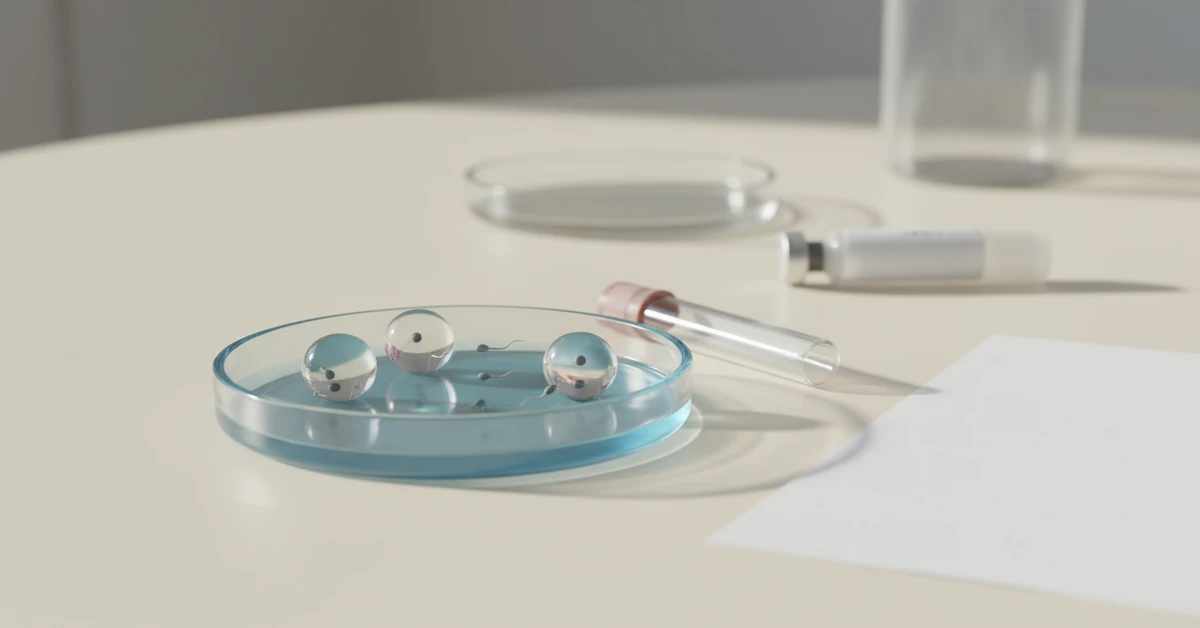
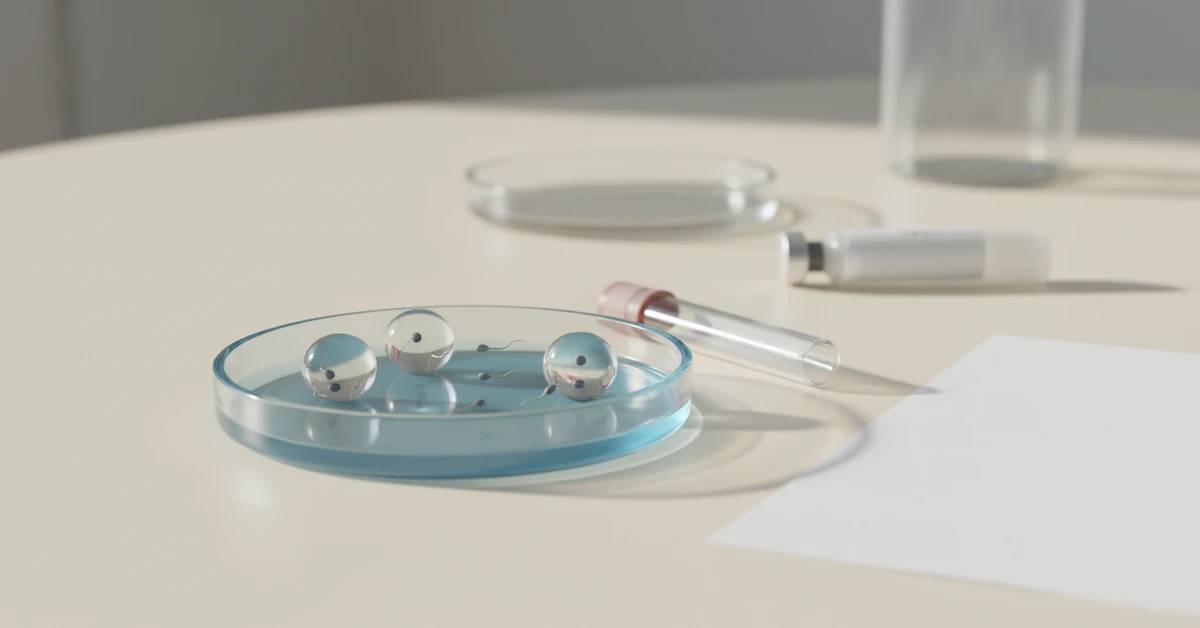
After egg retrieval and ICSI, one of the most anticipated laboratory updates is the number of eggs that fertilized normally.
In most cycles, a proportion of mature oocytes fertilize.
Occasionally, however, very few fertilize or none fertilize at all.
This is known as fertilization failure after ICSI.
The immediate question is understandable:
How can fertilization fail when the sperm was injected directly into the egg?
ICSI bypasses sperm penetration of the zona pellucida and oocyte membrane, but successful fertilization still requires a complex biological sequence after sperm injection.
The oocyte must activate.
Meiosis must resume.
The sperm nucleus must decondense.
Male and female pronuclei must form.
Only then can normal embryonic development begin.
A problem at any of these stages can result in fertilization failure.
What Does Normal Fertilization Look Like After ICSI?
The embryology laboratory usually checks injected mature oocytes the following day.
Normal fertilization is classically identified by two pronuclei, commonly reported as 2PN.
One pronucleus contains maternal genetic material and the other paternal genetic material.
A 2PN zygote has fertilized normally.
However, fertilization does not guarantee normal embryo development.
An embryo can fertilize normally and later arrest, or it can continue to a cleavage-stage embryo or blastocyst with varying morphology.
Safemedigo's embryo grading guide explains how embryo development is assessed after fertilization.
What Is Total Fertilization Failure?
Total fertilization failure means that none of the mature oocytes injected by ICSI show normal 2PN fertilization.
This is different from low fertilization, in which some eggs fertilize but the percentage is substantially lower than expected.
The distinction matters because a history of complete or very low fertilization can change management in a subsequent cycle.
ESHRE's 2026 good-practice recommendations for IVF laboratories specifically distinguish complete activation failure from very low fertilization and identify these as situations in which additional strategies may be considered.
Why Does ICSI Not Guarantee Fertilization?
Injecting sperm into the oocyte is only one part of fertilization.
After injection, the sperm normally triggers repeated rises in intracellular calcium.
These signals activate the oocyte and allow it to:
Resume meiosis.
Extrude the second polar body.
Form the female pronucleus.
Decondense sperm chromatin.
Form the male pronucleus.
Prepare for the first embryonic division.
If oocyte activation does not occur, the sperm may be present inside the oocyte without normal fertilization taking place.
What Are the Main Causes?
Fertilization failure can broadly involve:
Oocyte maturity.
Oocyte-related biological factors.
Sperm-related activation defects.
Failure of oocyte activation.
Rare technical or laboratory factors.
In many individual cycles, a single definitive cause cannot be identified.
A 2026 study examining total fertilization failure and embryo developmental arrest after ICSI reinforced the multifactorial nature of these outcomes.
Can Immature Oocytes Explain the Result?
Yes.
The number of eggs retrieved is not the same as the number of mature eggs available for ICSI.
ICSI should normally be performed on mature metaphase-II oocytes.
ESHRE's current laboratory recommendations state that only mature oocytes should be injected.
Therefore, when a patient hears:
“Ten eggs were retrieved and only two fertilized,”
an important question is:
How many of the ten were actually mature and injected?
If only three were mature, the interpretation is completely different.
Why Might Oocyte Maturity Be Low?
Possible contributing factors include:
Follicular development.
Follicle sizes at trigger.
Trigger timing.
Type of final maturation trigger.
Time between trigger and egg retrieval.
Ovarian response.
Individual oocyte biology.
When repeated cycles produce a high proportion of immature oocytes, the stimulation and final-maturation strategy deserves detailed review.
Does Female Age Matter?
Age can influence oocyte biological competence.
With advancing maternal age, abnormalities in meiotic spindle organisation and chromosome alignment become more frequent.
A study examining oocytes that failed to fertilize after ICSI found more spindle and chromosome abnormalities in oocytes from older women and identified failed oocyte activation as a major mechanism of fertilization failure.
Age, however, does not explain every case.
What Is Oocyte Activation Failure?
Following sperm entry, the oocyte requires activation.
One of the key sperm-derived factors involved in this process is phospholipase C zeta, or PLCζ.
PLCζ helps initiate the calcium oscillations required for oocyte activation.
When this system is deficient, the sperm may enter the oocyte but fail to trigger normal fertilization.
This has become one of the best-described mechanisms of total fertilization failure after ICSI.
Is the Problem Always Sperm-Related?
No.
Failure can arise from the sperm, the oocyte or an interaction between both.
A sperm cell may fail to provide an adequate activating signal.
Alternatively, the oocyte may fail to respond normally to that signal.
This is why neither partner should automatically be assigned “the cause” after one failed cycle.
What Is PLCζ?
PLCζ is a sperm-specific protein involved in initiating calcium oscillations after sperm-oocyte fusion or injection.
Abnormal quantity, localisation or function of this protein can impair oocyte activation.
Research continues to identify genetic variants affecting PLCζ. A 2026 study described a PLCζ variant associated with fertilization failure through insufficient functional protein.
PLCζ testing, however, remains specialised and is not routine in every fertility laboratory.
Can Sperm Morphology Be Relevant?
In selected conditions, yes.
A particularly important example is globozoospermia, in which sperm have abnormally round heads and may lack key activation factors.
ESHRE specifically identifies globozoospermia as one of the situations in which artificial oocyte activation can be considered.
Routine low morphology on a standard semen analysis does not automatically mean that oocyte activation will fail.
For a broader explanation of sperm count, motility, morphology and vitality, see Safemedigo's semen analysis guide.
Does Sperm DNA Fragmentation Cause Fertilization Failure?
Not necessarily.
Sperm DNA fragmentation can be relevant to male fertility and assisted reproduction, but it is not the universal explanation for fertilization failure after ICSI.
Some sperm with elevated DNA fragmentation can still fertilize an oocyte, with potential effects appearing later in embryo development or pregnancy.
Sperm DNA fragmentation testing should therefore not automatically be ordered after every fertilization failure.
Read more in Safemedigo's sperm DNA fragmentation guide.
Can the Oocyte Be Responsible Even When It Looks Normal?
Yes.
External morphology cannot show every aspect of oocyte function.
An apparently mature oocyte can still have abnormalities involving:
Meiotic spindle organisation.
Chromosome alignment.
Calcium signalling.
Activation pathways.
Completion of meiosis.
Rare genetic variants involving genes such as WEE2, PATL2, TUBB8 and others have been associated with fertilization or oocyte-maturation failure.
These genetic tests are not routine after one unsuccessful cycle.

Could the ICSI Procedure Itself Be Responsible?
Technical factors are possible, but they should be interpreted carefully.
Good ICSI practice includes:
Injecting mature oocytes.
Selecting viable sperm.
Appropriate sperm immobilisation.
Correct positioning of the oocyte.
Ensuring oolemma rupture.
Minimising inappropriate medium injection.
Maintaining suitable temperature and pH.
ESHRE's 2026 laboratory recommendations specifically address these technical points.
One failed cycle does not, by itself, demonstrate a laboratory error.
What Should the Embryology Laboratory Review?
A useful post-cycle review includes:
Number of oocytes retrieved.
Number of mature MII oocytes.
Number actually injected.
Oocyte morphology.
Any unusual resistance or fragility during injection.
Sperm source and vitality.
Any technical difficulties.
Number showing 2PN.
Any abnormal fertilization patterns.
This helps determine whether the pattern is more compatible with oocyte maturity, activation failure or another problem.
What Is Artificial Oocyte Activation?
Artificial oocyte activation, or AOA, is an additional laboratory procedure used after ICSI to induce the calcium signal that normally activates the oocyte.
The most common clinical approaches use calcium ionophores.
The intention is to compensate for inadequate physiological activation.
AOA is not a routine part of standard ICSI.
When Can AOA Be Considered?
ESHRE's updated 2026 good-practice recommendations state that artificial oocyte activation is not recommended for routine clinical use.
However, it is recommended for selected situations including:
Previous complete activation failure with 0% 2PN fertilization.
Very low fertilization, below approximately 30%.
Globozoospermia.
The purpose is to target patients with a demonstrated fertilization problem rather than adding AOA to every ICSI cycle.
Does AOA Guarantee Fertilization?
No.
AOA can only address certain activation defects.
It cannot correct every abnormality within an oocyte or sperm cell.
If the primary problem is severe oocyte dysfunction or another developmental abnormality, calcium ionophore activation may not solve the problem.
Does AOA Improve Outcomes?
Evidence suggests potential benefit in selected patients but should be interpreted carefully.
A recent meta-analysis of 21 studies found that calcium-ionophore AOA in patients with previous fertilization failure was associated with higher fertilization, clinical pregnancy and live-birth rates. However, study protocols varied and the authors called for additional randomised evidence before universal adoption.
Another systematic review including more than 56,000 mature oocytes found the clearest potential benefit in fertilization rates among patients with previous absent or low fertilization. Evidence for improved downstream clinical outcomes became less convincing when analyses were restricted to higher-quality studies.
This is why AOA remains a targeted intervention rather than a routine IVF add-on.
Is AOA Safe?
Available data are generally reassuring but long-term evidence is more limited than fertilization data.
A recent meta-analysis did not identify clear increases in adverse perinatal outcomes or congenital malformations, while also noting moderate-to-high risk of bias in parts of the evidence.
A large 2026 retrospective analysis of approximately 1,300 couples undergoing ICSI-AOA also reported no major new health concerns among resulting children during available follow-up.
Ongoing long-term monitoring remains appropriate.
Is Special Testing Needed Before AOA?
Not always.
Specialised testing of PLCζ or sperm-oocyte activation capacity exists mainly in selected or research settings.
For many patients, a documented history of complete or severe fertilization failure is the most important clinical evidence supporting consideration of AOA.
What if Only One or Two Eggs Fertilized?
This is low fertilization rather than total fertilization failure.
The denominator matters.
One fertilized oocyte out of two mature injected oocytes is very different from one fertilized oocyte out of ten mature injected oocytes.
Fertilization rate should therefore be calculated from mature injected oocytes, not from all retrieved eggs.
What Fertilization Rate Is Considered Very Low?
There is no universal single cutoff for every laboratory.
However, ESHRE identifies fertilization below approximately 30% as one situation in which AOA may be considered after previous ICSI.
This does not mean 29% always requires treatment or that 31% is automatically normal.
What if Only One Mature Oocyte Was Available?
A failure involving one mature oocyte is much harder to interpret than failure involving many mature oocytes.
One oocyte may simply fail by chance.
Repeated failure across several mature oocytes provides stronger evidence that a recurring activation or gamete problem may exist.
Should the Stimulation Protocol Be Changed Next Time?
Sometimes.
A protocol review is particularly important if the previous cycle showed:
A high proportion of immature oocytes.
Markedly asynchronous follicles.
Unexpected ovarian response.
Possible trigger-timing problems.
The physician may reconsider:
Medication doses.
Trigger type.
Trigger timing.
Interval between trigger and retrieval.
However, if many mature oocytes were injected and failed to activate, changing ovarian stimulation alone may not solve the problem.
Should the Male Partner Be Reassessed?
In selected cases, yes.
The team may review:
Semen analysis.
Sperm vitality.
Morphology.
The sample used on retrieval day.
Relevant medical history.
Additional male-factor investigations when clinically indicated.
Safemedigo's semen analysis guide can help explain the basic parameters.
Is Genetic Testing Needed?
Not after every failed cycle.
Genetic assessment may be discussed when there is:
Repeated total fertilization failure.
Repeated oocyte-maturation failure.
A severe unusual sperm phenotype.
A suggestive family or medical history.
Rare variants affecting oocyte activation and maturation have been identified, but this remains a specialised area rather than first-line testing for most couples.
Does One Failed Cycle Mean It Will Happen Again?
No.
A poor cycle can occur by chance, particularly when only a small number of mature oocytes were available.
The concern becomes greater when several mature oocytes all fail to fertilize or when the same pattern repeats in another cycle.
At that point, detailed review before repeating the same strategy is important.
Should ICSI Be Used Again?
Often yes, but the next strategy may be modified.
Options can include:
ICSI after adjusting stimulation or trigger timing.
ICSI with AOA in appropriately selected patients.
Further male-factor evaluation.
Further assessment of oocyte maturity or rare recurrent causes.
The key is not to repeat the previous cycle without understanding what happened.
What if Fertilization Occurred but Embryos Later Stopped Developing?
That is a different clinical problem.
If 2PN fertilization occurred and embryos subsequently arrested, this is embryo developmental arrest, not fertilization failure.
Possible mechanisms include gamete quality, chromosomal abnormalities and early developmental processes.
Embryo morphology alone cannot identify the exact cause.
Safemedigo's embryo grading guide explains the difference between fertilization and later embryo assessment.
What Information Should You Request From the Embryology Laboratory?
Ask for:
Total oocytes retrieved.
Number of mature MII oocytes.
Number injected.
Number with normal 2PN fertilization.
Any comments about oocyte morphology.
Any unusual injection findings.
Sperm vitality and source.
Whether failure was total or partial.
A detailed embryology report is much more useful than simply hearing that “the eggs did not fertilize.”
A Logical Plan After Fertilization Failure
The next-cycle discussion may include:
Review the embryology report
Clarify exactly how many mature oocytes were injected.
Review stimulation and trigger timing
Especially if oocyte maturity was poor.
Reassess sperm factors
When the sample or male history raises concerns.
Consider activation failure
Particularly when several mature oocytes had 0% fertilization.
Consider AOA selectively
When the clinical indication fits current guidance.
Escalate to specialised or genetic evaluation only when the pattern is recurrent or unusual
This avoids unnecessary testing after a single unexpected cycle.
Common Mistakes After One Failed Cycle
Avoid immediately assuming:
All oocytes are poor quality.
All sperm are defective.
Pregnancy is impossible.
Every supplement available is needed.
All advanced laboratory tests should be ordered.
AOA will definitely solve the next cycle.
One cycle provides information, but it does not always identify one definitive cause.
Questions to Ask Your Fertility Team
Ask:
How many oocytes were mature?
How many were actually injected?
How many had normal 2PN fertilization?
Was oocyte maturity a problem?
Did the embryologist note unusual oocyte characteristics?
Was sperm vitality satisfactory?
Does the pattern suggest oocyte activation failure?
Should stimulation or trigger timing change?
Would AOA be appropriate in another cycle?
Is any additional male, female or genetic evaluation justified?
Conclusion
Fertilization failure after ICSI does not necessarily mean that sperm injection itself failed.
After sperm enters the oocyte, a highly coordinated sequence of calcium signalling, oocyte activation, meiotic completion and pronuclear formation must occur.
Failure can involve:
Oocyte maturity.
Oocyte activation pathways.
Sperm activation capacity.
Rare technical factors.
Or a combination of mechanisms.
ESHRE's 2026 laboratory recommendations state that artificial oocyte activation should not be used routinely but can be considered after previous complete activation failure, very low fertilization or globozoospermia.
Recent meta-analyses suggest that calcium-ionophore activation can improve fertilization in appropriately selected patients with previous fertilization failure, while uncertainty remains regarding the strength of evidence for some later reproductive outcomes.
The most useful next step after a failed cycle is therefore a detailed review of the previous stimulation, oocyte maturity, sperm sample and embryology report before repeating treatment.
If you have experienced total or very low fertilization after ICSI, you can book a consultation with Safemedigo on WhatsApp to review the embryology report and discuss the next treatment strategy.
Frequently Asked Questions
Does zero fertilization after ICSI mean pregnancy is impossible?
No. The cause may be identifiable or the next cycle may be modified, and one failed cycle does not predict every future cycle.
What is the most common mechanism of ICSI fertilization failure?
Oocyte activation failure is an important mechanism, although oocyte maturity, sperm-related factors and other causes may also contribute.
Should artificial oocyte activation be used in the next cycle?
Not routinely. It is mainly considered after previous complete or very low fertilization or in specific conditions such as globozoospermia.
Does fertilization failure mean the problem comes from the male partner?
No. The cause can involve the sperm, the oocyte, both gametes or remain uncertain.
Can changing the stimulation protocol improve fertilization?
It can help when poor oocyte maturity or final-maturation timing contributed to the problem, but it will not correct every cause of fertilization failure.
