






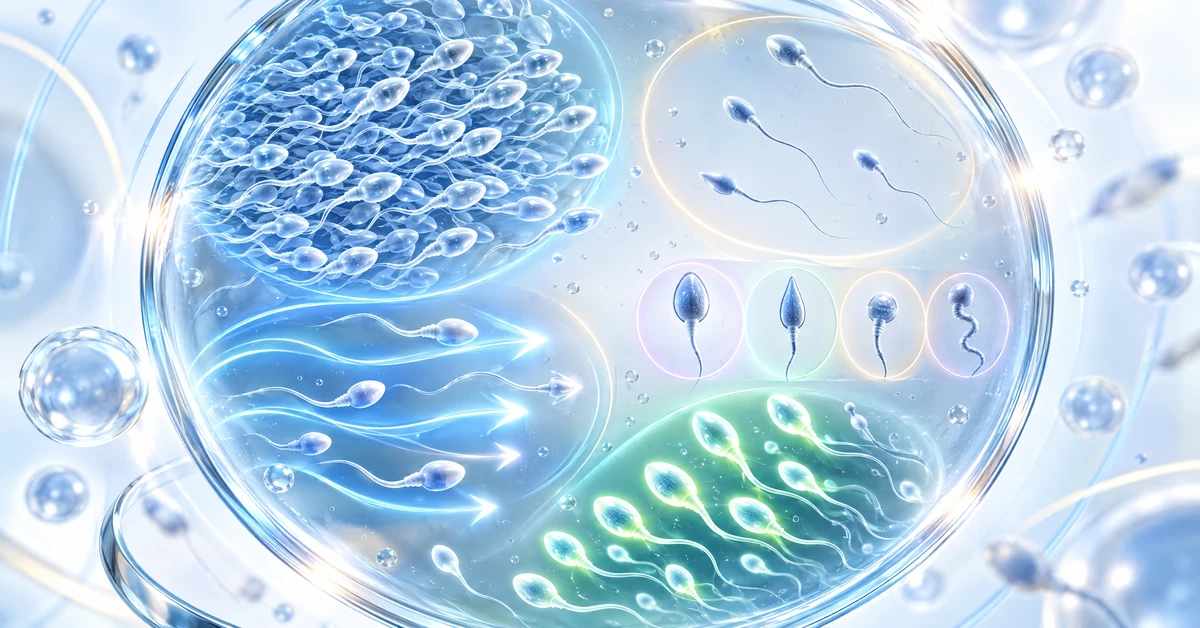
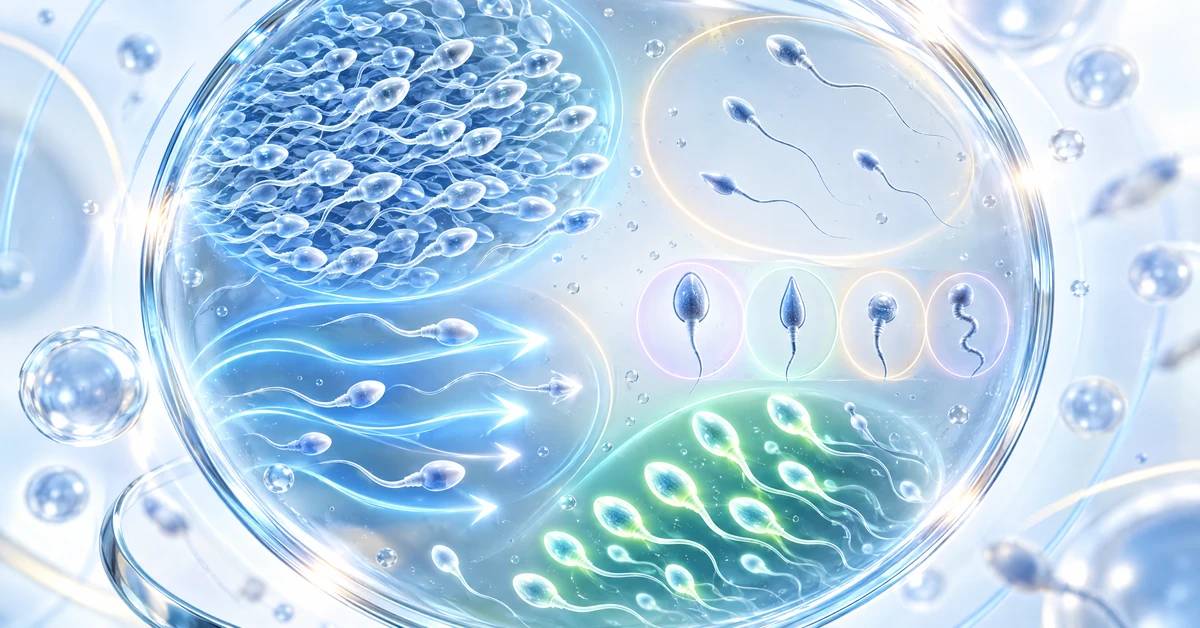
When a man receives a semen analysis report, he may see a long list of numbers and terms: semen volume, sperm concentration, total sperm count, progressive motility, morphology, vitality, and several other laboratory measurements.
One of the most common mistakes is to focus on a single number and conclude that fertility is either normal or severely impaired.
A semen analysis does not work that way.
It provides information about several different aspects of semen and sperm, and the parameters should be interpreted together rather than in isolation. The reference values printed on a laboratory report are also not absolute cutoffs separating fertile from infertile men.
The World Health Organization's sixth edition semen manual provides reference distributions based largely on men whose partners conceived naturally within one year. A result below one reference value therefore does not automatically mean infertility, while results above all reference values do not guarantee pregnancy.
What Does a Semen Analysis Measure?
Semen analysis is the main laboratory test used in the initial evaluation of male fertility.
A standard report may assess:
Semen volume.
Sperm concentration.
Total sperm number.
Progressive and total motility.
Sperm morphology.
Vitality when indicated.
pH and other semen characteristics.
Round cells, white blood cells, or additional laboratory observations when relevant.
These measurements provide important information, but they do not measure every aspect of sperm function and cannot predict natural pregnancy or the success of IUI, IVF, or ICSI with certainty.
What Are the Current WHO Reference Values?
The WHO 2021 sixth-edition data are widely used when interpreting semen analysis.
Approximate lower reference values include:
| Parameter | Approximate lower reference value |
|---|---|
| Semen volume | 1.4 mL |
| Sperm concentration | 16 million/mL |
| Total sperm number | 39 million/ejaculate |
| Total motility | 42% |
| Progressive motility | 30% |
| Vitality | 54% live |
| Normal morphology | 4% |
These figures should not be treated as diagnostic fertility cutoffs.
They represent statistical reference points, particularly lower fifth-percentile values in a reference population, rather than a line between fertile and infertile men.
What Does Semen Volume Mean?
Semen volume refers to the total amount of fluid in the ejaculate.
The approximate WHO lower reference value is 1.4 mL.
A low volume does not necessarily mean that sperm production inside the testicles is poor.
Possible explanations include:
Incomplete sample collection.
A shorter abstinence interval.
Partial retrograde ejaculation.
Ejaculatory duct obstruction.
Seminal-vesicle or prostate-related abnormalities.
Androgen deficiency in selected cases.
The first question after an unexpectedly low volume is often whether the entire sample was collected.
The first portion of the ejaculate can contain a substantial proportion of sperm, so losing part of the sample can significantly alter the reported result.
Sperm Concentration vs Total Sperm Count
These two measurements are related but are not the same.
Sperm Concentration
Sperm concentration tells us how many sperm are present in each milliliter of semen.
For example:
10 million/mL
means that approximately 10 million sperm are present in each milliliter.
The current lower reference value is approximately 16 million/mL.
When concentration is below the reference range, the term oligozoospermia may be used, but concentration alone does not determine fertility.
For a detailed discussion, see Low Sperm Count: Causes, Pregnancy Chances, and When IUI or ICSI May Be Needed.
Total Sperm Number
Total sperm number estimates how many sperm are present in the entire ejaculate.
It depends on both semen volume and sperm concentration.
Two men can therefore have the same sperm concentration but very different total sperm numbers if their semen volumes are different.
The approximate lower reference value is 39 million sperm per ejaculate.
Does 15 Million/mL Mean Infertility?
No.
It is incorrect to interpret semen analysis as:
16 million or higher = fertile.
15 million or lower = infertile.
Fertility does not suddenly change at a single laboratory number.
AUA/ASRM guidance emphasizes that semen-analysis findings generally have greater clinical significance when several abnormalities are present together rather than when there is only one mildly abnormal parameter.
For example, a mildly reduced concentration with strong motility and otherwise favorable parameters is different from severe oligozoospermia combined with poor motility and abnormal morphology.
What Does Sperm Motility Mean?
Motility describes sperm movement.
Reports commonly divide movement into several categories.
Progressive Motility
These sperm move forward.
Progressive movement is biologically important because sperm need to travel through the female reproductive tract toward the site of fertilization.
Non-Progressive Motility
The sperm are moving but do not make effective forward progress.
Immotile Sperm
No movement is seen.
Total Motility
This usually combines progressive and non-progressive motile sperm.
The approximate WHO reference values are 42% for total motility and 30% for progressive motility.
However, lower motility does not automatically make natural conception impossible.
Its importance depends on the severity of the reduction, sperm number, morphology, total motile sperm availability, and the couple's other fertility factors.
For a focused explanation, read Low Sperm Motility: Causes, Pregnancy Chances, and When IUI or ICSI May Be Needed.
What Does Sperm Morphology Mean?
Morphology evaluates sperm shape under a microscope.
Laboratory assessment examines features including:
The head.
Midpiece.
Tail.
Dimensions and overall structure.
A percentage is then reported for sperm meeting the laboratory's criteria for normal forms.
The current WHO reference value is approximately 4% normal forms.
That number often appears surprisingly low.
However, a morphology result of 4% does not mean that the remaining 96% of sperm are completely incapable of fertilization. Similarly, a result such as 2% does not prove that natural conception cannot occur.
Morphology criteria are strict, and morphology should not be used alone to make a major fertility decision.
For more detail, see Abnormal Sperm Morphology: What Normal Forms Mean and How They Affect Pregnancy, IUI and ICSI.
What Is Sperm Vitality?
Vitality is different from motility.
Sperm vitality measures the proportion of sperm that are alive.
A sperm cell can be alive without moving.
This distinction becomes particularly useful when a semen sample contains a very high proportion of immotile sperm.
A vitality test can help determine whether:
The immotile sperm are still alive.
Or a substantial proportion of them are dead.
The approximate WHO lower reference value for vitality is 54% live sperm.
Low Motility vs Low Vitality
These findings are not identical.
If a sperm cell is alive but cannot move effectively, the primary problem concerns motility.
If an immotile sperm cell is dead, the biological issue is different.
For this reason, laboratories may perform vitality testing when motility is extremely low or when nearly all sperm appear immotile.
The distinction may also matter when sperm are being considered for assisted reproductive treatment.

What Does Semen pH Mean?
Semen pH describes how acidic or alkaline the seminal fluid is.
A small change in pH should not be interpreted alone as evidence of infection or obstruction.
Its clinical value increases when considered alongside:
Semen volume.
Presence or absence of sperm.
Medical history.
Symptoms.
Physical examination.
Other investigations.
For example, semen volume and pH can provide additional clues during the evaluation of selected men with azoospermia.
What Do Round Cells or White Blood Cells Mean?
A semen report may mention round cells or leukocytes.
Not every round cell is a white blood cell. Some can be immature germ cells.
If leukocytospermia is suspected, the laboratory may need a more specific method to distinguish white blood cells from other round cells.
White blood cells also do not automatically prove a bacterial infection requiring antibiotics.
Antibiotic treatment should not be based on a semen-analysis number alone without evaluating symptoms, clinical findings, and appropriate testing.
Is One Semen Analysis Enough?
Not always.
Semen parameters naturally vary from one sample to another.
Results can be influenced by:
Duration of abstinence.
Recent fever or illness.
Collection technique.
Loss of part of the ejaculate.
Transport time.
Heat exposure.
Medications.
Normal biological variation.
Therefore, an abnormal result—especially one that may lead to an important treatment decision—often needs confirmation with another analysis in the appropriate clinical setting.
Current male-fertility guidance supports repeated semen assessment when the initial result is abnormal.
How Should You Prepare for a Semen Analysis?
Correct sample collection is essential.
The laboratory will usually request a defined period of ejaculatory abstinence before testing, commonly within the range recommended by WHO-based laboratory protocols.
The patient should:
Collect the entire sample whenever possible.
Use the laboratory-approved sterile container.
Record the collection time.
Tell the laboratory if any portion was lost.
Follow transport instructions if collecting away from the laboratory.
Tell the physician about recent fever, medications, hormones, or treatments that might affect the result.
When repeated testing is required, performing the analyses under reasonably similar conditions can make comparison more meaningful.
What If Several Parameters Are Abnormal?
This is where interpretation becomes more clinically important.
A man may have:
Low concentration alone.
Poor motility alone.
Low morphology alone.
Or a combination of low concentration, motility, and morphology.
Multiple abnormalities increase the importance of a complete male-fertility evaluation rather than simply labeling the semen report as “weak.”
Further evaluation may include:
Medical and reproductive history.
Testicular examination.
Medication and hormone review.
FSH, LH, and testosterone in appropriate cases.
Genetic testing in severe sperm-production disorders.
Imaging or other investigations when clinically indicated.
Can Varicocele Affect Semen Results?
Clinical varicocele can be associated with abnormal sperm concentration, total count, motility, or morphology in selected men.
However, finding a varicocele does not automatically mean that it is the cause of infertility, and not every varicocele requires surgery.
Treatment decisions depend on clinical examination, semen results, duration of infertility, and the female partner's reproductive situation.
For couples already considering assisted reproduction, see Varicocele Before IVF or ICSI: Should It Be Treated First or Should ART Begin Directly?.
Can Testosterone Therapy Change a Semen Analysis?
Yes, sometimes dramatically.
External testosterone and anabolic-androgenic steroids can suppress FSH and LH, reducing sperm production and, in some men, leading to azoospermia.
A normal or high serum testosterone level while receiving treatment therefore does not mean that sperm production is normal.
Men who currently use testosterone or have used it previously should tell the fertility specialist.
For a detailed explanation, read Testosterone Therapy and Male Fertility: How It Affects Sperm and Fertility Recovery.
When Are Additional Tests Needed?
Not every abnormal semen analysis requires a long list of investigations.
Further tests should be selected according to the type and severity of the abnormality.
Depending on the case, evaluation may include:
Hormonal testing.
Examination by a urologist or andrologist.
Scrotal Doppler ultrasound in selected situations.
Genetic testing in severe sperm-production disorders or azoospermia.
Additional sperm-function testing in specific clinical scenarios.
Each test should answer a clear clinical question rather than being ordered automatically.
Does Semen Analysis Measure Sperm DNA Quality?
No.
Standard semen analysis evaluates sperm number, movement, morphology, and other semen characteristics, but it does not directly measure DNA integrity inside sperm.
Some men may have relatively acceptable standard parameters while still having increased sperm DNA fragmentation.
However, sperm DNA fragmentation testing is not a routine test required for every infertile man.
Its use is generally considered in selected situations according to reproductive history, previous treatment outcomes, and the rest of the fertility evaluation.
Does a Normal Semen Analysis Exclude Male Infertility?
Not completely.
A normal standard analysis makes major abnormalities in basic semen parameters less likely, but it does not measure every aspect of sperm function.
At the same time, infertility may result from:
A female factor.
Combined male and female factors.
Or unexplained infertility after standard evaluation.
Both partners should therefore be assessed as part of the same fertility plan.
When Are IUI, IVF, or ICSI Considered?
Semen analysis contributes to the decision, but it is not the only factor.
IUI
IUI may be considered in selected mild or moderate male-factor cases when an adequate number of motile sperm remain after laboratory preparation.
IVF
IVF may be appropriate when female-factor infertility is present, simpler treatments have failed, or laboratory fertilization is otherwise indicated.
ICSI
ICSI may be more appropriate for severe male-factor infertility, extremely limited sperm numbers, severe motility problems, surgically retrieved sperm, or selected cases of previous fertilization failure.
The treatment choice should not be based on a single semen parameter.
Conclusion
A semen analysis is not a simple “fertile or infertile” test.
Correct interpretation requires looking at semen volume, sperm concentration, total sperm number, progressive and total motility, morphology, and vitality when indicated.
These findings must then be considered alongside medical history, examination, duration of infertility, the female partner's age, and her fertility factors.
WHO reference values are useful clinical tools, but they are not absolute fertility thresholds.
Major decisions such as IUI, IVF, or ICSI should therefore not be based on one isolated number, particularly when an abnormal first result has not yet been confirmed or its cause investigated.
If you have a semen analysis and would like to understand how the findings fit into your overall fertility assessment, you can contact Safemedigo on WhatsApp to share your results for a preliminary review and guidance on the appropriate next step.
Frequently Asked Questions
Does a sperm concentration below 16 million/mL mean infertility?
No. Approximately 16 million/mL is a reference value, not a strict fertility cutoff. It must be interpreted with motility, morphology, total count, and the couple's other fertility factors.
Which is more important: sperm count or motility?
Neither parameter can always be considered more important. Fertility depends on the combination of sperm number, movement, morphology, and the reproductive health of both partners.
What does 3% sperm morphology mean?
It means that approximately 3% of the sperm assessed meet the laboratory's strict criteria for normal morphology. It does not prove that natural conception is impossible.
Should an abnormal semen analysis be repeated?
Often, yes. Semen parameters vary naturally, and the result can be affected by collection conditions, recent illness, abstinence duration, and other factors.
Does a normal semen analysis guarantee fertility?
No. Normal basic semen parameters do not guarantee pregnancy, just as an abnormal result does not automatically mean infertility.
