






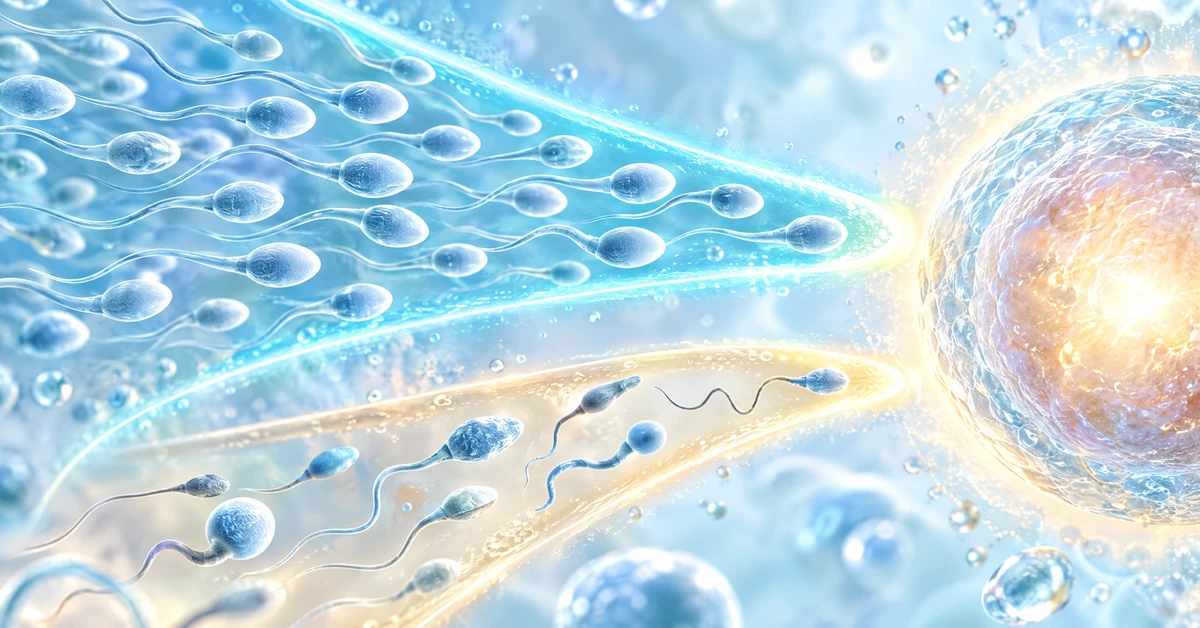
When a semen analysis shows a low percentage of normal sperm forms, men often see a result such as:
Normal forms: 3%
or:
Strict morphology: 2%
and assume that 97% or 98% of their sperm are “deformed” and incapable of fertilizing an egg.
That interpretation is too simplistic.
Sperm morphology is assessed using very strict microscopic criteria involving the head, midpiece and tail. As a result, the percentage of sperm that meet every criterion for a normal form can be relatively low even among men whose partners achieved natural pregnancy.
The key point is that morphology should not be interpreted alone.
What Is Sperm Morphology?
Sperm morphology describes the external shape and structure of sperm assessed under a microscope.
Laboratory evaluation can include:
Head shape and size.
Acrosome appearance.
Midpiece structure.
Head-to-tail attachment.
Tail length and shape.
Significant cytoplasmic abnormalities.
The laboratory then reports the percentage of sperm that meet the criteria for normal forms.
What Is Kruger Strict Morphology?
Kruger strict criteria are highly restrictive standards used to classify sperm shape.
Even relatively small deviations from the reference appearance can result in a sperm being classified as abnormal.
The word strict is therefore important.
An abnormal classification does not automatically mean that an individual sperm is incapable of fertilization.
What Does 4% Normal Morphology Mean?
WHO reference data place approximately 4% normal forms at the lower fifth percentile among men whose partners achieved natural conception within a defined period.
This does not mean:
4% or higher guarantees normal fertility.
Less than 4% means infertility.
A man with 2% morphology cannot achieve natural pregnancy.
It is a reference value, not an absolute fertility cutoff.
Does 4% Mean the Other 96% Are Useless?
No.
It means 4% of the assessed sperm met all strict morphological criteria.
It does not mean the other 96% are biologically incapable of fertilization.
Strict morphology classification is intentionally demanding, and the result cannot be directly converted into a percentage of sperm that can or cannot fertilize an egg.
What Is Teratozoospermia?
Teratozoospermia refers to a low percentage of sperm with normal morphology.
It may occur:
In isolation.
With low sperm concentration.
With reduced motility.
As part of more severe spermatogenic dysfunction.
Multiple major abnormalities in semen analysis generally carry more clinical significance than isolated low morphology.
Does Abnormal Morphology Mean Infertility?
No.
Morphology alone does not diagnose infertility in most men.
Natural pregnancy can occur despite a low normal-form percentage, particularly when:
Sperm concentration is reassuring.
Motility is good.
Total motile sperm numbers are adequate.
The female partner is relatively young.
Ovulation is normal.
Fallopian tubes are open.
No major additional fertility factors are present.
The clinical significance increases when morphology is abnormal together with concentration and motility.
Should the Semen Analysis Be Repeated?
An abnormal semen analysis may need confirmation.
Semen results naturally vary between samples because of:
Abstinence duration.
Recent illness or fever.
Sample collection conditions.
Transport time.
Biological variation.
Laboratory technique.
Morphology can also be influenced by laboratory experience and assessment methods.
A major decision such as proceeding directly to ICSI should not normally be based on one isolated morphology result without considering the rest of the fertility evaluation.
Can Morphology Results Differ Between Laboratories?
Yes.
Morphology assessment requires training and laboratory quality control and contains an element of observer variation.
Results can differ because of:
Slide preparation.
Staining methods.
Number of sperm assessed.
Laboratory expertise.
Application of strict criteria.
If an unexpected result would substantially change treatment, confirmation in an experienced andrology laboratory may be useful.

What Causes Abnormal Sperm Morphology?
Possible associations include:
Varicocele.
Smoking.
Excessive heat exposure.
Oxidative stress.
Testicular disorders.
Some reproductive-tract infections.
Environmental exposures.
Severe impairment of sperm production.
Rare genetic conditions.
Unexplained male-factor infertility.
In many men, no single cause can be identified.
Can Varicocele Affect Morphology?
In some men, clinical varicocele is associated with abnormalities in sperm concentration, motility and morphology.
It may also be associated with increased sperm DNA fragmentation in selected cases.
However, finding a varicocele does not prove that it caused the abnormal morphology, and not every varicocele needs treatment.
Surgery is most strongly considered when a palpable clinical varicocele is present together with infertility and abnormal semen parameters.
Read Varicocele and Male Fertility: When Is Surgery Needed?.
Do Smoking and Lifestyle Affect Morphology?
Lifestyle and environmental factors may influence overall semen quality.
Reasonable steps include:
Stopping smoking.
Avoiding anabolic steroids.
Limiting heavy alcohol use.
Improving weight and metabolic health.
Regular physical activity.
Reducing unnecessary prolonged heat exposure.
However, lifestyle changes cannot guarantee that morphology will rise from a particular percentage to another.
Do Hormones Cause Abnormal Morphology?
Hormonal disorders can affect sperm production and may produce several abnormal semen parameters.
However, isolated low morphology does not automatically indicate an FSH, LH or testosterone disorder.
Hormonal evaluation becomes more relevant when there is:
Very low sperm concentration.
Azoospermia.
Small testes.
Symptoms of low testosterone.
Clinical suspicion of endocrine dysfunction.
Read Male Fertility Hormone Tests: FSH, LH, Testosterone and Prolactin.
Does Low Morphology Mean High DNA Fragmentation?
No.
The two tests assess different sperm characteristics.
Morphology evaluates visible structure.
DNA-fragmentation testing assesses damage or breaks in sperm genetic material.
A man may have low morphology with relatively low DNA fragmentation, or normal morphology with elevated DNA fragmentation.
Morphology therefore cannot replace a DNA-fragmentation test.
DNA fragmentation is also not required routinely for every man with teratozoospermia.
It may be considered in selected situations such as recurrent pregnancy loss, unexplained infertility or repeated assisted-reproduction failure.
Read Sperm DNA Fragmentation Test: Why Is It Important?.
Are All Morphological Abnormalities Equally Important?
No.
A routine report usually gives an overall percentage of normal forms.
Rare specific morphological syndromes may carry greater clinical significance than an isolated low percentage.
One example is globozoospermia, in which sperm have characteristically round heads and abnormal or absent acrosomal structures.
This is very different from a routine report showing 2% or 3% normal forms with mixed abnormalities.
Specific patterns may require specialist assessment.
Can Natural Pregnancy Occur With 1% or 2% Morphology?
Yes, in some couples.
A very low strict-morphology percentage does not by itself make natural conception impossible.
Pregnancy potential also depends on:
Sperm concentration.
Motility.
Total motile sperm count.
Duration of infertility.
Female age.
Ovarian reserve.
Ovulation.
Tubal status.
A number such as 2% therefore cannot answer the pregnancy question on its own.
When Can a Couple Continue Trying Naturally?
Natural attempts may remain reasonable when:
Morphology is the main abnormal finding.
Concentration and motility are otherwise reassuring.
The female partner is relatively young.
Ovulation and tubes are normal.
Infertility duration is not prolonged.
No other indication requires faster treatment.
The female partner's reproductive timeline should always be considered.
Does Low Morphology Reduce IUI Success?
Severe male-factor infertility can reduce IUI success, but morphology alone is not always the decisive parameter.
Clinicians also consider:
Total motile sperm count.
Post-wash motile sperm numbers.
Female age.
Tubal status.
Ovulation.
Duration of infertility.
There is no valid universal rule that says:
Morphology below 4% means IUI cannot be used.
Some couples with isolated teratozoospermia may remain suitable for IUI depending on the entire clinical picture.
When Is IVF Considered?
IVF may be discussed when natural conception or IUI has a low expected chance or when other fertility factors are present, including:
Tubal disease.
Advanced female reproductive age.
Reduced ovarian reserve.
Prolonged infertility.
Multiple fertility factors.
When male-factor infertility is more severe, ICSI may be selected as the fertilization method.
Does Low Morphology Automatically Require ICSI?
No.
Isolated low morphology with otherwise reassuring sperm numbers and motility does not automatically mean ICSI is required.
ICSI becomes more strongly justified when there is:
Severe combined male-factor infertility.
Very limited availability of suitable sperm.
Low concentration and motility together with poor morphology.
Previous poor or failed fertilization with conventional IVF.
Surgically retrieved sperm.
Other specific laboratory or clinical indications.
Read IVF vs ICSI: What Is the Difference?.
How Does ICSI Bypass a Morphology Problem?
During ICSI, an embryologist identifies an appropriate sperm and injects it directly into a mature egg.
This bypasses the need for the sperm to:
Reach the egg by itself.
Bind to the egg.
Penetrate it through the conventional process.
This is why ICSI is useful in many severe male-factor cases.
However, ICSI does not repair the sperm itself.
Does ICSI Guarantee Genetically Normal Sperm Selection?
No.
Routine sperm selection for ICSI is largely based on features visible under the microscope, including movement and appearance.
An embryologist cannot determine the full chromosome status or DNA integrity of a sperm simply by looking at its shape.
A normal-looking sperm does not guarantee normal DNA, and an imperfect-looking sperm does not automatically carry a genetic abnormality.
Can Sperm Morphology Improve?
Sometimes semen results improve when a modifiable factor is addressed.
Examples may include treatment of an appropriately selected clinical varicocele, smoking cessation or broader lifestyle improvement.
However, there is no universal medication that reliably “corrects” sperm morphology in every man.
Any change also takes time because spermatogenesis occurs over a relatively long biological cycle.
Do Antioxidants Treat Teratozoospermia?
Many supplements are marketed for sperm quality, including:
CoQ10.
L-carnitine.
Zinc.
Selenium.
Vitamins C and E.
Evidence is inconsistent, and no single supplement regimen has been shown to normalize morphology or improve live birth for every man with isolated teratozoospermia.
Supplements should not replace investigation of possible causes.
Does Morphology Determine Embryo Quality?
No.
Embryo development depends on multiple male, female and laboratory factors, including:
Female age and egg quality.
Sperm genetic integrity.
Fertilization.
Chromosome competence.
Embryo development.
Laboratory conditions.
A low morphology percentage alone cannot be used to predict that embryos will be poor quality.
Does Low Morphology Cause Miscarriage?
Morphology alone cannot reliably predict miscarriage risk.
Sperm DNA fragmentation receives more attention in selected cases of recurrent pregnancy loss, but even DNA-fragmentation testing is not a universal screening test for every couple.
Recurrent miscarriage requires evaluation of both partners.
What Does 0% Normal Morphology Mean?
A report of 0% strict normal forms does not necessarily mean every sperm is incapable of fertilization.
The result reflects the cells examined and the very strict classification system used.
It warrants:
Review of laboratory quality.
Repeat testing when appropriate.
Assessment of concentration and motility.
Clinical evaluation of the male partner.
Investigation of potentially modifiable factors.
Discussion of the couple's reproductive strategy.
A rare uniform morphological abnormality may require more specialized assessment.
Common Mistakes When Reading Morphology Results
Common errors include:
Treating 4% as a line separating fertility from infertility.
Assuming 3% normal forms means 97% of sperm cannot fertilize.
Choosing ICSI based on morphology alone.
Ignoring sperm concentration and motility.
Not confirming an unexpected semen result.
Assuming low morphology proves high DNA fragmentation.
Taking supplements indefinitely without investigating possible causes.
Ignoring the female partner's age and fertility factors.
Conclusion
Sperm morphology is an important part of semen analysis, but it is not an independent fertility test.
The WHO 4% normal-forms value is a reference percentile, not a cutoff proving fertility above it or infertility below it.
Natural pregnancy can occur with low morphology, particularly when concentration, motility and female fertility factors are favorable.
Low morphology also does not automatically mean elevated DNA fragmentation or that ICSI is required.
The appropriate plan depends on the complete semen analysis, repeat testing when needed, male medical history, infertility duration and the female partner's reproductive factors.
If your semen analysis shows low sperm morphology and you want to understand whether natural conception, IUI, IVF or ICSI may be appropriate, contact Safemedigo on WhatsApp for a preliminary review of both partners' fertility results.
Frequently Asked Questions
Does morphology below 4% mean infertility?
No. Four percent is a reference value rather than an absolute fertility cutoff, and natural conception can occur below this level.
Does 2% morphology mean 98% of sperm cannot fertilize an egg?
No. It means 2% of the assessed sperm met all strict morphology criteria. It cannot be directly translated into the percentage capable of fertilization.
Does abnormal morphology always require ICSI?
No. Treatment depends on the complete male factor, previous fertilization history and female fertility factors.
Does low morphology mean high sperm DNA fragmentation?
Not necessarily. Morphology and DNA fragmentation measure different sperm characteristics.
Can sperm morphology improve?
It may improve when certain modifiable factors are addressed, but no single treatment guarantees normalization for every man.
