


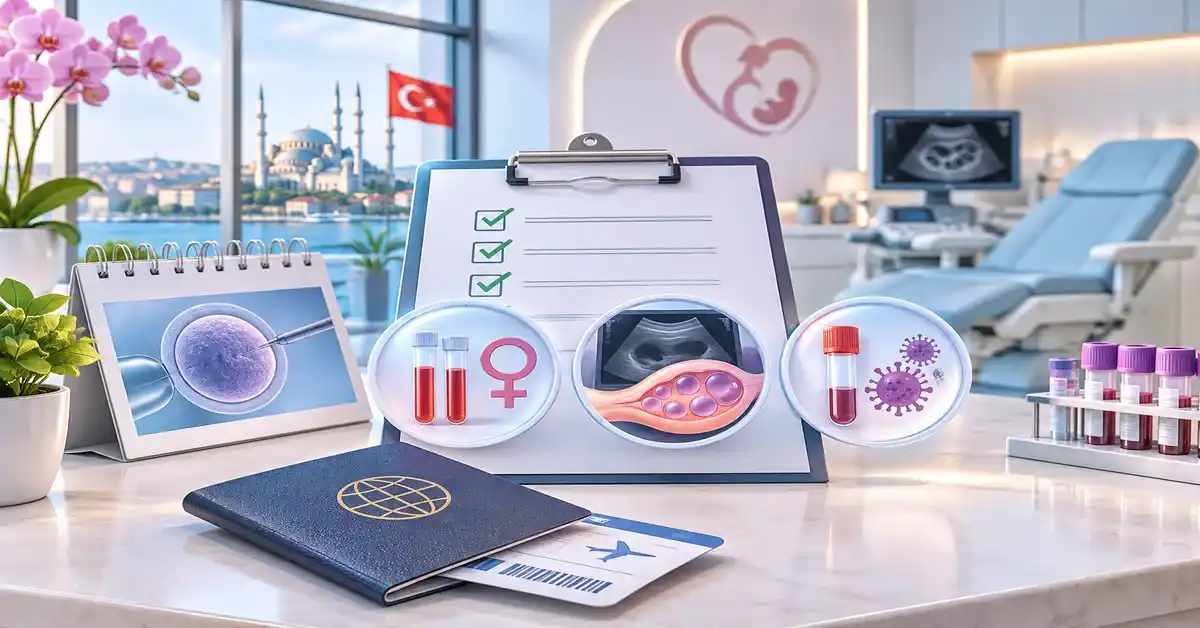
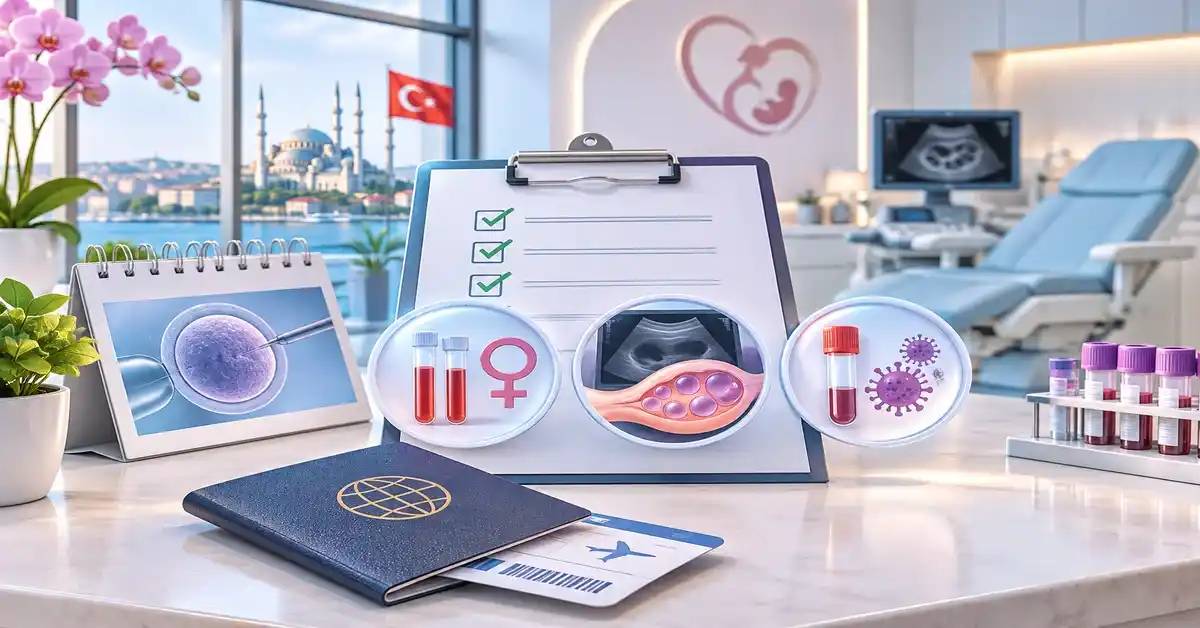
Travelling to Turkey for IVF does not mean that every investigation has to begin after arrival.
Many couples can complete an important part of their fertility assessment in their home country and send the results to the fertility team before travelling.
This can help identify missing information, estimate ovarian response, recognise male-factor infertility and determine whether anything should be treated before the IVF cycle begins.
However, not all tests work the same way.
Some can be performed almost any day.
Others depend on a specific menstrual-cycle day.
Ultrasound reports need specific measurements.
And some specialised tests should not be ordered at all unless the patient's history justifies them.
The goal is therefore not to perform as many tests as possible. It is to complete the right investigations at the right time and in a format the treating team can actually use.
The American Society for Reproductive Medicine (ASRM) recommends a systematic, timely and cost-effective infertility evaluation rather than indiscriminate testing.
For a broader overview, see Safemedigo's IVF Preparation: Hormonal Tests and Analysis Guide.
Why Complete IVF Testing Before Travel?
Pre-travel testing can help the fertility team understand:
Expected ovarian response.
Ovarian reserve.
Whether uterine or ovarian abnormalities are already known.
Whether there is a significant male factor.
Which previous tests remain useful.
Whether a result may change treatment timing.
And whether treatment can reasonably begin soon after arrival.
This is especially important for international patients because discovering a major missing investigation after arriving may prolong the stay or postpone treatment to another cycle.
Send Existing Records Before Ordering New Tests
The first step should be reviewing what you already have.
Useful information includes:
Age.
Duration of infertility.
Menstrual-cycle pattern.
Previous pregnancies.
Miscarriages or ectopic pregnancy.
Previous operations.
Previous IVF cycles.
Egg-retrieval and embryology reports.
Recent ultrasound.
Ovarian-reserve testing.
Semen analysis.
Current medications.
Relevant chronic conditions.
The fertility team can then decide what actually needs updating.
This follows the same principle as Safemedigo's medical evaluation before travelling to Turkey: medical planning should come before travel logistics.
Can AMH Be Tested in Your Home Country?
Yes.
Anti-Müllerian hormone is one of the easiest ovarian-reserve tests to complete before travel.
Unlike basal FSH and estradiol, AMH can generally be measured at different points in the menstrual cycle.
ASRM explains that ovarian-reserve testing is useful for predicting response to stimulation rather than determining whether a woman can become pregnant. ESHRE also recommends either AMH or antral follicle count for predicting a high or low ovarian response.
A low AMH result should not automatically be translated into poor egg quality.
Read more in Diminished Ovarian Reserve: Low AMH, Egg Quality and IVF.
Can FSH and Estradiol Be Tested Before Travel?
Yes, but timing matters.
When used as basal ovarian-reserve tests, FSH and estradiol are generally measured together during the early follicular phase, usually cycle days 2–4.
The report should therefore include:
Cycle day.
Result.
Units.
Test date.
A laboratory result without the menstrual-cycle context may be less useful.
Can You Have Your Antral Follicle Count at Home?
Yes, provided the ultrasound is performed appropriately.
A fertility ultrasound should ideally describe:
The uterus.
Endometrium.
Right ovary.
Left ovary.
Any ovarian cyst.
Any suspected fibroid or polyp.
And the antral follicle count in each ovary.
ESHRE's updated ovarian-stimulation guideline recommends AMH or AFC for predicting ovarian response.
A report simply stating “normal ovaries” is much less useful for IVF planning.
What Should the Ultrasound Report Include?
Ask the examiner to document:
Antral follicles in each ovary.
Ovarian abnormalities.
Cyst size and appearance when present.
Endometrial thickness and appearance.
Uterine abnormalities.
Relevant pelvic findings.
Images may also be helpful when the treating doctor needs to review the findings directly.
Can the Male Partner Complete Semen Analysis Before Travel?
Yes, and this is often preferable.
ASRM recommends concurrent evaluation of the male partner when he is contributing sperm, with at least one semen analysis obtained at the beginning of infertility evaluation.
A semen report should ideally include:
Sample volume.
Sperm concentration.
Total count.
Motility.
Morphology when assessed.
Relevant laboratory comments.
Severely abnormal results may justify repeat testing or further male evaluation before travel.
Is Sperm DNA Fragmentation Needed Before Every IVF Cycle?
No.
Advanced sperm-function testing is not routinely recommended as part of the initial infertility evaluation without a specific indication.
Some selected couples may benefit from further evaluation, but the decision should follow medical review rather than being included automatically in every fertility package.
Should TSH Be Tested Before Travel?
Thyroid testing may be appropriate according to symptoms, menstrual abnormalities, known thyroid disease or other clinical considerations.
However, the 2026 ASRM infertility-evaluation guidance does not recommend routine serum TSH testing in every woman without an indication.
This should be distinguished from clinic-specific preconception or procedural screening requirements.
Is Prolactin Required for Everyone?
No.
Routine prolactin testing is not recommended for every infertility patient.
It may be indicated in women with:
Galactorrhoea.
Oligomenorrhoea.
Amenorrhoea.
Or another relevant clinical reason.
What About LH and Progesterone?
These tests can be useful in particular circumstances but are not universal pre-travel screening tests.
They may be used:
During ovarian stimulation.
To assess ovulation timing.
During natural-cycle frozen embryo transfer.
To confirm a particular hormonal stage.
Their usefulness therefore depends strongly on timing.
Can an HSG Be Completed Before Travelling to Turkey?
Yes, if the fertility doctor considers it useful.
Hysterosalpingography can provide information about:
Tubal patency.
Proximal or distal blockage.
Tubal architecture.
And aspects of the uterine cavity.
ASRM considers HSG and hysterosalpingo-contrast sonography appropriate approaches for assessing tubal patency.
However, not every woman planning IVF automatically needs an HSG before travelling.

Why Do the Fallopian Tubes Matter if IVF Bypasses Them?
IVF bypasses the tubes for fertilisation, but tubal disease can still matter.
Hydrosalpinx is an important example.
A fluid-filled damaged tube may influence embryo-transfer planning and may need treatment before transfer.
Therefore, tubal assessment may be relevant when the history or ultrasound suggests disease.
Can Uterine Evaluation Be Completed at Home?
Often, yes.
Initial assessment may include transvaginal ultrasound.
Depending on the history, the doctor may request:
HSG.
Saline infusion sonography.
Hysteroscopy.
Or another targeted investigation.
ASRM recommends tailoring uterine and tubal investigation to the patient's history rather than using every procedure routinely.
Do You Need Hysteroscopy Before Travelling?
Not routinely.
Hysteroscopy may be appropriate when there is:
Suspected endometrial polyp.
Intrauterine adhesions.
Abnormal bleeding.
An abnormal imaging finding.
Or another clinical indication.
It should not automatically be performed before every first IVF attempt.
What About Infectious-Disease Screening?
IVF centres commonly require specific infectious-disease screening before laboratory procedures.
These tests can often be performed in the home country, but patients should ask the centre:
Which tests are required.
How recent the results must be.
Whether a specific laboratory format is needed.
Whether any tests must be repeated in Turkey.
Requirements can differ between centres and regulatory settings.
Can Routine Blood Tests Be Completed at Home?
Usually, yes.
Depending on the medical history and clinic protocol, this may include:
Complete blood count.
Blood group.
Glucose-related testing.
Other pre-procedure blood work.
The key issue is how recent the result needs to be at the time treatment begins.
Is HbA1c Needed for Every IVF Patient?
No.
It may be particularly relevant for patients with:
Diabetes.
Known glucose problems.
Metabolic risk factors.
Or another clinical indication.
Preconception health assessment should be individualised rather than reduced to one universal laboratory panel.
Does Every Couple Need Karyotyping?
No.
Chromosome analysis can be appropriate in selected circumstances, including certain reproductive, genetic or male-factor histories.
ASRM lists karyotyping among investigations that should not be ordered routinely in every infertility evaluation without a specific indication.
What About Immune and Thrombophilia Tests?
Large immune panels and thrombophilia testing should not be ordered routinely simply because IVF is planned.
ASRM specifically includes immunologic and thrombophilia testing among investigations that are not part of routine infertility evaluation without clinical indications.
This matters because international patients are sometimes offered expensive “fertility packages” containing many tests that do not change treatment.
Do All Medical Reports Need Translation?
Not necessarily.
Straightforward laboratory reports may be understandable when test names, numbers and units are clearly displayed.
Longer documents may require translation or a clear medical summary, particularly:
Operation reports.
Hysteroscopy reports.
Imaging.
Genetic reports.
Complex diagnoses.
The priority is accurate communication, not translating every page of an old medical file.
Is a Photograph of a Result Enough?
It can be sufficient for preliminary review if everything is readable.
Make sure it shows:
Test name.
Result.
Unit.
Reference range where relevant.
Date.
Laboratory identification when possible.
For ultrasound and imaging, the full report or original images may be required.
How Recent Should AMH Be?
There is no universal expiry date applying to every patient.
A repeat test may be useful if significant time has passed or the patient's ovarian history has changed, such as after ovarian surgery.
ASRM does not recommend routine serial AMH measurements simply to track ovarian reserve over time. A single value should be interpreted with age, history and previous treatment response.
Can Ovarian Stimulation Begin in Your Home Country?
Sometimes.
This is more complex than simply completing tests before travel.
Remote stimulation requires:
A physician-approved protocol.
Local ultrasound.
Rapid communication of follicle measurements.
Relevant hormone tests.
Medication adjustments.
A clear travel date before the final stages.
Patients should not restart medication from an old IVF cycle without new instructions.
Which Tests Become Time-Sensitive During Stimulation?
Once stimulation begins, results need to reflect the ovaries at that specific stage.
The team may request:
Transvaginal ultrasound.
Estradiol.
LH.
Progesterone.
The exact tests depend on the treatment protocol.
These cannot be replaced by results obtained casually several days earlier.
Which Tests May Still Be Repeated in Turkey?
Even with a well-prepared file, some investigations may be repeated after arrival.
Examples include:
Baseline ultrasound.
Stimulation monitoring.
Hormone tests needed for medication decisions.
Tests required immediately before egg retrieval.
Clinic-specific safety investigations.
This does not mean the pre-travel tests were wasted. The doctor may simply need current information for that exact day.
Can Pre-Travel Testing Reduce the Stay in Turkey?
Potentially, yes.
If the patient arrives with a usable fertility file, less time may be needed for initial investigation.
If key information is missing, the first days may instead be spent completing:
Ovarian-reserve assessment.
Male evaluation.
Uterine imaging.
Or other investigations.
For broader planning, see Safemedigo's guide on how long to stay in Turkey for medical treatment.
Does Testing at Home Always Save Money?
No.
A cheap test is not economical if it has to be repeated because:
It was not requested.
It is too old.
The report is incomplete.
Units are missing.
It was performed on the wrong cycle day.
Or a different investigation was required.
The most cost-effective strategy is usually to obtain the requested tests, not every fertility test available.
A Practical Pre-Travel IVF Testing List
Depending on the patient, useful pre-travel information may include:
AMH.
Antral follicle count.
Basal FSH and estradiol when requested.
Semen analysis.
Tubal evaluation when indicated.
Uterine assessment.
Required infectious-disease screening.
Relevant general health tests.
Previous IVF records.
Previous surgery reports.
This is not a universal checklist for every couple.
Tests You Should Not Order Automatically
Do not automatically request:
Large immunology panels.
Extensive thrombophilia testing.
Unselected genetic testing.
Sperm DNA fragmentation.
Routine hysteroscopy.
Endometrial biopsy.
Or expensive fertility add-on testing
without a reason.
Current ASRM guidance specifically discourages several such tests as routine infertility investigations.
What Should You Ask the Centre Before Going to the Laboratory?
Ask for:
Exact test name.
Required timing.
Whether fasting is needed.
Required menstrual-cycle day.
How recent the result should be.
Required units if relevant.
Whether images are needed.
Whether the test will be repeated in Turkey.
This prevents unnecessary duplication.
How Should You Organise Your Medical File?
Separate it into clear sections.
Female Partner
Medical history.
Hormone tests.
Ovarian reserve.
Ultrasound.
Tubal and uterine reports.
Previous treatment.
Male Partner
Semen analyses.
Relevant laboratory results.
Fertility-related procedures or treatment.
Previous IVF Cycles
Number of eggs retrieved.
Mature eggs.
Fertilisation.
Embryo development.
Blastocyst information.
Embryo grades.
Genetic-testing results when applicable.
Transfer outcomes.
A structured file is far easier to review than dozens of unrelated screenshots.
Should You Wait Until Every Test Is Complete Before Contacting the Clinic?
No.
Contacting the fertility team first is usually better.
Send what you already have.
The team can identify missing information and tell you exactly what to complete before travel.
Conclusion
A substantial part of IVF evaluation can often be completed in the patient's home country before travelling to Turkey.
AMH, antral follicle count, semen analysis and selected uterine, tubal or general medical tests can often be reviewed remotely.
However, some investigations depend on menstrual-cycle timing, some become relevant only during stimulation and several advanced tests should not be routinely ordered at all.
ASRM's current infertility guidance emphasises systematic and cost-effective evaluation, while ESHRE recommends AMH or antral follicle count as the main tools for predicting ovarian response to stimulation.
The best approach is therefore to send the existing file first, receive an individualised test list and then complete the necessary investigations before travel.
If you are planning IVF in Turkey, you can book a consultation with Safemedigo on WhatsApp to review which tests can be completed at home and which should be performed after arrival.
Frequently Asked Questions
Can I have my AMH tested before travelling to Turkey?
Yes. AMH can generally be measured at different points in the menstrual cycle and sent for pre-travel review.
Do all hormone tests need to be done on cycle day 2?
No. Basal FSH and estradiol are cycle-timed, while AMH usually does not require a specific day.
Can my partner complete semen analysis before travelling?
Yes. A recent semen analysis can identify important male-factor issues before the treatment trip.
Does every IVF patient need hysteroscopy before travelling?
No. Hysteroscopy is generally used when the history or imaging suggests a uterine-cavity indication.
Can completing tests at home shorten my stay in Turkey?
Yes, when the results are current, complete and specifically requested by the treating fertility team.