







Peyronie’s disease can create two related problems that interfere with sexual function: penile deformity caused by fibrous scar tissue and erectile dysfunction that prevents sufficient rigidity. The deformity may include curvature, shortening, an hourglass narrowing, indentation, or a hinge-like area that becomes unstable during erection.
When erectile rigidity remains adequate, curvature can often be managed without a penile implant. Plication or plaque incision and grafting may be considered according to the deformity. When significant erectile dysfunction does not respond adequately to medication, injections, or other treatments, a penile implant can address both problems by restoring rigidity and supporting correction of the curvature during the same operation.
Implant placement alone may straighten the penis sufficiently in some patients. Others require manual modeling over the inflated cylinders, plication sutures, or plaque incision with grafting. The selected approach depends on curvature severity, deformity type, penile length, tissue fibrosis, implant choice, and the patient’s expectations.
How Peyronie’s Disease Causes Curvature and Erectile Dysfunction
Peyronie’s disease involves fibrous tissue within the covering of the erectile bodies. The plaque does not expand normally during erection, causing the penis to bend toward the restricted side. Complex cases may involve more than a single curve and can include narrowing, rotation, shortening, and reduced axial stability.
How Fibrous Plaque Changes the Erect Shape
The deformity may be upward, downward, lateral, or multidirectional. Some men develop an hourglass narrowing rather than a severe angle, while others experience a hinge effect that makes penetration difficult even when the erection appears reasonably firm.
Possible features include:
- Painful erection during the active phase.
- Penile curvature.
- Loss of length.
- Hourglass narrowing or indentation.
- Difficulty with penetration.
- Instability at the plaque site.
- Distress, reduced confidence, and avoidance of intimacy.
Why Erectile Dysfunction May Occur
Erectile dysfunction may be related to diabetes, vascular disease, previous surgery, medication, or aging rather than the plaque alone. Peyronie’s fibrosis can nevertheless interfere with balanced expansion and create a mechanical weakness.
A man may achieve partial erection but lack the rigidity needed to overcome the deformity or maintain penetration. Evaluation should therefore consider the functional quality of the erection, not simply whether an erection can occur.
How the Implant Addresses Both Problems
Penile prosthesis cylinders are placed within the erectile bodies to create controlled rigidity. Their expansion supports the penis internally and may reduce curvature by stretching the fibrotic tissues.
Curvature correction may occur through:
- Implant placement and inflation alone.
- Manual modeling over the cylinders.
- Plication of the longer side.
- Controlled plaque-releasing incisions.
- Graft placement when a large defect is created.
Read about: Types of Penile Implants: Pros and Cons of Each Type
Who Benefits From Penile Implant Surgery for Peyronie’s Disease?
A penile implant is not the first treatment for every curved erection. The key question is whether erectile rigidity is adequate and responds to therapy. The decision should be based on objective assessment of the erection, deformity, penile length, and the impact on intercourse.
Appropriate Candidates for the Dual Procedure
Implant surgery is commonly considered when Peyronie’s disease is accompanied by erectile dysfunction that remains inadequate despite appropriate treatment.
Potential candidates include men with:
- Insufficient rigidity despite correctly used medication.
- Poor response or intolerance to penile injections.
- Curvature that prevents penetration together with erectile dysfunction.
- Hourglass deformity or instability with poor rigidity.
- Severe fibrosis, shortening, and functional impairment.
- Previous unsuccessful straightening surgery.
- A clear understanding of implant function and limitations.
Surgery for Peyronie’s disease is generally planned after the deformity has stabilized and when it compromises sexual function.
When an Implant May Not Be the Best Option
Men who achieve reliable erections naturally or with medication may be better candidates for curvature correction without a prosthesis. Depending on the anatomy, this may involve plication or plaque incision and grafting.
Implantation may also be postponed or avoided when there is:
- Active skin or urinary infection.
- Poorly controlled medical disease.
- An expectation that the implant guarantees penile enlargement.
- Inadequate understanding of device use.
- Inability to operate a pump without an alternative plan.
- Unwillingness to have an implanted device.
Treatment Selection According to Erectile Function
| Clinical situation | Possible treatment pathway | Main goal |
|---|---|---|
| Good erections and mild stable curvature | Observation or nonsurgical care | Control symptoms and monitor stability |
| Good erections but intercourse-limiting curvature | Plication or plaque incision and grafting | Straighten while preserving natural erections |
| Erectile dysfunction responsive to treatment | ED treatment with separate curvature assessment | Avoid unnecessary implantation |
| Treatment-resistant ED with Peyronie’s disease | Implant with or without straightening maneuvers | Restore rigidity and correct deformity |
| Severe fibrosis and complex deformity | Implant with selected reconstruction | Achieve a functionally straight erection |
Types of Penile Implants Used With Peyronie’s Disease
The principal options are inflatable and malleable prostheses. Selection is based on anatomy, fibrosis, hand function, concealment preferences, deformity complexity, and the surgeon’s experience rather than price alone.
Inflatable Penile Prosthesis
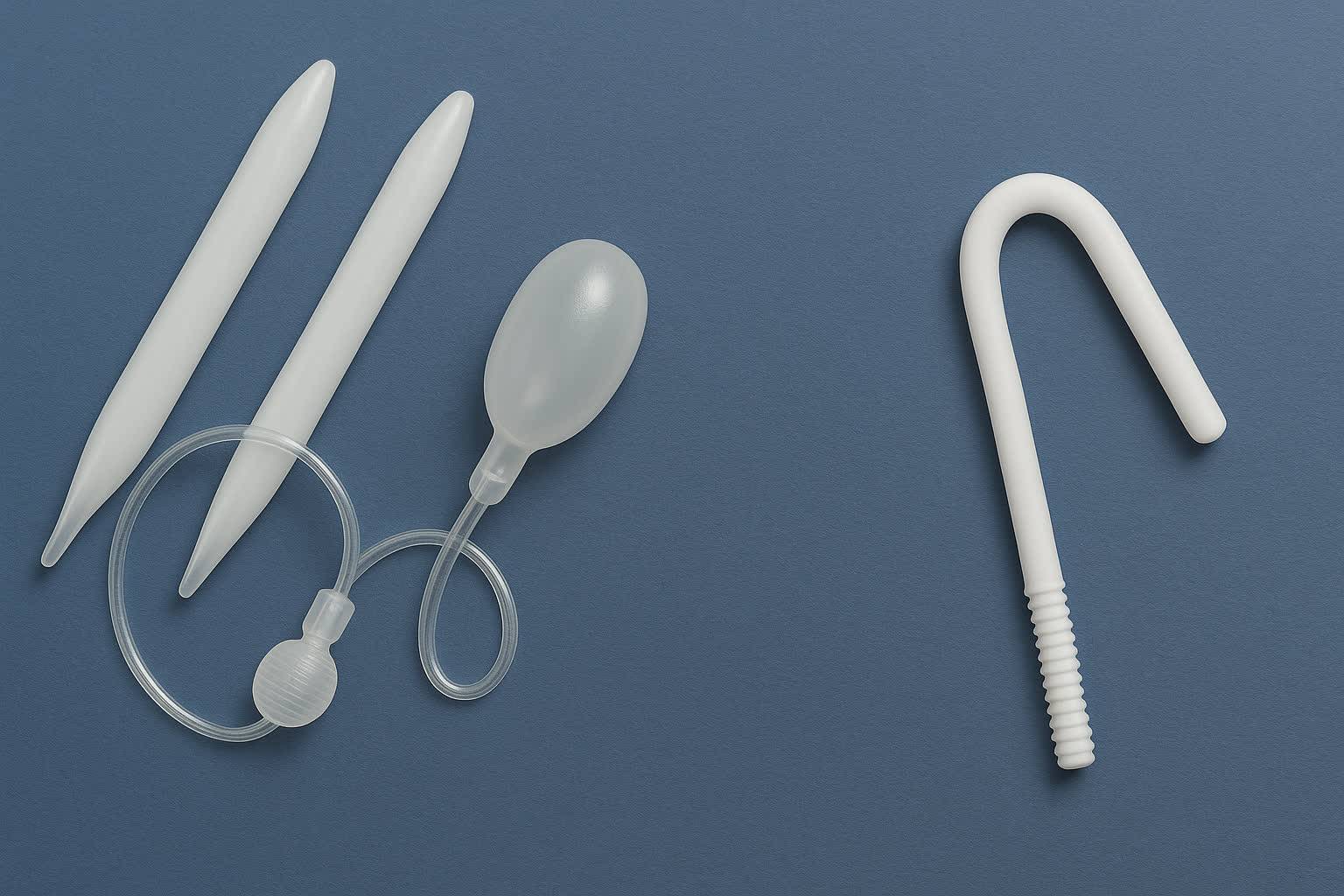
An inflatable system commonly includes two cylinders, a scrotal pump, and a fluid reservoir. The patient transfers fluid into the cylinders for intercourse and returns it to the reservoir afterward.
It is frequently preferred in Peyronie’s disease because it:
- Provides strong axial rigidity.
- Allows the residual curve to be assessed during surgery.
- Supports manual modeling.
- Produces a more natural flaccid appearance when deflated.
- Permits gradual postoperative cycling.
- Offers flexibility in complex reconstructive planning.
Inflatable prosthesis placement is the most frequently selected approach for men with Peyronie’s disease and medication-resistant erectile dysfunction.
Malleable Penile Prosthesis
A malleable prosthesis consists of bendable rods that remain relatively firm. The penis is positioned upward for intercourse and downward for concealment.
It may suit men who prioritize simpler operation or cannot manipulate a small pump. However, concealment may be more difficult, and its role in complex curvature correction differs from that of an inflatable system.
Inflatable Versus Malleable Implant
| Feature | Inflatable implant | Malleable implant |
|---|---|---|
| Rigidity control | Inflated and deflated when needed | Relatively constant firmness |
| Concealment | More natural when deflated | Requires manual positioning |
| Hand function | Pump operation required | Simpler to operate |
| Peyronie’s correction | Well suited to modeling and cycling | Suitable in selected cases |
| Components | Cylinders, pump, and usually reservoir | Two flexible rods |
| Mechanical complexity | More components can eventually fail | Mechanically simpler |
| Complex deformity | Often provides greater operative flexibility | Selection depends on individual anatomy |
How Curvature Is Corrected During Implant Surgery
After the cylinders are inserted and inflated, the surgeon assesses the residual curvature. The usual principle is to begin with the least invasive maneuver capable of producing a functionally straight erection.
Straightening From Implant Expansion and Manual Modeling
Cylinder placement and internal dilation may produce enough straightening without another procedure. If a significant curve remains, controlled manual modeling can be performed over the inflated prosthesis.
The cylinders act as an internal support while the penis is carefully bent opposite the curve to stretch or disrupt the restrictive tissue. Modeling can be highly effective, but excessive force may injure the urethra or damage implant components.
Plication for Residual Curvature
Plication sutures shorten the longer side to balance the shorter fibrotic side. This can correct selected residual curves after implantation or modeling.
Plication may be considered when:
- A meaningful curve remains.
- The deformity is not dominated by a major hourglass defect.
- Penile length can tolerate some additional shortening.
- Avoiding plaque incision and grafting is preferred.
The main trade-off is potential length loss because the longer side is shortened.
Plaque Incision and Grafting
Severe curvature, marked narrowing, complex deformity, or substantial shortening may require controlled incisions that release the fibrotic area. A graft may cover the defect when the opening is large.
This technique adds complexity and may increase the risk of bleeding, urethral injury, sensory change, surface irregularity, or infection. No single adjunctive procedure is superior for every case; the deformity and tissue defect determine the choice.

Preoperative Assessment, Surgery, and Recovery
Successful treatment depends on more than the implant model. Preoperative evaluation determines whether erectile dysfunction, curvature, or both require treatment and helps the surgeon anticipate fibrosis and prepare alternative straightening methods.
Evaluation Before Implant Surgery
Assessment includes the duration and stability of Peyronie’s disease, erection pain, penetration difficulty, erectile-treatment response, previous surgery, and current medications.
Testing may include:
- Erection photographs taken according to clinical instructions.
- A medically induced erection to measure curvature.
- Penile Doppler imaging when vascular assessment is needed.
- Urine testing before surgery.
- Diabetes and anesthesia-related blood tests.
- Review of anticoagulant medication.
- Assessment of hand function for pump use.
- Measurement of stretched penile length.
An induced erection provides a more objective assessment of curvature and complex deformity than verbal description alone.
Main Surgical Steps
The operation generally involves:
- Anesthesia and sterile preparation.
- Surgical access to the erectile bodies.
- Careful dilation through fibrotic tissue.
- Measurement and selection of cylinder size.
- Implant placement and inflation.
- Assessment of residual curvature.
- Manual modeling when required.
- Plication or plaque release and grafting in selected cases.
- Pump and reservoir placement for an inflatable device.
- Wound closure and postoperative planning.
The goal is a rigid, functionally straight erection, not perfect geometric straightness at the cost of unnecessary tissue injury.
Recovery and Implant Activation
Swelling, bruising, and penile or scrotal discomfort are expected during early recovery. The patient should follow wound instructions, take prescribed medication, and avoid sexual activity until healing is confirmed.
Recovery commonly includes:
- Monitoring for redness, drainage, or fever.
- Scrotal support and temporary activity restriction.
- Review of pump and cylinder position.
- Activation teaching after sufficient healing.
- Gradual cycling when recommended.
- Return to intercourse only after surgical approval.
Aggressive early inflation or unsupervised attempts to gain length can cause pain or tissue injury.
Read about: Types of Penile Implants and Benefits of Flexible Devices
Results, Risks, Cost Factors, and Surgeon Selection
The dual procedure can restore rigidity and reduce curvature to a functionally useful degree. Results vary according to fibrosis, previous surgery, deformity complexity, implant selection, and realistic expectations.
Expected Results and Important Limitations
Many patients achieve reliable rigidity with substantial improvement in curvature. The implant alone may be enough in some cases; others need modeling, plication, or grafting.
A penile implant:
- Does not always remove the plaque.
- Does not guarantee restoration of lost length.
- Does not automatically increase sexual desire.
- Does not restore ejaculation lost for another reason.
- Does not always create natural glans engorgement.
- May eventually require revision or replacement.
Preoperative counseling about length is particularly important. Peyronie’s disease may already have shortened the penis, and plication can add further shortening.
Possible Complications
Potential complications include:
- Device infection.
- Bleeding or hematoma.
- Residual curvature.
- Cylinder malposition or asymmetry.
- Persistent narrowing or indentation.
- Chronic pain or altered sensation.
- Urethral injury.
- Device erosion.
- Pump, tubing, or cylinder failure.
- Dissatisfaction with length or appearance.
- Need for revision surgery.
Complex fibrosis and previous operations can increase surgical difficulty. Experience with both prosthetic surgery and penile reconstruction is therefore important.
Cost Factors and Choosing the Surgeon
Cost varies according to implant type, fibrosis severity, additional straightening or grafting, anesthesia, hospital care, and follow-up. Combined reconstruction is generally more complex than implant surgery without Peyronie’s deformity.
Questions to ask include:
- How often does the surgeon treat Peyronie’s disease with implants?
- Is the surgeon experienced in modeling, plication, and grafting?
- Which implant is recommended and why?
- What is the likelihood that the implant alone will straighten the penis?
- What is the plan for residual curvature?
- What change in length should be expected?
- How is infection risk reduced?
- What does activation and follow-up involve?
- How are complications and future revisions managed?
Read about: Hydraulic Penile Implant vs Flexible: Which Offers Better Control
Conclusion
A penile implant can provide a dual solution when Peyronie’s disease is accompanied by erectile dysfunction that no longer responds adequately to other treatment. The implant restores rigidity, while its cylinders and additional surgical maneuvers can correct curvature during the same operation.
The implant is not the preferred treatment for a man with reliable erections, and it does not guarantee penile length restoration or complete removal of every deformity. Outcome depends on careful patient selection, accurate assessment, appropriate implant choice, and reconstructive surgical experience.
Frequently Asked Questions: Penile Implant and Peyronie’s Disease: A Dual Solution
Can the penile implant straighten Peyronie’s curvature by itself?
It may provide sufficient straightening in some patients. Others require manual modeling, plication, or plaque incision and grafting.
When is an implant preferable to curvature surgery alone?
It is usually preferred when Peyronie’s disease is combined with erectile dysfunction that does not respond adequately to medication, injections, or other therapies.
Is an inflatable implant better for Peyronie’s disease?
It is commonly preferred because it provides strong rigidity and supports modeling and gradual cycling, although a malleable implant may suit selected patients.
Does the implant restore lost penile length?
Restoration is not guaranteed. The implant improves rigidity and may improve alignment, but previous fibrosis and additional plication can affect final length.
Can curvature return after implant surgery?
A small residual or later change is possible. The implant provides ongoing internal support, but functionally significant curvature requires specialist assessment.