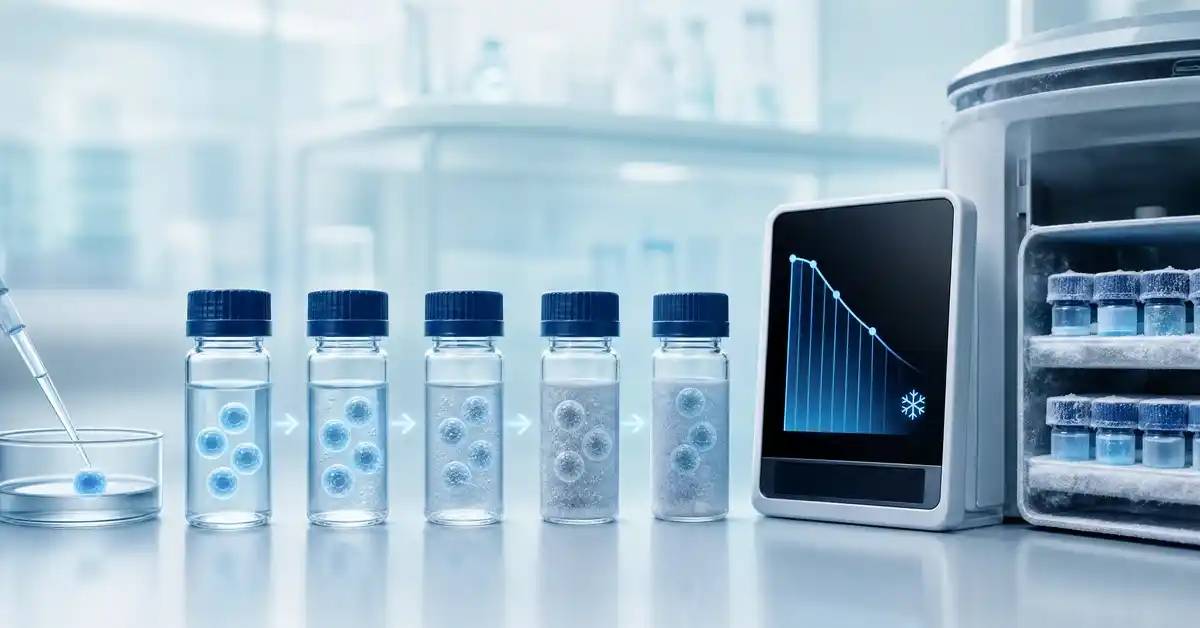








When fertility is threatened by highly gonadotoxic chemotherapy, radiation, reproductive surgery or another urgent medical treatment, egg or embryo freezing may be considered.
But what happens when there is not enough time for ovarian stimulation and egg retrieval?
And what if the patient is a child who has not yet reached puberty?
This is where:
ovarian tissue cryopreservation
can become important.
Ovarian tissue cryopreservation is no longer considered experimental for appropriately selected patients.
Current ASRM guidance recognizes it as an established fertility-preservation strategy and identifies it as the principal established method for prepubertal girls facing highly gonadotoxic treatment.
However, that does not mean it is appropriate for every woman or every cancer diagnosis.
Patient selection, age, ovarian reserve, disease type and the risk of malignant cells being present within the ovarian tissue are all important.
What Is Ovarian Tissue?
The outer ovarian cortex contains a large number of small primordial follicles.
Each follicle contains an immature oocyte.
Unlike conventional egg freezing, ovarian tissue cryopreservation does not require individual mature eggs to be stimulated and collected.
Instead, a portion of ovarian cortex containing many follicles is removed and stored.
This means that a relatively small volume of tissue can preserve a large follicle population.
How Is Ovarian Tissue Freezing Different From Egg Freezing?
Egg freezing generally requires:
Ovarian stimulation.
Several days of medication.
Follicle monitoring.
Egg retrieval.
Identification of mature oocytes.
Vitrification.
Ovarian tissue freezing does not require mature-oocyte development first.
A section of ovarian cortex is surgically removed, processed and cryopreserved.
This makes it valuable when there is insufficient time for stimulation.
Read Safemedigo's step-by-step egg freezing guide.
Is Ovarian Tissue Cryopreservation Still Experimental?
No.
ASRM now considers ovarian tissue cryopreservation an acceptable established fertility-preservation technique for carefully selected patients.
Pregnancies and live births have been reported after transplantation of previously frozen ovarian tissue.
However, “established” does not mean guaranteed or equally effective for every patient.
The procedure remains highly specialized and should be offered by teams with appropriate surgical, laboratory and reproductive expertise.
Who Is It Most Useful For?
It may be especially valuable for:
Prepubertal girls facing highly gonadotoxic treatment.
Women who cannot delay treatment long enough for ovarian stimulation.
Patients facing a very high risk of treatment-related ovarian failure.
Selected patients receiving intensive chemotherapy or pelvic radiation.
In some circumstances it may also be offered in addition to egg or embryo cryopreservation.
Why Is It Important for Prepubertal Girls?
Before puberty, conventional ovarian stimulation and mature-oocyte retrieval are generally not practical options.
However, the ovary already contains a large pool of primordial follicles.
Ovarian tissue can therefore be collected and stored before gonadotoxic treatment.
It is currently the principal established fertility-preservation strategy for prepubertal girls.
Is It Only for Children?
No.
Adults may also benefit.
It becomes particularly relevant when:
Cancer treatment must begin urgently.
Ovarian stimulation is unsuitable.
Or treatment carries a very high risk of ovarian failure.
Can Egg and Ovarian Tissue Freezing Be Combined?
Yes, in selected cases.
A patient may undergo ovarian stimulation and egg retrieval when time permits, while ovarian tissue is also stored as an additional strategy.
This is not necessary for everyone.
The decision depends on:
Age.
Ovarian reserve.
Treatment gonadotoxicity.
Available time.
Expected egg yield.
Read Safemedigo's guide to fertility preservation for women and men.
How Is Ovarian Tissue Collected?
Collection is usually performed surgically by laparoscopy.
The surgeon removes an appropriate amount of ovarian cortex or part of one ovary.
The tissue is immediately transferred to a specialized laboratory.
It is then dissected into small pieces suitable for cryopreservation.
Must an Entire Ovary Be Removed?
Not always.
Many procedures remove only part of the ovarian cortex or a portion of one ovary.
The aim is to preserve enough follicles without unnecessarily sacrificing remaining ovarian function.
Removing both ovaries solely for cryopreservation is generally not justified.
Current ASRM guidance states that bilateral oophorectomy for preservation alone is usually inappropriate unless the planned treatment carries an extremely high likelihood of complete ovarian failure.
Is the Procedure Major Surgery?
It is often performed laparoscopically under general anaesthesia.
It is usually less extensive than major open surgery, but it still has surgical risks.
These include:
Bleeding.
Infection.
Rare injury to nearby structures.
Anaesthetic complications.
Postoperative adhesions.
The procedure must also fit safely into the oncology timeline.
How Long Is Recovery?
Recovery varies according to the surgery and the patient's overall health.
Laparoscopic recovery is generally faster than recovery from open surgery.
The timing of chemotherapy or radiotherapy should be coordinated in advance.
Is Hormonal Stimulation Needed?
No.
This is one of the major advantages.
The patient does not need the usual 8–12 days of gonadotropin stimulation required for mature egg retrieval.
Does That Make It Faster Than Egg Freezing?
It avoids ovarian stimulation, but the overall timeline still includes:
Assessment.
Anaesthesia preparation.
Surgery scheduling.
Laboratory processing.
Coordination with oncology.
The pathway therefore needs to be organized rapidly.
How Is Ovarian Tissue Frozen?
The ovarian cortex is divided into thin fragments, exposed to cryoprotective solutions and stored at very low temperatures.
Two major approaches are:
Slow freezing.
Vitrification.

Which Is Better: Slow Freezing or Vitrification?
For individual oocytes and embryos, vitrification has become standard in many laboratories.
Ovarian tissue is different.
Slow freezing has the largest historical clinical evidence base and was considered the established standard in ESHRE's fertility-preservation guideline.
Vitrification is technically feasible and increasingly studied, but most accumulated pregnancy and live-birth experience has historically involved slow-frozen ovarian tissue.
The best method for a single oocyte should therefore not automatically be assumed to be the best method for ovarian cortex.
What Happens During Storage?
The tissue remains cryopreserved at extremely low temperatures.
Its follicles remain metabolically arrested rather than continuing normal growth.
Does Long Storage Damage the Tissue?
Deep cryostorage can preserve tissue for prolonged periods.
Future outcome depends on more than storage duration.
Important factors include:
Age at tissue collection.
Follicle density.
Laboratory processing.
Cryopreservation method.
Transplantation expertise.
What Happens After Cancer Treatment?
The tissue is not automatically transplanted back.
The team first needs to determine:
Has cancer treatment finished?
Is pregnancy medically appropriate?
Could malignant cells be present in the stored tissue?
Does the patient have infertility or ovarian failure?
Is she ready to pursue pregnancy?
Only then is transplantation considered.
How Is Ovarian Tissue Reimplanted?
Stored tissue is thawed and autotransplanted back into the patient's body.
The most commonly used approach places tissue in or near the pelvic reproductive organs.
What Is Orthotopic Transplantation?
Orthotopic transplantation places the tissue in a physiologically relevant pelvic location.
This may include:
The remaining ovary.
A pelvic peritoneal site.
Other nearby reproductive locations.
This approach has produced the strongest fertility outcomes.
What Is Heterotopic Transplantation?
Heterotopic transplantation places the tissue at a distant site such as the abdominal wall or subcutaneous tissue.
Reproductive outcomes are far less established.
Most successful pregnancies have followed orthotopic transplantation.
How Soon Does the Tissue Start Working?
The graft must develop a new blood supply before follicles can grow.
According to data summarized by ASRM, ovarian function resumed in more than 70% of transplanted patients, with a mean time of approximately 19 weeks after transplantation.
This is an average, not an individual guarantee.
What Does Ovarian Function Restoration Mean?
The patient may experience:
Return of menstruation.
Hormone production.
Follicular growth.
Ovulation.
And in some cases natural pregnancy.
Can Natural Pregnancy Occur?
Yes.
This is one of the major advantages of ovarian tissue transplantation.
If ovulation resumes and the fallopian tubes and sperm are suitable, conception can occur naturally.
A substantial proportion of pregnancies reported after ovarian tissue transplantation have occurred without assisted reproductive treatment.
Can IVF Be Used After Transplantation?
Yes.
If follicles begin growing, ovarian stimulation and egg retrieval may also be possible.
IVF may be useful when:
Age is advancing.
Fallopian tubes are damaged.
Male-factor infertility is present.
Natural conception does not occur.
What Are the Pregnancy and Live-Birth Rates?
Numbers should be interpreted carefully because available data largely come from specialist centres and selected patients.
A systematic review cited by ASRM reported approximately:
37% pregnancy rate.
28% live-birth rate.
after transplantation of previously cryopreserved ovarian tissue.
These figures are not personal guarantees.
Outcome depends on:
Age at tissue freezing.
Follicle density.
Underlying disease.
Treatment history.
Amount of tissue transplanted.
Centre experience.
Will Everyone Who Freezes Tissue Need to Use It?
No.
Some women recover ovarian function after cancer treatment and never require transplantation.
The tissue therefore acts as a fertility-preservation resource rather than a treatment that must eventually be used.
How Long Does a Transplanted Graft Function?
Duration varies considerably.
ASRM cites data suggesting an average graft function of approximately 2.5 years in one systematic review.
Some grafts function for shorter periods and some for longer.
Can Tissue Be Transplanted More Than Once?
Potentially yes.
If enough tissue has been stored, it may sometimes be divided between more than one transplantation procedure.
This depends on the stored volume and the patient's reproductive plan.
Can It Be Used Simply to Restore Hormones?
Transplanted tissue can restore ovarian endocrine function.
However, current guidance does not support ovarian tissue transplantation primarily as a long-term hormone replacement strategy.
Graft function is generally temporary.
The main reason for transplantation is usually fertility when the patient is ready to conceive.
Can Healthy Women Freeze Ovarian Tissue to Delay Menopause?
Routine use for this purpose is not currently recommended.
Surgery carries risk, and the balance between benefit and harm has not been sufficiently established.
What Is the Main Cancer-Specific Risk?
The major concern is:
reintroducing malignant cells with the transplanted tissue.
If microscopic cancer cells were present in the ovarian cortex at the time of collection, transplantation could theoretically reintroduce disease.
Cancer type therefore matters greatly.
Which Cancers Raise the Most Concern?
Risk is higher in diseases that can involve the ovaries or circulate through the blood.
Important examples include:
Certain leukemias.
Some hematologic malignancies.
Selected tumors with ovarian involvement.
Does Leukemia Automatically Exclude Ovarian Tissue Freezing?
Not necessarily.
Tissue collection may still be considered in specialized settings.
However, future transplantation requires particularly careful assessment.
Recent evidence summarized by ASRM is more reassuring than older literature in some highly selected leukemia patients, but the issue cannot be generalized.
Can the Tissue Be Tested for Cancer Cells Before Transplantation?
Assessment may involve:
Histology.
Molecular testing.
Disease-specific tumor markers.
However, no available test can guarantee that every malignant cell has been excluded.
ASRM notes that the reliability of screening in eliminating the risk of malignant reseeding remains uncertain.
What If Transplantation Is Considered Unsafe?
Alternative future strategies are being studied.
One approach is to obtain oocytes or follicles from ovarian tissue and mature them outside the body rather than transplanting the tissue itself.
These approaches remain limited.
What Is Ovarian Tissue Oocyte In Vitro Maturation?
Immature oocytes can sometimes be identified during ovarian-tissue processing.
Some may be matured in the laboratory and later cryopreserved or fertilized.
A small number of live births have been reported after related approaches.
However, outcome data remain limited.
This should not currently be presented as a guaranteed replacement for ovarian tissue transplantation.
Can Primordial Follicles Be Fully Grown in the Laboratory?
Researchers are working toward growing primordial follicles from stored ovarian cortex entirely outside the body.
The objective is to avoid transplantation when there is concern about malignant contamination.
This is not yet an established routine human clinical treatment.
Does Age Matter?
Yes, substantially.
The ovarian follicle pool declines with age.
Ovarian tissue preservation generally has greater potential when performed at younger ages when follicle density is higher.
It should not be assumed to have equal effectiveness at all ages.
Does AMH Matter Before Tissue Collection?
AMH and AFC may help describe ovarian reserve.
However, the decision also depends on:
Age.
Expected treatment-related ovarian failure risk.
Available time.
Underlying disease.
A single low AMH result should not automatically determine the entire decision.
Can Tissue Be Frozen If an Ovarian Tumor Is Present?
This requires extreme caution.
When ovarian malignancy or ovarian involvement is possible, the risks of storing and later transplanting tissue must be assessed by oncology and fertility specialists.
How Is This Different From Ovarian Transposition?
Ovarian transposition does not remove and freeze ovarian tissue.
Instead, the ovary is surgically moved away from the expected pelvic radiation field.
Ovarian tissue cryopreservation removes tissue from the body and stores it for possible future transplantation.
What About GnRH Agonists?
GnRH agonist ovarian suppression during chemotherapy may reduce ovarian-insufficiency risk in some women, particularly with breast cancer.
It should not replace established cryopreservation methods when those are feasible.
Read Safemedigo's guide to fertility preservation before chemotherapy.
Can Pregnancy Occur Without IVF After Tissue Transplantation?
Yes.
If ovulation resumes and there are no major tubal or male fertility problems, spontaneous conception may occur.
However, it cannot be guaranteed.
What If the Patient Is Older When the Tissue Is Transplanted?
The age-related characteristics of the oocytes in the graft largely reflect the patient's age when the tissue was collected.
However, age at pregnancy still affects:
General health.
Pregnancy risks.
Obstetric care.
Are Children Born After Ovarian Tissue Transplantation Healthy?
Available follow-up is broadly reassuring and has not identified a clear pattern of abnormalities caused by the tissue-freezing or transplantation process itself.
However, the number of births remains far smaller than after conventional IVF, so continued long-term follow-up is appropriate.
What About Testicular Tissue Freezing in Boys?
This is an important distinction.
Ovarian tissue cryopreservation in prepubertal girls is an established fertility-preservation strategy.
In contrast:
testicular tissue cryopreservation in prepubertal boys remains investigational.
Prepubertal boys do not yet produce mature sperm that can be used directly.
No established routine clinical method currently converts their stored tissue into sperm that reliably results in human live birth.
What Are the Rules in Turkey?
Turkish regulations permit storage of female reproductive cells and gonadal tissue for defined medical indications, including:
Before chemotherapy or radiotherapy expected to damage reproductive cells.
Before operations expected to cause loss of reproductive function, including ovarian removal.
Selected diminished ovarian reserve or premature-menopause-risk situations with the required medical documentation.
Ovarian tissue preservation before highly gonadotoxic treatment therefore falls within a recognized medical framework in Turkey.
Does the Patient Have to Be Married?
No.
Medically indicated ovarian tissue preservation does not depend on marital status.
The patient may be a child, adolescent or unmarried adult woman.
Future use of reproductive cells or embryos in Turkey remains subject to the assisted-reproduction rules in force at that time.
How Long Can Tissue Be Stored in Turkey?
Reproductive tissue is subject to Turkish storage regulations.
Published rules allow storage for up to five years, with longer storage requiring Ministry of Health authorization and continued consent procedures for ongoing storage.
Can Tissue Be Moved to Another Turkish Centre?
Turkish regulations permit transfer of frozen reproductive cells and gonadal tissue between licensed centres when written, technical and documentation requirements are followed.
International transfer requires additional review of both countries' laws and centre policies.
Who Requires Particularly Careful Assessment?
Especially:
Patients with cancers that may involve ovarian tissue.
Some leukemia and hematologic malignancy patients.
Older patients with very low ovarian reserve.
Patients with significant surgical risk.
Patients without a sufficiently high fertility-loss risk to justify surgery.
Questions to Ask the Centre
Ask:
Why is ovarian tissue freezing being recommended instead of egg freezing?
Is there enough time for ovarian stimulation first?
How much tissue will be removed?
How much ovarian tissue will remain?
Which cryopreservation method will be used?
How much experience does the centre have with transplantation?
Could my cancer involve ovarian tissue?
How will the tissue be assessed before transplantation?
What happens if future transplantation is considered unsafe?
Conclusion
Ovarian tissue cryopreservation is now an established fertility-preservation strategy for appropriately selected patients and is no longer generally considered experimental.
It is particularly important when:
There is not enough time for ovarian stimulation and egg retrieval.
Treatment carries a high risk of ovarian failure.
The patient is prepubertal.
The procedure involves surgically removing ovarian cortex, dividing and cryopreserving it, and potentially transplanting it back after cancer treatment when medically appropriate.
Successful transplantation can restore:
Ovarian function.
Menstruation.
Hormone production.
Ovulation.
And fertility.
Pregnancy may occur naturally or through IVF.
However, success is not guaranteed.
Transplantation is also not appropriate for every cancer because malignant cells could theoretically be reintroduced with the graft.
This is especially important in leukemia and selected hematologic malignancies.
The purpose of transplantation is generally to restore fertility when pregnancy is desired rather than to function as long-term hormone replacement.
It is also important not to confuse established ovarian tissue preservation in girls with testicular tissue preservation in prepubertal boys, which remains investigational.
The correct question is therefore not:
Is ovarian tissue freezing better than egg freezing?
It is:
Does this patient need a method that does not require stimulation, and can her tissue eventually be transplanted safely given the underlying disease?
If you or your daughter are preparing for treatment that could damage ovarian function, you can book a consultation with Safemedigo on WhatsApp to review age, ovarian reserve, diagnosis, treatment timing and whether egg, embryo or ovarian tissue preservation is the most appropriate option.
Frequently Asked Questions
Is ovarian tissue freezing still experimental?
No. It is now an established fertility-preservation method for appropriately selected patients and the principal established option for prepubertal girls facing gonadotoxic treatment.
When is ovarian tissue freezing preferable to egg freezing?
It is particularly useful when there is insufficient time for ovarian stimulation, in prepubertal patients, or when treatment carries a very high risk of ovarian failure.
Can natural pregnancy happen after ovarian tissue transplantation?
Yes. If ovarian function and ovulation return and other fertility factors are favorable, spontaneous pregnancy can occur without IVF.
Can ovarian tissue be transplanted after leukemia treatment?
It may be possible in highly selected cases, but the risk of malignant contamination requires expert assessment, and no test can completely eliminate that concern in every patient.
Is testicular tissue freezing in boys equivalent to ovarian tissue freezing in girls?
No. Ovarian tissue cryopreservation in girls is established, while prepubertal testicular tissue cryopreservation remains investigational.