


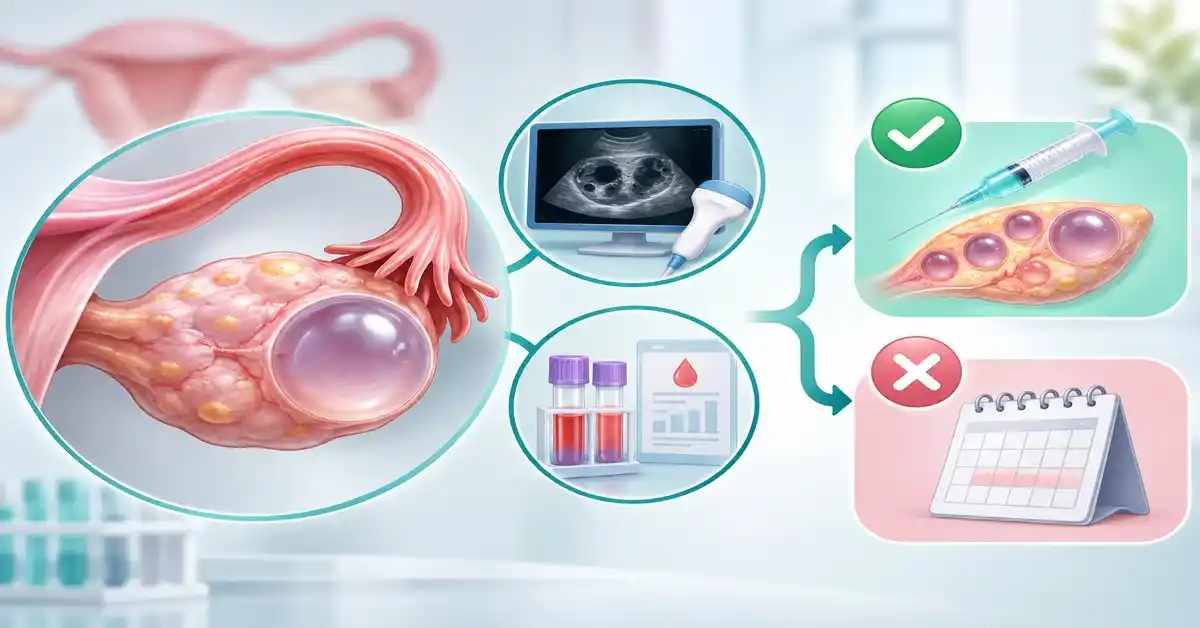
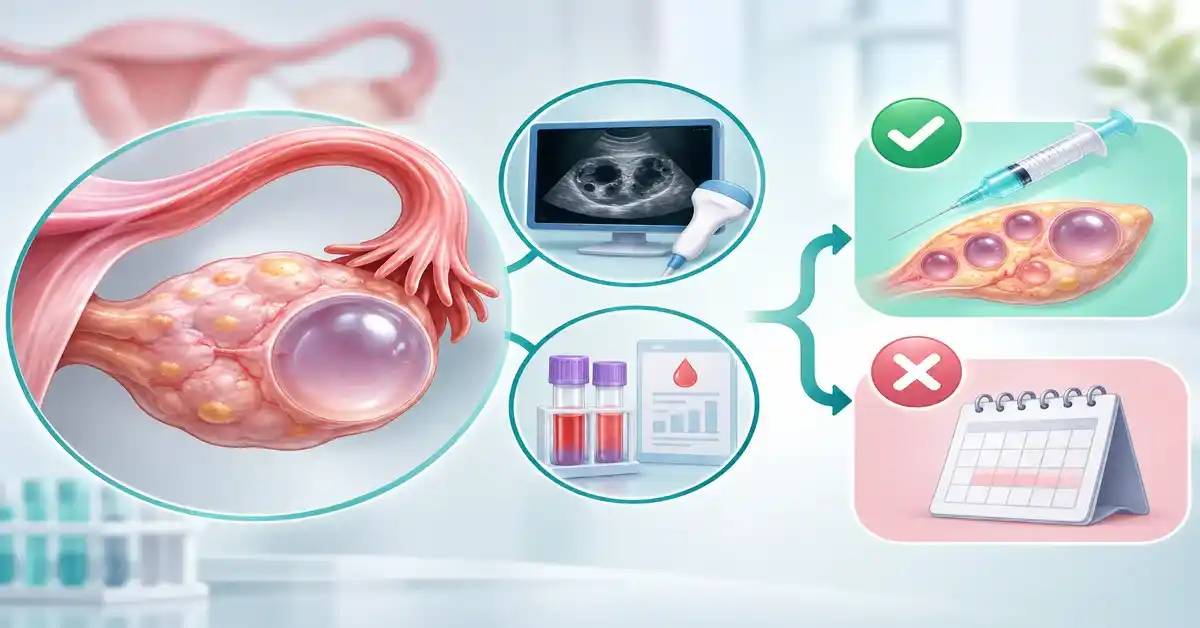
Finding an ovarian cyst on the baseline ultrasound before IVF does not automatically mean that stimulation must be cancelled or that surgery is required.
Ovarian cysts are not all the same.
A cyst may be a temporary functional cyst related to the menstrual cycle, a corpus luteum cyst, an ovarian endometrioma, or another type of ovarian lesion requiring a different approach.
The important question is therefore not simply:
“Is there a cyst?”
It is:
“What type of cyst is it, is it hormonally active, and does it affect ovarian response, follicle access or treatment safety?”
The American Society for Reproductive Medicine (ASRM) notes that functional ovarian cysts are common in reproductive-aged women and that the impact of a baseline cyst on IVF outcomes remains controversial. Earlier studies suggested more cancellations or poorer stimulation responses in some patients, whereas later studies did not consistently show fewer follicles or retrieved oocytes.
What Is an Ovarian Cyst?
An ovarian cyst is a fluid-filled or otherwise cystic structure within or on the surface of an ovary.
Many are benign.
However, the word “cyst” alone does not determine management.
Important characteristics include:
Size.
Ultrasound appearance.
Internal contents.
Whether one or both ovaries are affected.
Symptoms.
Hormonal activity.
Previous imaging.
And ovarian reserve.
What Types of Cysts Are Common Before IVF?
Follicular Cysts
These form when a follicle continues to grow without progressing through normal ovulation.
They are often simple and fluid filled.
Many resolve spontaneously.
Corpus Luteum Cysts
These develop after ovulation.
They may produce progesterone and sometimes appear more complex than a simple cyst on ultrasound.
They also commonly resolve without surgery.
Ovarian Endometriomas
These are ovarian cysts associated with endometriosis and usually contain old blood.
Their management before IVF is particularly important because ovarian surgery itself may reduce ovarian reserve.
Other Ovarian Lesions
Dermoid cysts and other benign or occasionally concerning masses may also be identified.
A lesion with atypical imaging features should be evaluated before stimulation begins.
Why Is Baseline Ultrasound Important?
Baseline ultrasound helps assess:
Antral follicle count.
Ovarian size.
Presence of cysts.
Endometrial appearance.
And other pelvic findings.
If a cyst is identified, additional hormone tests or repeat imaging may occasionally be needed before deciding whether to start stimulation.
Does Every Ovarian Cyst Delay IVF?
No.
Stimulation may sometimes proceed when the cyst is:
Small.
Simple.
Hormonally inactive.
Not interfering with follicle assessment.
And not associated with important symptoms.
Treatment may be postponed when a cyst:
Is hormonally active.
Is large enough to interfere with treatment.
Causes significant pain.
Obscures follicles.
Makes egg retrieval difficult.
Or has suspicious imaging features.
Management should therefore be individualized.
What Does a Hormonally Active Cyst Mean?
Some functional cysts produce estradiol or progesterone.
This can affect the hormonal environment at the planned start of stimulation.
ASRM notes that both follicular and corpus luteum cysts may be hormonally active.
The physician may therefore combine ultrasound findings with hormone levels before deciding whether treatment should begin.
Can Functional Cysts Resolve on Their Own?
Yes.
Many functional ovarian cysts regress spontaneously.
This is why immediate aspiration or surgery is usually unnecessary after a single ultrasound finding when the cyst otherwise appears benign.
Repeat ultrasound during the next cycle may be sufficient.
Are Birth-Control Pills Used for Ovarian Cysts Before IVF?
Hormonal contraception may be used in fertility treatment for scheduling purposes and to reduce the likelihood of some cysts forming.
However, it does not mean that every existing cyst should automatically be treated with contraceptive pills.
ASRM recognizes hormonal contraception as a possible tool for cycle scheduling and ovarian-cyst prevention in fertility treatment.

Should a Cyst Be Aspirated Before IVF?
Routine cyst aspiration is not appropriate for every patient.
Aspiration may not permanently resolve the cyst and carries potential risks including:
Pain.
Bleeding.
Infection.
And ovarian injury.
The decision should depend on cyst type and the reason intervention is being considered.
Does Cyst Size Matter?
Yes, but not by itself.
A larger cyst can:
Cause pain.
Obscure developing follicles.
Make egg retrieval technically difficult.
Or contribute to ovarian enlargement.
However, a simple larger cyst may be managed very differently from a smaller lesion with atypical features.
There is no universal diameter that automatically requires cancellation of an IVF cycle.
What About an Ovarian Endometrioma?
Endometriomas deserve a different approach.
The European Society of Human Reproduction and Embryology (ESHRE) recommends against routine surgery for ovarian endometrioma before assisted reproductive technology solely to improve live-birth rates because surgery has not shown clear reproductive benefit and is likely to reduce ovarian reserve.
Read more in Endometriosis and Infertility: When Is IVF Needed?.
Can IVF Start With an Endometrioma Still Present?
Often, yes.
This may be reasonable when the endometrioma:
Has a typical stable appearance.
Is not causing severe pain.
Has no suspicious features.
And does not prevent access to follicles.
ESHRE notes that surgery before assisted reproduction may be considered for endometriosis-associated pain or when the endometrioma makes follicle access difficult.
Why Not Remove Every Endometrioma Before IVF?
Ovarian surgery may remove or damage healthy ovarian tissue.
It can also affect ovarian blood supply.
This is particularly important in patients with:
Diminished ovarian reserve.
Previous ovarian surgery.
Bilateral endometriomas.
Or advanced reproductive age.
The potential reduction in ovarian reserve must therefore be weighed against any surgical benefit.
Read Diminished Ovarian Reserve: Does Low AMH Mean Poor Egg Quality and When Is IVF Needed?.
Does an Endometrioma Reduce Ovarian Response?
It may.
A 2026 systematic review and meta-analysis found that ovaries affected by unilateral endometriomas can show reduced response to ovarian stimulation compared with the unaffected ovary in the same patient.
This does not prove that surgical removal will improve stimulation response.
The effect of the cyst and the effect of surgery are separate questions.
When Might Surgery Before IVF Be Appropriate?
Surgery may be considered when there is an indication beyond attempting to improve IVF success.
Examples include:
Significant pain.
Suspicious imaging.
Marked growth.
Difficulty accessing follicles.
Or another surgical indication.
Whenever ovarian surgery is required, preservation of healthy ovarian tissue is particularly important.
What if Ovarian Reserve Is Already Low?
Management becomes more complex.
Surgery may further reduce ovarian reserve, while delaying IVF may also carry reproductive cost.
In selected patients, proceeding directly to IVF may be more appropriate.
In others, the nature of the ovarian lesion may require treatment first.
Important factors include:
Age.
AMH and antral follicle count.
Cyst type and size.
Unilateral or bilateral disease.
Previous ovarian surgery.
And expected accessibility during retrieval.
Can an Ovarian Cyst Be Malignant?
Most ovarian cysts identified in reproductive-aged women are benign.
However, certain ultrasound features require further assessment.
These may include:
Solid components.
Papillary projections.
Irregular septations.
Unusual blood flow.
Rapid enlargement.
Or an appearance inconsistent with a typical functional cyst.
Ovarian stimulation should not proceed until a concerning lesion has been appropriately evaluated.
Are Tumour Markers Needed for Every Cyst?
No.
Tumour markers are not routine tests for every simple ovarian cyst.
Some markers can also be elevated in benign conditions such as endometriosis.
They should be ordered only when clinically indicated.
Can Stimulation Make the Cyst Larger?
Some hormonally responsive or functional cysts may change during treatment.
For this reason, ovarian ultrasound monitoring continues throughout stimulation.
A stable cyst, however, does not automatically become dangerous because stimulation begins.
Does an Ovarian Cyst Increase Torsion Risk?
Ovarian torsion occurs when an ovary twists around its supporting structures.
Larger ovaries or ovarian masses can contribute to risk in selected cases.
IVF stimulation also enlarges the ovaries.
Patients may therefore be advised to avoid intense physical activity during stimulation.
Sudden severe pelvic pain, especially with nausea or vomiting, requires urgent assessment.
What if a Cyst Is Found on the Day Stimulation Is Supposed to Start?
The physician may:
Proceed with stimulation.
Repeat hormone tests.
Repeat ultrasound.
Delay the cycle.
Or further evaluate the lesion.
The choice depends on cyst characteristics and hormonal activity.
Does a Cyst Larger Than 3 cm Automatically Cancel IVF?
No.
There is no universal 3-cm rule for all ovarian cysts.
A simple inactive cyst may not require cancellation, whereas a smaller hormonally active or suspicious lesion may require postponement.
What if Only One Ovary Has a Cyst?
The other ovary may still respond normally.
Even the affected ovary may contain accessible follicles around the cyst.
Whether those follicles can be safely retrieved depends on the cyst's location and size.
What if Both Ovaries Have Endometriomas?
This requires particularly careful planning.
Bilateral ovarian surgery may carry a greater risk of reducing ovarian reserve.
The potential benefit of surgery therefore needs to be weighed carefully against ovarian damage and reproductive timing.
Can Eggs Be Retrieved From an Ovary With a Cyst?
Sometimes.
The physician may be able to access normal follicles while avoiding the cyst.
Technical feasibility depends on:
Cyst position.
Size.
Follicle distribution.
Needle pathway.
And operator experience.
Can an Endometrioma Be Accidentally Punctured During Retrieval?
Clinicians generally try to avoid puncturing an endometrioma because of concerns about contamination and infection.
However, cyst location can occasionally make access to surrounding follicles difficult.
Pre-retrieval ultrasound planning is therefore important.
Are Antibiotics Automatically Needed With an Endometrioma?
No.
Antibiotic policies around oocyte retrieval vary according to clinical risk and centre protocol.
Patients should not self-start antibiotics simply because an endometrioma exists.
Can Eggs or Embryos Be Frozen Before Ovarian Surgery?
Yes, in selected cases.
When surgery is necessary but there is concern that ovarian reserve may decline afterward, fertility preservation may be discussed before the operation.
This can involve:
Ovarian stimulation.
Egg retrieval.
Oocyte freezing.
Or embryo creation and freezing.
ASRM recognizes controlled ovarian stimulation with oocyte or embryo cryopreservation as a major fertility-preservation strategy when the clinical situation safely allows it.
Should Ovarian Reserve Be Checked Before Cyst Surgery?
Often, yes, particularly when the operation involves ovarian tissue.
Evaluation may include:
AMH.
Antral follicle count.
Age.
And previous ovarian surgery.
The updated ESHRE ovarian-stimulation guideline recommends either AMH or antral follicle count to predict high or low ovarian response.
These markers do not independently predict pregnancy or live birth.
Must IVF Wait Until Every Cyst Has Disappeared?
No.
The goal is not to create an ovary with no visible cysts.
The goal is to establish that:
The lesion is understood.
There are no concerning features.
The hormonal environment is appropriate.
Follicles can be monitored.
And egg retrieval can be performed safely.
Treatment may therefore proceed despite selected ovarian cysts.
What Should an Ultrasound Report Describe?
A useful report should ideally document:
Which ovary contains the cyst.
Accurate dimensions.
Cyst appearance.
Simple or complex contents.
Wall characteristics.
Solid components.
Septations.
Relevant blood flow.
And antral follicle count in each ovary.
This provides more information than simply writing “ovarian cyst present.”
Questions to Ask Before Starting IVF
Useful questions include:
What type of cyst does this appear to be?
Is it likely functional or an endometrioma?
Is it hormonally active?
Do I need repeat imaging?
Will it affect ovarian response?
Will it interfere with egg retrieval?
Is surgery truly necessary?
Could surgery reduce ovarian reserve?
Should fertility preservation be considered before surgery?
Common Mistakes
Common errors include:
Assuming every ovarian cyst requires surgery.
Cancelling treatment based on cyst size alone.
Performing routine surgery for every endometrioma before IVF.
Ignoring the effect of ovarian surgery on ovarian reserve.
Starting stimulation without evaluating an atypical lesion.
Routine cyst aspiration without a clear indication.
And assuming that a cyst means the ovary cannot respond to stimulation.
Conclusion
An ovarian cyst before IVF does not automatically mean treatment must be postponed.
Management depends on the cyst's type, hormonal activity, size, ultrasound appearance, symptoms and whether it affects ovarian monitoring or access to follicles.
Functional cysts often regress spontaneously, and stimulation may sometimes proceed when a cyst is simple and inactive.
Ovarian endometriomas require particularly careful decision-making. Routine surgery before IVF does not improve live-birth outcomes for all patients and can reduce ovarian reserve, so surgery should not be performed solely to improve IVF success.
Surgery may still be appropriate for pain, suspicious lesions or technically difficult follicle access.
If an ovarian cyst has been identified before IVF, you can book a consultation with Safemedigo on WhatsApp to review the ultrasound, ovarian reserve and treatment timing.
Frequently Asked Questions
Does an ovarian cyst always prevent IVF stimulation?
No. Some simple, hormonally inactive cysts allow treatment to proceed, while others require reassessment or delay.
Should an endometrioma always be removed before IVF?
No. Routine surgery does not improve IVF outcomes for every patient and may reduce ovarian reserve.
Can a functional ovarian cyst disappear without treatment?
Yes. Many functional cysts resolve spontaneously over one or more cycles.
Does cyst size alone determine whether IVF should be delayed?
No. Cyst type, appearance, hormonal activity, symptoms and follicle accessibility are also important.
Can eggs be frozen before ovarian-cyst surgery?
Yes, in selected patients when surgery may threaten ovarian reserve.