


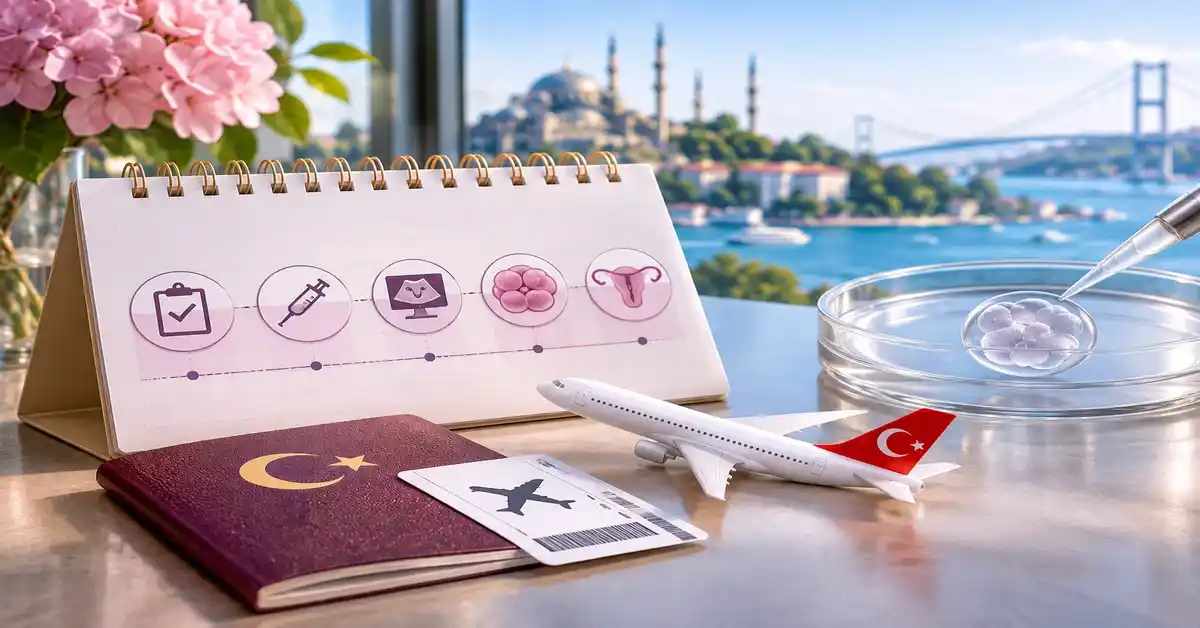
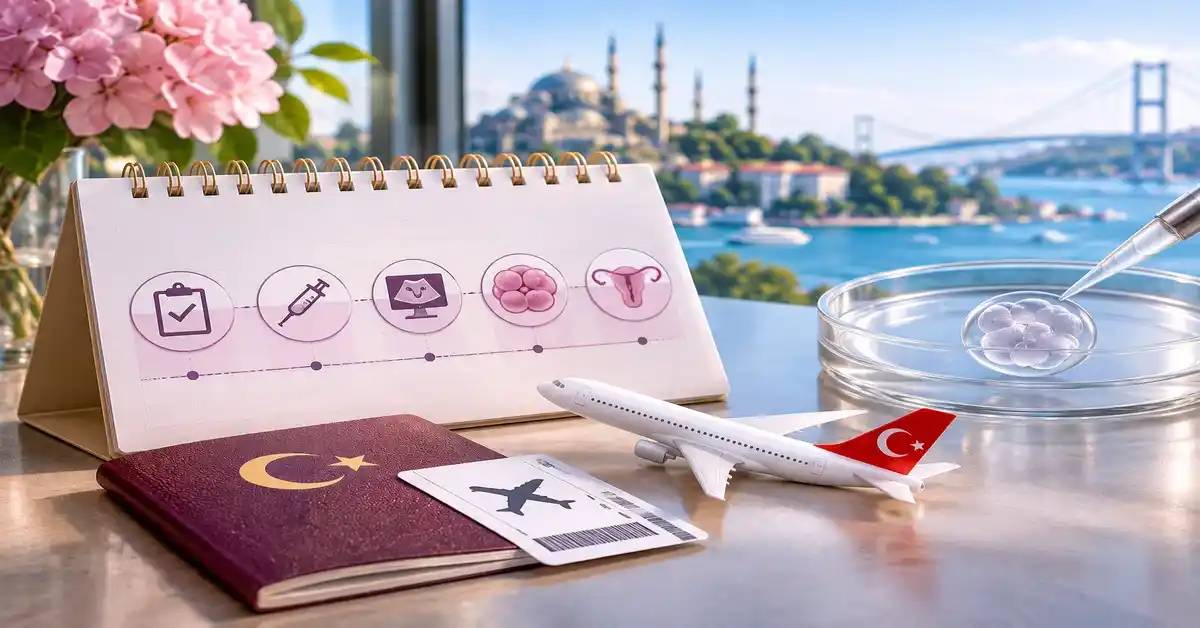
Travelling to Turkey for IVF should begin with medical assessment rather than booking a flight.
IVF is particularly sensitive to timing because treatment may depend on the menstrual cycle, ovarian response, ultrasound findings, hormone results and embryo development.
For this reason, there is no single travel schedule that fits every international patient.
One patient may complete stimulation, egg retrieval and fresh embryo transfer during one visit. Another may retrieve and freeze embryos during the first trip and return later for frozen embryo transfer.
In selected cases, part of the monitoring may also be completed in the patient's home country before travelling to Turkey.
Good planning can reduce unnecessary travel, prevent poorly timed flight bookings and help couples understand which steps can be completed before arrival and which must take place at the fertility centre.
Why Does IVF Travel Require Different Planning?
IVF is not a one-day procedure.
The treatment journey may include:
Initial evaluation of both partners.
Review of previous fertility testing.
Additional investigations when indicated.
Ovarian stimulation.
Follicle monitoring.
Egg retrieval.
Semen collection or male-factor treatment.
Fertilisation and embryo culture.
Fresh embryo transfer or embryo freezing.
Pregnancy testing.
Or preparation for a later frozen embryo transfer.
Travel therefore needs to follow the medical plan rather than forcing the treatment into a fixed holiday schedule.
Start With Medical Evaluation Before Booking Flights
International patients should ideally send their records for preliminary review before committing to travel dates.
The American Society for Reproductive Medicine (ASRM) recommends systematic infertility evaluation, including assessment of relevant female factors and concurrent male evaluation when a male partner provides sperm.
Useful records may include:
Age and reproductive history.
Duration of infertility.
Menstrual cycle information.
Previous pregnancies or miscarriages.
Previous fertility treatment.
IVF cycle reports.
Ovarian reserve results when available.
Ultrasound reports.
Tubal or uterine assessments when clinically indicated.
Semen analysis.
Previous surgical reports.
Current medications.
The purpose is not to order every available test before travel. It is to identify which information is actually needed for planning.
Can Tests Be Completed in Your Home Country?
Often, yes.
Blood tests, ultrasound monitoring and other investigations may sometimes be performed locally and shared electronically with the treating team.
This can reduce the number of days required in Turkey.
However, the fertility centre should confirm:
Which tests are acceptable.
When they should be performed.
Which laboratory units are required.
What information the ultrasound report must include.
And how recent the results should be.
Previous results should not automatically be assumed to remain valid.
When Should You Arrive in Turkey?
Timing depends on the treatment plan.
When stimulation will begin in Turkey, arrival is often organised around the beginning of the menstrual cycle so baseline ultrasound and required tests can be completed before medication starts.
If the doctor approves remote initiation and monitoring, the patient may travel later during stimulation.
This requires close coordination because medication doses and timing may change according to follicular development.
Treatment should never be altered simply to match a flight schedule without medical approval.
How Long Does IVF Treatment in Turkey Take?
There is no fixed duration.
When ovarian stimulation, retrieval and fresh embryo transfer are all completed in Turkey, couples may commonly need approximately two to three weeks, although individual cycles can be shorter or longer.
With a freeze-all strategy, the first visit may end after egg retrieval and embryo freezing.
The patient then returns for frozen embryo transfer during a later cycle.
The overall travel plan therefore depends on whether treatment is intended as:
One treatment visit.
Two separate visits.
Or a combination of remote monitoring and treatment in Turkey.
Why Can the Schedule Change?
Ovarian response cannot be predicted perfectly.
A patient may need:
Additional stimulation days.
Medication adjustments.
Repeat hormone testing.
A different trigger date.
Or a change from fresh transfer to embryo freezing.
International patients should therefore avoid extremely inflexible return bookings whenever possible.
What Happens During Ovarian Stimulation?
Fertility medications are used to encourage several follicles to develop.
Ultrasound monitoring, and sometimes hormonal blood tests, help the doctor assess the response and determine when the final maturation injection should be administered.
Medication type, dose and duration vary between patients.
The plan cannot be determined from age or AMH alone.
Does the Male Partner Need to Stay for the Entire Cycle?
Not always.
If the male partner does not need early evaluation, he may sometimes arrive closer to egg retrieval and semen collection.
This should be planned in advance.
When there is significant male-factor infertility or a possibility of surgical sperm retrieval, earlier assessment may be necessary.
What Documents Should International IVF Patients Bring?
Patients should confirm requirements directly with the centre, but commonly useful documents include:
Passports.
Official marriage documentation.
Certified translation when requested.
Previous fertility records.
Laboratory results.
Ultrasound and imaging reports.
Previous operation reports.
Medication lists.
Previous IVF and embryo reports.
Turkish assisted-reproduction regulations are structured around treatment of married couples, so international patients should confirm documentary requirements before travelling.
What Happens After Egg Retrieval?
Retrieved oocytes are assessed for maturity.
Fertilisation is then performed according to the clinical and laboratory plan, followed by embryo culture.
The number of eggs retrieved is not the same as the number of embryos eventually available for transfer or freezing.
There are several stages:
Eggs retrieved.
Mature eggs.
Fertilised eggs.
Developing embryos.
And embryos suitable for transfer or cryopreservation.
The final outcome cannot be predicted on retrieval day alone.
Does Embryo Transfer Always Happen During the Same Trip?
No.
Fresh Embryo Transfer
Transfer may occur several days after retrieval when the clinical situation and endometrium are appropriate.
Frozen Embryo Transfer
Embryos may instead be cryopreserved and transferred during a later cycle.
A freeze-all strategy may be selected because of:
Risk of ovarian hyperstimulation.
Endometrial concerns.
A uterine condition requiring treatment.
Preimplantation genetic testing.
Or another clinical reason.
For international patients, this may mean planning a second visit rather than one long stay.

What if Preimplantation Genetic Testing Is Planned?
Preimplantation genetic testing usually changes the travel pathway.
Embryos are cultured to the appropriate stage, biopsied when indicated and usually frozen while results are awaited.
The first visit therefore focuses on stimulation, retrieval, fertilisation, embryo culture, biopsy and freezing.
Embryo transfer is then planned later.
Patients should understand this before booking one extended trip expecting immediate transfer.
Can You Fly Home After Egg Retrieval?
Many patients can travel after an appropriate recovery period if the treating team confirms that they are clinically well.
After retrieval, some pelvic discomfort, bloating, fatigue or light bleeding may occur.
Severe or increasing pain, rapidly worsening abdominal swelling, shortness of breath, persistent vomiting or reduced urination require medical assessment.
The return flight should therefore not be scheduled immediately after retrieval without allowing for recovery and review.
Can You Fly After Embryo Transfer?
Air travel itself does not cause the embryo to fall out or automatically prevent implantation.
Travel planning should nevertheless consider:
Patient comfort.
Flight duration.
Medication timing.
Any need for follow-up.
And individual medical risks.
Prolonged bed rest is not generally required after embryo transfer, but the treating physician's specific instructions should be followed.
Where Should You Stay During IVF?
Convenient access to the fertility centre is usually more useful than staying in a distant tourist area.
During stimulation, repeated ultrasound or laboratory visits may be required.
Consider:
Travel time to the centre.
Transport availability.
Flexible accommodation dates.
Kitchen facilities for longer stays.
Nearby pharmacies.
And the needs of an accompanying partner.
Can IVF Treatment Be Combined With Tourism?
Light sightseeing may be possible on suitable days, but the treatment schedule should remain the priority.
During ovarian stimulation, strenuous physical activity may be restricted because enlarged ovaries can be more vulnerable to discomfort or torsion.
After egg retrieval, patients may also need more rest.
A tightly scheduled tourism programme is therefore not ideal.
How Should International Patients Choose an IVF Centre in Turkey?
Price should not be the only deciding factor.
Patients should ask about:
Licensing.
Experience of the fertility team.
Embryology laboratory standards.
Who manages the stimulation plan.
How monitoring results are reviewed.
Embryo freezing policy.
What is included in the quoted price.
Medication costs.
Additional procedure costs.
Follow-up after returning home.
And what happens if embryo transfer does not occur during the first visit.
Success rates should also be interpreted cautiously because results vary by age, diagnosis and patient population.
What Should an IVF Price Quote Include?
A transparent quote should clarify whether the cost includes:
Consultations.
Ultrasound monitoring.
Hormone testing.
Stimulation medication.
Egg retrieval.
Anaesthesia.
Fertilisation.
Embryo culture.
Embryo transfer.
Embryo freezing.
Storage.
Genetic testing when planned.
And post-transfer medication.
Two clinics may quote very different prices because the included services are not the same.
Can the Final Cost Change?
Yes.
Variable expenses may depend on:
Medication dose.
Length of stimulation.
Number of embryos frozen.
Number of embryos genetically tested.
Additional procedures.
Or a later frozen embryo transfer.
Patients should therefore ask which elements are fixed and which may change.
What Should Be Arranged Before Leaving Turkey?
Patients should leave with a clear next-step plan.
This may include:
Medication instructions.
Dates for blood tests.
Pregnancy-test timing.
Early-pregnancy ultrasound instructions.
Egg-retrieval report.
Embryology information.
Embryo-transfer report when applicable.
And instructions about symptoms requiring urgent medical assessment.
When embryos are frozen, patients should also understand their number, developmental stage, storage arrangements and next transfer plan.
How Does Follow-Up Work After Returning Home?
The fertility journey may continue after travel ends.
Follow-up can include:
Pregnancy blood testing.
Hormonal monitoring when indicated.
Early pregnancy ultrasound.
Medication adjustments.
And review of results with the Turkish fertility team.
Patients should know before departure where to send results and how follow-up communication will work.
What if the Pregnancy Test Is Positive?
Follow-up then shifts toward confirming normal pregnancy development.
Medication should not be stopped simply because the pregnancy test is positive unless instructed by the fertility doctor.
Once the pregnancy is established, routine care can usually transition to an obstetrician in the patient's home country.
What if the IVF Cycle Is Unsuccessful?
The next step should begin with reviewing what happened during the cycle.
Important factors include:
Ovarian response.
Number of eggs retrieved.
Maturity.
Fertilisation.
Embryo development.
Endometrial findings.
And embryo-transfer details.
One failed cycle does not automatically justify a large panel of additional tests.
Common Travel-Planning Mistakes
Common mistakes include:
Booking flights before medical evaluation.
Fixing the return date before understanding the treatment pathway.
Travelling with incomplete records.
Starting medication without clear supervision.
Failing to evaluate the male partner before travel.
Assuming every cycle ends with fresh embryo transfer.
Assuming genetic testing and embryo transfer occur during the same visit.
Comparing clinics only by headline price.
Not checking what a package includes.
And leaving Turkey without a clear follow-up plan.
Practical Checklist Before Travel
Before travelling, confirm that you have:
A preliminary treatment plan.
An appropriate arrival date.
A list of required tests.
Personal identification and marriage documentation.
Electronic copies of medical records.
Any medications required before arrival.
Confirmed clinic appointments.
Flexible accommodation.
A reasonably flexible return flight.
And a clear plan for when the male partner needs to be present.
Conclusion
IVF travel to Turkey is easier to organise when the medical plan comes before the travel plan.
Pre-travel evaluation helps determine required testing, appropriate arrival timing and whether treatment is likely to require one visit or several.
Some patients may complete part of their monitoring at home, while others should begin the entire cycle in Turkey.
Egg retrieval does not always mean embryo transfer will occur during the same visit. Embryo freezing, genetic testing or uterine factors may make a later frozen transfer more appropriate.
Before returning home, patients should have written medication, follow-up and testing instructions because fertility treatment may continue after they leave Turkey.
If you are considering IVF in Turkey, you can book a consultation with Safemedigo on WhatsApp to review your records and organise testing, travel timing and treatment steps before booking your trip.
Frequently Asked Questions
How long should I stay in Turkey for IVF?
A full stimulation-to-transfer cycle may commonly require around two to three weeks, but timing varies by response and treatment strategy.
Can I start stimulation in my home country?
Sometimes. Remote initiation may be possible when the doctor approves and appropriate ultrasound and laboratory monitoring are available locally.
Does my partner need to travel with me from the beginning?
Not always. The required arrival date depends on semen collection, testing and whether any male-factor procedure is needed.
Will I need a second trip if my embryos are frozen?
Usually, if you leave after retrieval. Frozen embryo transfer is arranged during a later cycle.
Can pregnancy follow-up be completed in my home country?
Yes. Blood tests and early ultrasound can often be performed locally and shared with the treating fertility team.