









As we age, our skin naturally loses its elasticity and firmness, leading to the appearance of a sagging face that can affect our appearance and self-confidence. For many years, surgery was the only available solution to combat these changes, but it brought with it concerns about general anesthesia, a long recovery period, and significant costs.
Today, aesthetic medicine offers an innovative and effective solution known as the Thread Face Lift, a non-surgical technique that promises quick results and a more youthful, vibrant look with minimal intervention.
At Safemedigo, we believe that beauty should be accessible to everyone safely and easily. Therefore, we present this comprehensive guide that covers everything you need to know about the thread lift procedure, from the types of threads used to the expected results, cost, and essential tips, to help you make an informed decision towards restoring your skin's youthfulness.
What is a Thread Face Lift?
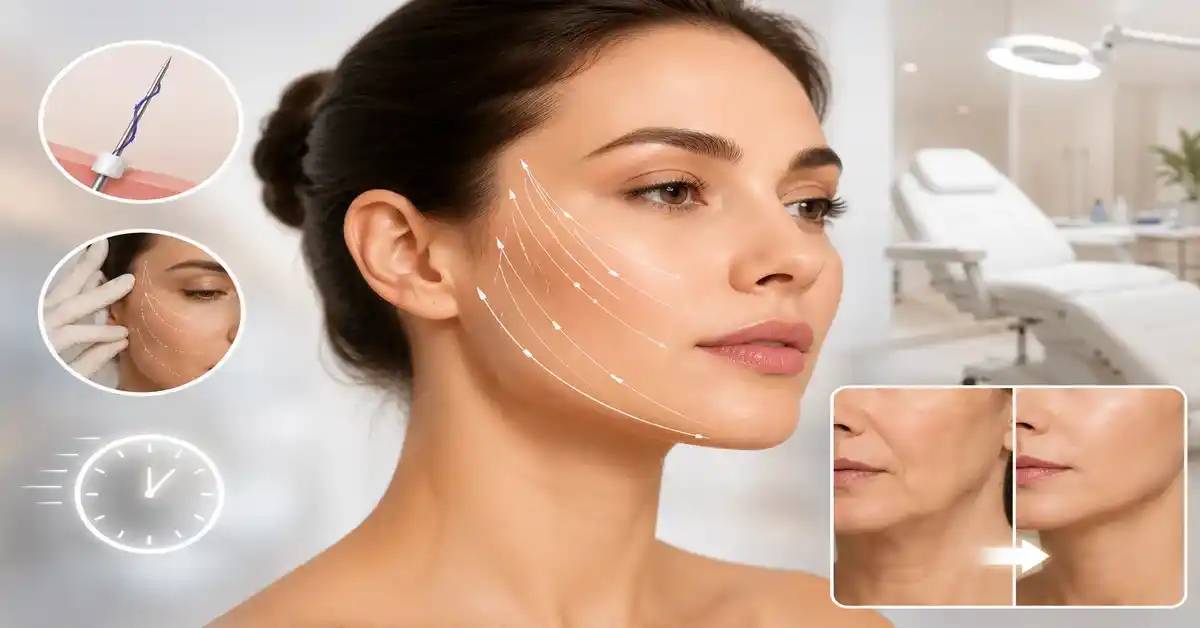
A Thread Face Lift is an advanced, non-surgical cosmetic procedure designed to lift and tighten sagging tissues in the face and neck, resulting in a more youthful and defined appearance. This procedure involves inserting special, dissolvable medical threads under the skin using fine needles. These threads work to immediately lift the skin and stimulate the body's natural collagen production over the long term, which enhances the skin's elasticity and radiance.
Definition of face-lift threads and their types
Face-lift threads are sutures made from biocompatible materials that are completely absorbable by the body over time, ensuring their high safety profile. These threads feature a unique dual-action mechanism:
the first effect is an immediate mechanical lift, where the threads (especially those with barbs or cones) anchor into the soft tissue under the skin and lift it to its new position.
The second, and more crucial long-term effect, is the biological stimulation of collagen and elastin production. As the body absorbs these threads, it builds a new network of collagen fibers around them, leading to a natural and gradual improvement in skin quality, thickness, and elasticity. This effect ensures that the thread lift results are sustained even after the threads have fully dissolved.
Why choose a thread lift procedure over surgery?
The thread lift vs surgical facelift comparison reveals several fundamental differences that make threads a preferred choice for many.
First, the thread lift benefits are clear in that it is a minimally invasive procedure that does not require general anesthesia but is performed under local anesthesia, significantly reducing the risks associated with anesthesia.
Second, the recovery period is very short, with most people able to return to their daily activities within two to three days, compared to weeks or even months of recovery after surgery.
Third, the thread lift procedure leaves no visible scars, as the threads are inserted through tiny entry points that heal quickly.
Finally, the thread lift cost is much lower than the cost of surgery, making it an accessible option for a wider range of people seeking an effective and safe solution to the signs of aging.
Areas suitable for thread lift
Face-lift threads are versatile and can treat many areas of the face and neck that show signs of sagging. The most prominent of these areas include:
Eyebrows: Threads can be used to lift drooping eyebrows, giving the eyes a more open and alert appearance.
Mid-face and Cheeks: Threads are very effective in lifting and redefining sagging cheeks, which reduces the depth of the nasolabial folds (the lines extending from the nose to the corners of the mouth).
Jawline (Jowls): This is one of the most common uses, where threads work to tighten the sagging skin along the jawline, redefining the facial contours and providing a more youthful look.
Neck: Threads can be used to tighten the loose skin under the chin and in the neck area, reducing the appearance of a "double chin" and horizontal wrinkles.
Around the Mouth: Certain types of threads (like smooth threads) can be used to improve the appearance of fine lines around the mouth (marionette lines).
Types of Face Lift Threads (PDO, PLLA, PCL)
There are several types of face lift threads used in this procedure, differing in their material, duration in the body, and ability to stimulate collagen. The choice among these types depends on the patient's condition and the desired results.
PDO threads: specifications and use
PDO (Polydioxanone) threads are the most common and widely used in the thread lift procedure. This material has been used in the manufacturing of absorbable surgical sutures for decades, proving its high safety. PDO threads dissolve completely in the body within 6 to 12 months. During this period, they strongly stimulate the production of type I and type III collagen. PDO threads come in three main forms:
Mono Threads: These are smooth threads used to improve skin texture and tighten areas needing minimal support. They are often inserted in a mesh-like pattern to promote overall collagen production.
Screw/Tornado Threads: These are threads twisted around the needle, giving them more volume and a better ability to slightly lift sagging skin and fill some wrinkles.
Cog/Barbed Threads: These threads are equipped with very fine barbs or hooks that grip the tissue under the skin, allowing the doctor to immediately and effectively lift and tighten the skin. These are the primary threads used to achieve a noticeable lifting effect.
PLLA and PCL threads: differences and results
Besides PDO threads, other types offer longer-lasting results:
PLLA (Poly-L-Lactic Acid) Threads: This material is known for its use in dermal fillers (like Sculptra). PLLA threads are characterized by their superior ability to stimulate collagen production gradually and continuously. Their results last longer than PDO threads, as they can remain in the body for up to two years. They are stiffer than PDO threads and provide a strong lift and significant improvement in tissue volume.
PCL (Polycaprolactone) Threads: These are the newest and longest-lasting threads. They can last in the body for more than two years, providing very long-term collagen stimulation. PCL threads are highly flexible and strong, making them an excellent choice for achieving a powerful lift and natural-looking results with great thread lift longevity.
Choosing the right thread type for sagging
The choice of the appropriate thread type depends on several factors evaluated by the specialist. For mild to moderate sagging face and thread lift cases, PDO threads may be sufficient to achieve the desired results, especially in younger patients. For more advanced sagging or when the patient desires the longest-lasting results possible, PLLA or PCL threads may be the better option. Doctors often combine different types of threads in the same procedure to achieve the best results; for example, using cog threads to lift tissues and mono threads to improve skin quality in other areas.
Who is Eligible for a Thread Lift?
A thread face lift is not suitable for everyone. Determining the ideal candidate depends on a careful assessment of the skin condition, degree of sagging, and the patient's realistic expectations.
Sagging face and thread lift – when is it suitable?
A thread face lift is most suitable for individuals suffering from mild to moderate facial sagging. These are people who have begun to show signs of loss of elasticity, such as sagging cheeks, the appearance of lines around the mouth, or a loss of jawline definition, but do not have severe sagging or excess skin that requires surgical removal.
The procedure is ideal for those looking for a noticeable and natural-looking improvement without undergoing major surgery. In cases of severe sagging, threads may not be sufficient to achieve the desired results, and a traditional facelift might be the more effective solution.
Age and medical considerations
Typically, ideal candidates are in their late thirties to early fifties. At this age, the skin still has enough elasticity to respond effectively to the thread lift and collagen stimulation. Medically, the candidate should be in good general health and not suffer from uncontrolled chronic diseases such as diabetes or autoimmune disorders. They should also not have any active skin infections in the area to be treated. Realistic expectations are a prerequisite; the patient must understand that thread lift results are natural and not as dramatic as surgical results.
Thread lift for men and women
Absolutely. Cosmetic procedures are no longer exclusive to women. The thread lift for men and women has become equally popular. Men, just like women, want to maintain a youthful and energetic appearance, especially in a competitive work environment. Threads can be used in men to define the jawline, lift the cheeks, and reduce signs of fatigue. The application technique may differ slightly to suit the more defined male facial structure and thicker skin, but the principle and results remain effective for both genders.
Read about: Latest Thread Face Lift Methods for Quick Visible Results
Preparation Before a Thread Lift
Good preparation before a thread lift is key to achieving the best results and minimizing any potential risks. Your journey with a thread face lift begins with a comprehensive medical consultation and ends with strict adherence to pre-procedure instructions.
Medical consultation and expected results
The first and most important step is to consult a qualified and experienced cosmetic doctor. During this consultation, the doctor will assess the degree of facial sagging, skin quality, and facial structure. They will discuss your goals and expectations and explain in detail the thread lift benefits and thread lift side effects in your specific case.
The doctor will also determine the most suitable types of face lift threads for you and the areas to be treated. This is an excellent opportunity to ask all your questions and voice your concerns. At Safemedigo, we guarantee a transparent and detailed consultation with the best experts to help you fully understand the procedure. Contact us on WhatsApp today to book your free consultation.
Tips before a thread lift (avoiding smoking, blood thinners)
To ensure a safe and smooth procedure, your doctor will ask you to follow some tips before a thread lift. The most important of these include:
Stop taking blood-thinning medications: You should stop taking medications such as aspirin, ibuprofen, and supplements like vitamin E and fish oil for one to two weeks before the procedure to reduce the risk of bruising and bleeding.
Avoid smoking and alcohol: Smoking negatively affects the healing process and the skin's ability to recover. It is strongly recommended to stop smoking for at least two weeks before and after the procedure. Alcohol should also be avoided for 48 hours before the procedure as it increases blood thinning.
Inform your doctor of your medical history: You must be completely honest with your doctor about any medical conditions you have or any medications you are taking.
Logistical preparations – clinic, anesthesia, procedure
The thread lift procedure is a simple procedure performed in the doctor's clinic and does not require a hospital stay. The procedure is performed under local anesthesia, where an anesthetic is injected at the entry and exit points of the threads to ensure you feel no pain. The entire process usually takes between 45 to 90 minutes, depending on the number of threads and the areas being treated. It is a good idea to arrange for someone to drive you home after the procedure, although most people feel comfortable enough to drive themselves.

Steps of the Thread Lift Procedure
Understanding the steps of the procedure helps to alleviate anxiety and gives you a clear picture of what to expect on the day of the operation.
How the thread lift procedure is performed
The procedure begins with thoroughly cleaning and sterilizing the face. The doctor then marks the entry and exit points for the threads on your face and draws the paths they will follow. Local anesthesia is injected at these points. After the anesthesia takes effect, the doctor inserts the thread under the skin using a very fine needle or a cannula.
The needle is passed through the fatty tissue under the skin along the pre-marked path and then exits at the exit point. Once the thread is in place, the doctor gently tightens and lifts the tissue to achieve the desired lift. The excess ends of the thread are trimmed, and their ends disappear completely beneath the skin's surface.
Duration and immediate recovery
As mentioned, the entire procedure takes less than 90 minutes. Immediately after the procedure, you can see an instant improvement in skin tightness. There may be some slight swelling, redness, or bruising at the thread insertion sites, which is completely normal. You can go home the same day. There is no recovery period in the traditional sense, but there are some instructions to follow for the first few days.
Sensations during and after the procedure
Thanks to local anesthesia, you will not feel any pain during the insertion of the threads. You may feel some pressure or a slight pulling sensation as the doctor secures the threads, but it is a tolerable feeling. After the anesthesia wears off, you may feel some mild pain or discomfort, which can be easily controlled with regular pain relievers like paracetamol. You may also feel that your face is unusually tight for the first few days; this feeling gradually subsides as the tissues adapt to their new position.
Thread Lift Results: What to Expect
Thread lift results are one of the most attractive aspects of this procedure, combining immediate improvement with long-term rejuvenation.
Immediate results vs long-term results
The results can be divided into two phases: immediate results and long-term results. The immediate result is the mechanical lifting effect that occurs as soon as the threads are inserted and tightened. You will immediately notice that the sagging areas have been lifted and your facial contours are more defined.
The long-term results, which are the most significant, appear gradually over the following weeks and months. These results are the product of the natural collagen production stimulation process. As the new collagen network is built, you will notice that your skin has become thicker, more elastic, and more radiant, and its overall quality has improved.
When results appear after a thread lift
When results appear after a thread lift? As mentioned, you will see about 20-30% of the final result immediately after the procedure. But the full and final result takes time to appear. The collagen production process begins after about 4-6 weeks and continues to improve for up to 6 months. Therefore, it can be said that the final result of a thread lift appears completely after about 3 to 6 months from the procedure and continues to improve thereafter.
Thread lift longevity
Thread lift longevity depends on several factors, most importantly the type of threads used, the patient's age, skin quality, and lifestyle. In general, the results can last from one to three years. With PDO threads, the results usually last for 12-18 months. With PLLA and PCL threads, the results can extend to two years or more. It is important to remember that the natural aging process continues, so maintaining a healthy lifestyle and a good skincare routine can help prolong the results.
Benefits and Side Effects of Thread Lift
Like any cosmetic procedure, a thread lift has benefits and side effects that must be weighed to make an informed decision.
Thread lift benefits – less invasive, shorter recovery
The main thread lift benefits are that it is:
A non-surgical procedure: It does not require large surgical incisions or general anesthesia.
Quick recovery period: You can return to normal life within a few days.
Immediate and natural results: It provides an immediate lift with gradual improvement, giving a natural, unexaggerated look.
Collagen stimulation: It improves skin quality in the long run.
Safe: Risks and complications are very rare when performed by an expert doctor.
Lower cost: It is much more economical than traditional surgery.
Thread lift side effects – temporary, possible complications
As for the thread lift side effects, they include:
Temporary effect: The results are not permanent like surgical results and last only 1-3 years.
Not suitable for severe sagging: It cannot replace surgery in cases of advanced sagging and excess skin.
Possible complications: Although rare, some complications can occur such as infection, thread protrusion, asymmetry, or skin dimpling. Most of these problems are minor and can be easily corrected.
Requires high expertise: The results depend heavily on the skill and experience of the doctor.
Thread lift vs surgical facelift comparison
When we make a thread lift vs surgical facelift comparison, we find that threads excel in terms of safety, speed of recovery, and cost, while surgery excels in the extent of the effect and the permanence of the results. Threads are ideal for those looking for a noticeable and natural improvement with minimal risk and recovery time, while surgery is the best option for those with severe sagging who want more dramatic and permanent results.
Read about: Thread Face Lift: Turkey vs Germany
Thread Lift Cost and Considerations
Cost is an important factor when considering any cosmetic procedure. The thread lift cost is reasonable compared to surgical alternatives.
Thread lift cost in Turkey
The thread lift cost in Turkey is highly competitive, making it a preferred destination for many around the world. Prices in Turkey are much lower than in Europe and North America, without compromising on quality or safety standards. Clinics like Safemedigo offer comprehensive packages that include the procedure, consultations, and follow-up at excellent prices, providing exceptional value for money.
Factors affecting the cost of the thread lift procedure
The final cost of the thread lift procedure is influenced by several factors, including:
Number of threads used: The more threads, the higher the cost.
Type of threads: PLLA and PCL threads are more expensive than PDO threads.
Treated areas: Treating the entire face costs more than treating just one area.
Doctor's experience and clinic's reputation: Famous doctors and prestigious clinics charge more.
Geographic location of the clinic: Prices vary significantly from one country to another.
Is a thread lift worth it in terms of value?
For the right candidate, a thread lift procedure is definitely worth the value. It provides an effective and safe solution to combat the early signs of aging and gives natural and noticeable results at a reasonable cost and with a short recovery period. When comparing the cost to the results that last for several years, many find it an excellent investment in their appearance and self-confidence.
Post-Thread Lift Care and Follow-Up
Achieving great results doesn't end when the procedure is over. Proper post thread lift care and recovery play a crucial role in enhancing and maintaining the results.
Post thread lift care and recovery
In the first few days and weeks after the thread lift procedure, it is important to follow the doctor's instructions carefully. These recommendations include:
Avoid exaggerated facial expressions: Try to avoid laughing or yawning forcefully for two weeks.
Sleep on your back: Avoid sleeping on your face or side for at least a week to prevent pressure on the threads.
Avoid facial massages: Do not massage or rub your face vigorously for 3-4 weeks.
Avoid strenuous exercise: Refrain from strenuous exercise for two weeks.
Eat soft foods: It may be best to eat soft foods for the first few days to avoid excessive mouth movement.
Tips to enhance thread lift results (sunscreen, avoiding sauna)
To maintain thread lift results for as long as possible, it is advisable to follow a healthy lifestyle. Use sunscreen daily to protect your skin from the damage of ultraviolet rays that accelerate the aging process. Avoid exposure to extreme heat such as saunas or steam baths for two weeks after the procedure. Staying hydrated and following a balanced diet rich in antioxidants also helps maintain skin health.
When to repeat or redo the procedure
Since the results are temporary, you may need to repeat the procedure to maintain the lifted appearance. A maintenance or "touch-up" session can be performed after 12-24 months, depending on the type of threads used and your body's response. Sometimes, combining thread lift with fillers and injections can be beneficial for more comprehensive and rejuvenating facial results.
Conclusion
In a world seeking quick and safe beauty, the Thread Face Lift emerges as a revolutionary solution that combines effectiveness and safety. It is not just a cosmetic procedure, but an investment in self-confidence and satisfaction with one's appearance without the need to risk major surgery. By understanding the different types of face lift threads and knowing the thread lift benefits and side effects, you can make an informed decision that suits your goals and condition. The natural thread lift results and short recovery period make it an ideal choice for today's fast-paced lifestyle.
At Safemedigo, we are committed to providing the highest standards of quality and care, placing the expertise of the best doctors in Turkey at your disposal. We are here to guide you every step of the way towards achieving the youthful look you deserve. Are you ready to restore your skin's freshness? Contact our team today via WhatsApp to start your journey towards renewed beauty.
Frequently Asked Questions: Thread Face Lift: Non-Surgical Technique with Quick Results
Is the thread face lift safe?
Yes, the thread face lift is considered a very safe procedure when performed by a qualified and experienced doctor. The materials used in the threads (such as PDO and PLLA) are biocompatible with the body and have been used in medical applications for decades. Risks such as infection or thread protrusion are very rare and can be easily avoided by following proper sterilization techniques and appropriate aftercare.
What is the main difference between a thread lift and a surgical facelift?
The main thread lift vs surgical facelift difference lies in the degree of invasiveness and the results. A thread lift is a minimally invasive procedure performed under local anesthesia, with a short recovery period and results that last from one to three years. A surgical facelift is a major procedure that requires general anesthesia and a long recovery period, but it provides more dramatic and permanent results, making it the best option for cases of severe sagging.
When do results appear after a thread lift?
When results appear after a thread lift? You will see an immediate lift right after the procedure. However, the final result develops gradually as collagen production is stimulated. The results begin to improve noticeably after 4-6 weeks and reach their final peak after about 3 to 6 months, as the skin becomes thicker and more radiant.
What is the thread lift cost in Turkey?
The thread lift cost in Turkey is very reasonable compared to European countries and the United States. The final cost depends on the number and type of threads used and the doctor's experience. To get an accurate and personalized price quote for your case, it is best to consult a trusted clinic like Safemedigo.
Can a thread lift be combined with other procedures?
Yes, combining thread lift with fillers and injections is often done to achieve comprehensive facial rejuvenation. Fillers can be used to restore volume to the cheeks or lips, while threads work to lift and tighten sagging skin. This combination can provide integrated and stunning results, addressing both volume loss and sagging at the same time.