




An eyebrow transplant is not simply a small hair transplant performed above the eyes.
Although the treatment area is limited, eyebrow restoration is one of the most detail-sensitive forms of hair transplantation because a few millimetres of design difference or a small error in hair angle can noticeably change facial appearance.
A natural result depends on:
Identifying the cause of eyebrow loss.
Selecting an appropriate candidate.
Designing a shape that suits the face.
Choosing suitable donor hair.
Using fine follicular units, usually single-hair grafts.
Implanting hairs at very low angles.
Reproducing the changing direction of natural eyebrow growth.
What is an eyebrow transplant?
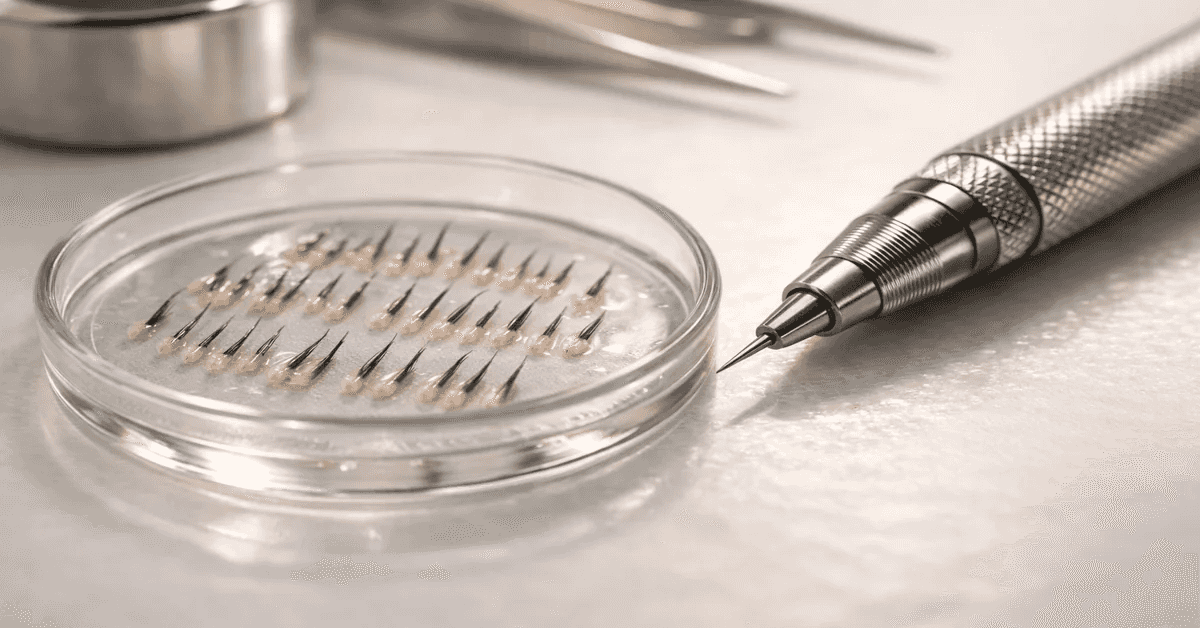
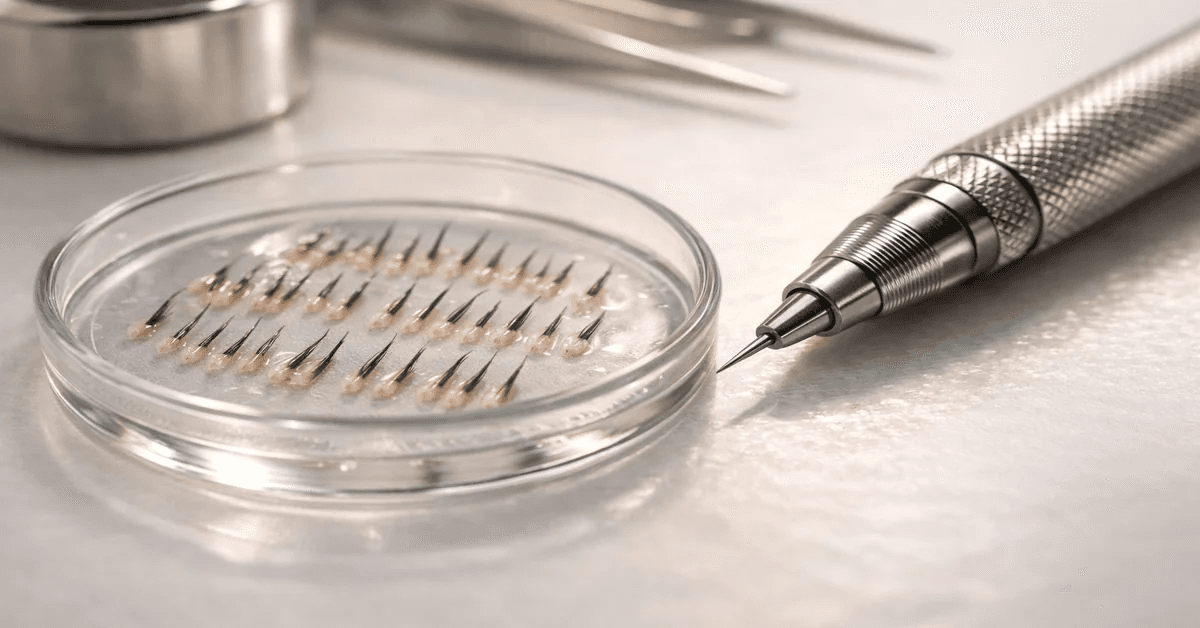
An eyebrow transplant transfers living follicular units, usually from the scalp, into areas of missing or thin eyebrow hair.
The grafts are commonly harvested with FUE and then prepared before implantation into the planned eyebrow shape.
Unlike scalp transplantation, the goal is not simply to create maximum density.
The hairs must be placed:
In the right position.
At the right angle.
In the right direction.
With appropriate density.
In a shape that fits the patient's facial anatomy.
Why is eyebrow transplantation technically demanding?
Natural eyebrow hair grows very close to the skin surface.
Its direction also changes across different parts of the brow.
These areas can roughly be described as:
The medial head.
The body.
The arch.
The tail.
A graft placed too upright can grow outward rather than lying flat against the skin.
This can be difficult to correct later.
Who may benefit from eyebrow transplantation?
Selected men and women may be candidates.
Overplucking
Repeated eyebrow plucking over many years can sometimes produce persistent thinning.
If the follicles no longer recover sufficiently, transplantation may be considered.
Naturally sparse eyebrows
Some people naturally have:
Low density.
Weak tails.
Visible gaps.
Asymmetry.
Transplantation can increase density or modify shape in appropriate candidates.
Trauma and scars
Eyebrow hair can be lost after:
Injury.
Burns.
Surgery.
Other scars.
Selected stable scars may be transplanted, although growth can be less predictable because scar tissue differs from normal skin.
Stable loss after a medical condition
In some cases transplantation can be considered after the underlying condition has been treated and shown to be stable.
Diagnosis should come first.
Why must the cause of eyebrow loss be diagnosed?
Eyebrow thinning can sometimes be a sign of a condition that should not be treated primarily with surgery.
Potential causes include:
Alopecia areata.
Scarring alopecia.
Thyroid disease.
Dermatologic disorders.
Inflammatory or autoimmune conditions.
Repeated traction or plucking.
If the disease remains active, newly transplanted hairs may also be affected.
When may an eyebrow transplant be inappropriate?
Transplantation may need to be delayed or avoided when there is:
Active alopecia areata.
Active scarring alopecia.
Ongoing inflammation.
An unexplained medical cause.
Unrealistic design expectations.
Inadequate donor hair.
The underlying condition should be evaluated first.
Are eyebrow transplants only for women?
No.
Men can also undergo eyebrow restoration.
The design is often different.
Female eyebrow restoration
May focus on:
Greater fullness.
Rebuilding the tail.
Correcting overplucking.
Refining the arch.
Improving asymmetry.
Male eyebrow restoration
Often preserves:
A straighter shape.
Different density.
A more masculine brow thickness.
Less sharply defined cosmetic contouring.
There is no universal brow template.

How is the eyebrow designed?
Design should account for:
Facial shape.
Eye position.
Remaining natural brow.
Brow bone anatomy.
Age.
Sex.
Patient preference.
Can I simply copy a celebrity eyebrow?
A photograph can be useful as inspiration, but copying another person's brow exactly is rarely ideal.
A shape that suits one face may look unnatural on another.
The final design should combine:
patient preference + facial anatomy + biologically achievable hair direction.
Does symmetry mean both eyebrows should be identical?
No.
Natural eyebrows are rarely perfectly identical.
The goal is balanced, natural symmetry rather than mathematically mirrored brows.
Where is donor hair taken from?
The scalp is commonly used.
However, donor selection matters.
Hair should ideally be:
Relatively fine.
Similar in calibre to eyebrow hair.
Appropriate in texture.
Suitable for creating natural movement.
Why isn't the thickest donor hair always best?
Very coarse scalp hair may look disproportionately thick in an eyebrow.
On the scalp, coarse hair can improve visual coverage.
In an eyebrow, excessive thickness may reduce naturalness.
Why are single-hair grafts important?
Natural eyebrows visually consist of individual hairs.
Single-hair follicular units are therefore particularly useful around:
The borders.
The medial brow.
The tail.
Fine-detail areas.
Using two- or three-hair grafts in inappropriate positions can produce a coarser appearance.
What if donor follicular units contain multiple hairs?
Some grafts can be prepared or divided when appropriate to create units that better match eyebrow design.
This makes graft preparation an important part of the procedure.
How are eyebrow grafts harvested?
FUE is commonly used because it allows individual follicular units to be selected.
It avoids the linear donor scar associated with FUT.
However, FUE itself does not guarantee a natural eyebrow.
The most demanding stages are usually:
Design.
Graft selection.
Recipient-site creation.
Implantation direction.
Implantation angle.
Is DHI better for eyebrow transplantation?
Implanter devices may be useful in some eyebrow procedures.
They can offer placement control in selected cases.
However:
DHI does not automatically equal a more natural eyebrow.
The final appearance still depends on graft selection, direction, angle and overall planning.
Why is implantation angle so important?
Eyebrow hairs emerge at a very low angle relative to the skin.
If grafts are implanted too upright:
The hairs may project away from the skin.
Styling becomes difficult.
The brow may look coarse or unnatural.
Careful recipient-site planning is therefore critical.
Does hair direction stay the same across the whole brow?
No.
Hair direction changes from the medial portion through the body and tail.
Natural patterns often involve gradual changes and overlapping directions.
Implanting every graft in one identical direction can create an artificial appearance.
How many grafts does an eyebrow transplant require?
There is no single standard number.
Graft requirements depend on:
Small gaps versus major reconstruction.
Tail restoration.
Density enhancement.
Complete eyebrow creation.
Brow size.
Existing hair density.
Desired design.
Small corrections
May require only tens of grafts.
Larger reconstruction
May require a few hundred grafts per eyebrow.
The goal should not be the largest possible number.
Precision and distribution matter more than graft-count marketing.
Are 300 grafts per eyebrow enough?
For one patient, that may be more than necessary.
For another, it may be insufficient.
The correct question is:
How much area needs to be restored and what density will look natural in that design?
Can an entire eyebrow be reconstructed?
Yes, selected patients can undergo partial or complete eyebrow reconstruction.
Complete reconstruction requires more detailed planning than simply adding density to an existing brow.
When native eyebrow hairs remain, they provide valuable guidance for direction and design.
What happens to scalp hair after it is transplanted into the eyebrow?
This is important to understand before treatment.
Transplanted scalp follicles retain much of their donor-site growth behaviour.
They may therefore continue growing longer than natural eyebrow hairs.
Will transplanted eyebrow hair need trimming?
Often, yes.
Patients may need regular:
Trimming.
Grooming.
Brushing or direction control.
This can be especially important when scalp hair has been used as the donor source.
The hair should not be assumed to biologically transform into naturally short eyebrow hair.
What if my scalp hair is curly?
Transplanted hair can retain donor characteristics.
Curly, wavy or very coarse scalp hair should therefore be considered during donor selection and design planning.
Can eyebrow transplantation be performed in scar tissue?
In selected stable scars, yes.
The physician should evaluate:
Scar thickness.
Blood supply.
Age of the scar.
Cause of the scar.
Any active inflammatory disease.
Growth may be less predictable than in normal skin.
Can I have an eyebrow transplant if I already have microblading?
Often, yes.
Existing microblading or tattoo pigment does not automatically prevent transplantation.
The old design may be used as a reference or ignored if it does not fit the intended new brow.
Does microblading need to be removed first?
Not always.
It depends on:
Pigment colour.
Existing shape.
Pigment position.
New design.
Skin condition.
Removal or correction may be discussed if the old tattoo conflicts strongly with the planned result.
Eyebrow transplant vs microblading
They are fundamentally different procedures.
Microblading
Adds pigment into the skin to simulate hairs.
It does not create living hair.
Eyebrow transplant
Transfers living follicles that can produce real hair.
Which one is better?
It depends on the goal.
A patient seeking a small visual shape change may prefer cosmetic pigmentation.
Someone with genuine hair loss who wants living hair may be more suitable for transplantation if medically appropriate.
Can the two be combined?
Yes, some patients with previous microblading later undergo transplantation.
The design should be coordinated carefully so that pigment and new hair direction do not conflict.
What happens on the day of surgery?
Typical stages include:
Final eyebrow design.
Donor-area selection.
Local anaesthesia.
Graft harvesting.
Graft preparation.
Recipient-site creation.
Implantation according to planned angle and direction.
Procedure time depends on graft number and complexity.
Is eyebrow transplantation painful?
It is usually performed with local anaesthesia.
Patients may feel discomfort during anaesthetic injections and mild sensitivity afterward.
Pain varies individually.
What happens after eyebrow transplantation?
During the first several days, patients may notice:
Small crusts.
Redness.
Mild swelling.
Local tenderness.
The grafted area should not be scratched or aggressively manipulated.
Will the transplanted eyebrow hairs shed?
Early shedding can occur.
This does not automatically indicate failed grafts.
The visible shafts can fall while the follicles remain under the skin and later enter a new growth cycle.
When does new eyebrow hair start growing?
Growth usually begins gradually several months after transplantation.
Some patients may start noticing new hairs around months three or four, followed by progressive improvement.
When is the final result visible?
The result often becomes much clearer during months six to nine.
Further maturation can continue afterward, and a more complete assessment may require around 12 months.
Can an eyebrow transplant look unnatural?
Yes, particularly when design or implantation is poorly performed.
Potential aesthetic problems include:
Grafts placed too upright.
Incorrect directions.
Excessive density.
Overly regular rows.
Noticeable asymmetry.
Hair that is too coarse for the brow.
Experience specifically in eyebrow restoration therefore matters.
Can a previous eyebrow transplant be repaired?
Sometimes.
Revision may involve:
Adding grafts.
Filling gaps.
Adjusting the shape.
Removing poorly positioned hairs.
Visually redirecting the design.
Incorrect implantation angle can be more difficult to correct than low density.
Can badly angled hairs be removed?
Selected hairs may potentially be managed using approaches such as:
Follicular extraction.
Electrolysis.
Laser hair removal when appropriate.
Redesign around the problem.
This is another reason why precise planning is important from the start.
Will I need a second session?
Some patients achieve their goal with one session.
Others may consider an additional procedure when:
The reconstruction was extensive.
The first session used conservative density.
Growth was incomplete.
More fullness is desired later.
A second session should generally be considered only after the first result has had enough time to mature.
How should you choose an eyebrow-transplant clinic?
Do not ask only:
How many grafts will you transplant?
Ask:
How many eyebrow restoration cases have you performed?
Can I see patients similar to me?
Who designs the eyebrow?
Who creates recipient sites?
What types of grafts will be used?
How are implantation angles controlled?
Who performs harvesting and placement?
Can eyebrow candidacy be assessed from photographs?
Photographs can support a useful preliminary assessment.
Helpful images include:
Full frontal face.
Close-up of both eyebrows.
Individual photographs of each brow.
Side views.
Donor-area images when possible.
However, photographs cannot always identify the medical cause of eyebrow loss or assess scalp and skin disease completely.
Conclusion
Eyebrow transplantation is a highly detail-dependent procedure in which naturalness depends on much more than graft count.
A successful plan begins by identifying the cause of eyebrow loss, selecting suitable donor hair, designing a brow that fits the face and implanting fine grafts at the very low angles and changing directions seen in natural eyebrow hair.
Patients should also understand that scalp hair transplanted into the eyebrows may continue growing and often requires regular trimming, while the final result develops gradually over several months.
If you are considering eyebrow transplantation in Turkey, Safemedigo can review your eyebrow photographs, donor area and available medical history to help assess candidacy, possible design and expected graft requirements before booking. Contact Safemedigo on WhatsApp.
Frequently Asked Questions
How many grafts are needed for an eyebrow transplant?
There is no fixed number. Small corrections may need only tens of grafts, while major or complete reconstruction may require a few hundred grafts per eyebrow.
Does transplanted eyebrow hair need trimming?
Often yes. Scalp-derived grafts can retain their original growth characteristics and may continue growing longer than natural eyebrow hair.
Is eyebrow transplantation suitable after overplucking?
It may be appropriate when the loss is stable and there is no active medical condition preventing transplantation.
Can eyebrow transplantation be performed over microblading or tattoo pigment?
Often yes, but the existing pigment, skin condition and new design should be evaluated before treatment.
When are eyebrow-transplant results visible?
New growth generally begins after several months, becomes clearer around 6–9 months and may continue maturing toward 12 months.