








For centuries, kidney stones have posed a painful and distressing medical challenge for millions worldwide. The sudden, excruciating pain caused by these stones as they travel through the urinary tract can be one of the most intense experiences a person can endure. With the advancement of medicine, innovative solutions have emerged that go beyond traditional surgery and the scalpel, offering safer and more comfortable alternatives for patients. At the forefront of these solutions is the revolutionary non-surgical kidney stone treatment known as Extracorporeal Shockwave Lithotripsy (ESWL), a technique that has transformed urological care since its introduction in the 1980s.
ESWL for kidney stones is based on a simple yet ingenious concept: using high-energy, precisely focused sound waves to break down solid stones into tiny, sand-like fragments. This allows them to pass easily through the urinary tract and be expelled naturally from the body with urine. This therapeutic approach, performed entirely from outside the body, has spared patients the need for surgical incisions, reduced hospital stays, and accelerated the pace of recovery and return to normal life. However, this procedure is not a one-size-fits-all solution, and its success heavily depends on the careful selection of the right patient.
In this detailed guide, we will delve into the intricacies of kidney stones shockwave therapy, explore its mechanism of action, and precisely identify who the ideal candidates are for this procedure and for which cases it is not suitable. We will also highlight the preparation steps, what to expect during and after the session, and provide a comprehensive comparison with other treatment methods. At Safemedigo, we believe that a patient's understanding of their treatment options is the cornerstone of the healing journey, and we aim to provide you with the necessary knowledge to make an informed decision in collaboration with your doctor.
What is Kidney Stones Shockwave Therapy (ESWL)
Extracorporeal Shockwave Lithotripsy (ESWL) is an advanced medical procedure used to treat kidney and ureteral stones without any surgical intervention. Since its adoption, it has become the first-line treatment for many cases of urinary stones due to its high efficacy and safety profile.
Definition of shockwave treatment for kidney stones
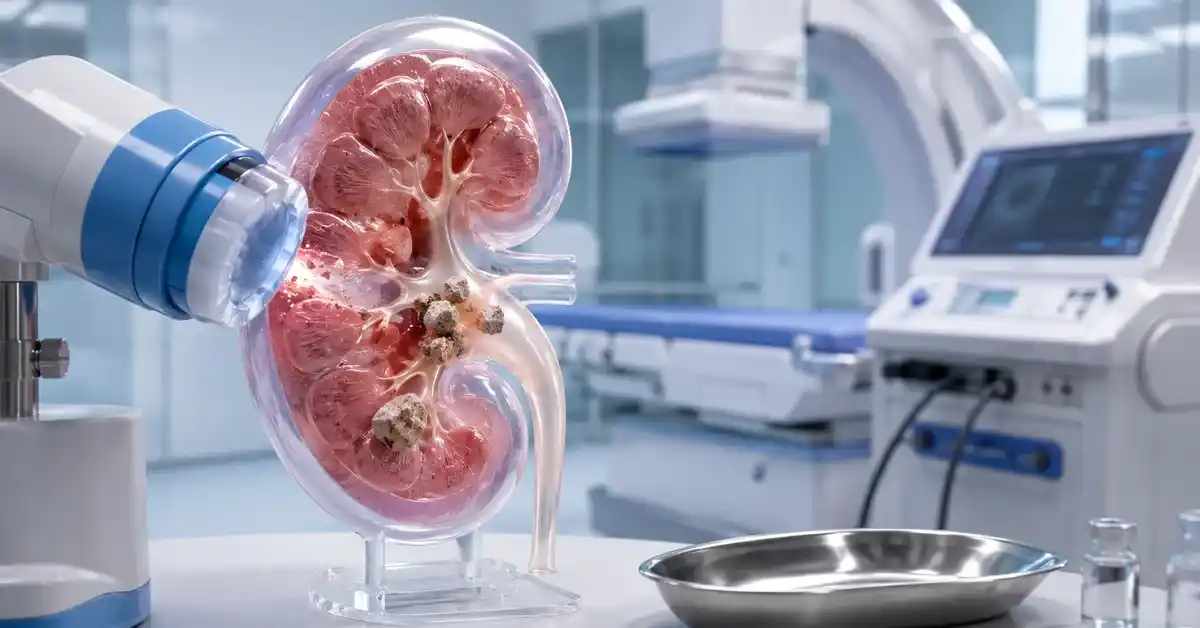
The shockwave treatment for kidney stones involves the application of high-pressure, focused acoustic waves generated by a specialized machine outside the body. These waves are precisely targeted to intersect and concentrate at a specific point within the body—the location of the stone. The significance of this treatment lies in its ability to provide an effective solution to a painful and common problem while avoiding the risks associated with traditional surgery, such as bleeding, infection, and severe postoperative pain, as well as significantly shortening the recovery period.
How shockwave therapy works to fragment kidney stones
Kidney stone fragmentation with shockwave therapy operates on two main physical principles. First, as the wave passes from the surrounding soft tissues (which are mostly water) into the hard stone, there is a sudden change in acoustic impedance. This generates mechanical stress on the stone's surface, causing it to crack. Second, the waves create tiny bubbles in the fluids surrounding the stone (a phenomenon called cavitation). These bubbles rapidly collapse, generating small secondary shockwaves that contribute to breaking the stone from within. Thousands of shockwaves (typically 2,000 to 4,000) are delivered during a single session, gradually disintegrating the stone into fine particles that can be easily eliminated.
When Is Shockwave Therapy Suitable for Kidney Stones
Undoubtedly, kidney stones treatment without surgery is an attractive option, but its success critically depends on several factors related to the stone itself. Therefore, a thorough evaluation before the procedure is essential to determine if ESWL is the best choice for the patient.
Kidney stone size and composition for ESWL
The kidney stone size for ESWL is one of the most important factors. Generally, extracorporeal shockwave lithotripsy for kidney stones is most effective for stones ranging from 4 mm to 2 cm (20 mm) in diameter. Stones larger than 2 cm may require multiple sessions or may not fragment completely, increasing the risk of the ureter becoming blocked by a column of fragments (known as "Steinstrasse" or stone street). The stone's composition also plays a vital role. Soft to medium-hard stones, such as calcium oxalate dihydrate and uric acid stones, respond excellently to shockwaves. In contrast, very hard stones like calcium oxalate monohydrate, cystine, and brushite stones are resistant to fragmentation, and ESWL may not be the optimal choice for them.
Location of kidney stones and suitability for shockwave treatment
The location of the stone significantly affects the procedure's effectiveness and the ease with which fragments can pass. Treatment of stones in the renal pelvis and upper part of the ureter is most successful. For stones located in the lower pole of the kidney, the passage of fragments can be more difficult due to gravity, which reduces success rates, especially if the angle of the lower pole calyx is sharp. For ureteral stones, shockwave therapy is very effective for stones in the upper ureter, while other options like ureteroscopy may be better for stones in the lower part, near the bladder.
Who Are Ideal Candidates for ESWL Kidney Stones Treatment
Determining kidney stones shockwave lithotripsy eligibility is key to the treatment's success. The treating physician performs a comprehensive evaluation to decide if a patient is a good candidate for this procedure.
Small to medium kidney stones are eligible for shockwave therapy
The ideal candidate is a patient with a single stone, smaller than 2 cm, with a low to medium density (less than 1000 Hounsfield units on a CT scan), located in a favorable position such as the renal pelvis or upper ureter. The patient should also be in generally good health and able to lie in the required position for about an hour. Understanding when is shockwave therapy suitable for kidney stones helps in setting realistic expectations about the treatment outcome.
Cases not suitable for shockwave treatment
There are absolute and relative contraindications for this procedure. Cases where ESWL is strictly not suitable include:
- Pregnancy: Due to the potential risk of shockwaves and X-rays to the fetus.
- Untreated bleeding disorders: This increases the risk of severe bleeding around the kidney (renal hematoma).
- Active urinary tract infection (UTI): The infection must be treated first to avoid its spread throughout the body (sepsis).
- Urinary tract obstruction distal to the stone: This would prevent the fragments from passing.
- Aortic aneurysm: The proximity of the aneurysm to the shockwave path could pose a risk.
Relative contraindications include morbid obesity (which increases the skin-to-stone distance and reduces wave effectiveness) and skeletal deformities that prevent accurate stone localization.
Read about: Kidney Stone Laser Treatment: Procedure and Quick Recovery
Steps and Preparation for ESWL Kidney Stones Treatment
Proper preparation ensures a smooth and safe procedure. These steps begin several days before the scheduled session.
Pre-treatment diagnostics and imaging
Before deciding on the ESWL procedure, the doctor will order a series of tests to accurately determine the stone's characteristics and rule out any contraindications. These tests typically include:
- Non-contrast CT scan: This is the best method for accurately determining the stone's size, location, and density.
- Abdominal X-ray (KUB): To ensure the stone is visible on X-ray, as some lithotripters rely on X-ray for targeting.
- Urinalysis and urine culture: To rule out a urinary tract infection.
- Blood tests: To assess kidney function and check for any blood clotting problems.
Preparations before shockwave procedure (blood thinners, fasting, etc.)
Based on the test results, the doctor will provide clear instructions. Blood-thinning medications such as aspirin, clopidogrel, and warfarin must be stopped 5 to 7 days before the procedure, following consultation with the prescribing physician. The patient will also be asked to fast from food and drink for 6 to 8 hours before the session to minimize risks associated with sedation or anesthesia. If you take regular medications, you should discuss how to manage them on the day of the procedure with your doctor.

What Happens During and After Shockwave Treatment for Kidney Stones
The session typically lasts about 45 to 60 minutes and is performed on an outpatient basis, with no need for an overnight hospital stay.
Stone fragmentation and passage through urine
The patient lies on a special table and is given pain relievers or light sedation to ensure comfort. The stone's location is precisely identified using X-rays or ultrasound. A water-filled cushion is then placed against the patient's skin over the kidney area. The machine generates shockwaves that travel through the water, skin, and soft tissues without causing harm, concentrating their full energy on the stone to break it apart. The patient hears a repetitive clicking sound and feels light taps on their skin. After the session, the small fragments begin to move with the flow of urine to be expelled from the body over several days or weeks.
Post-treatment care and recovery (hydration, monitoring urine)
The kidney stones shockwave therapy aftercare period is crucial for the success of the procedure. Key recommendations include:
- Drink plenty of water: It is advised to drink at least 2 to 3 liters of water daily to help flush out the stone fragments.
- Strain your urine: Your doctor may ask you to urinate through a special strainer to collect some fragments for analysis, which helps in developing a future prevention plan.
- Manage pain: It is normal to feel some renal colic as the fragments pass. Prescribed pain relievers can be taken to manage this discomfort.
- Monitor your urine: It is very common to see blood in the urine (hematuria) for a day or two after the procedure. You should inform your doctor if the bleeding persists or is severe.
Advantages and Limitations of Shockwave Therapy vs Other Methods
Every treatment method has its pros and cons, and the choice of the most appropriate method depends on each patient's individual case.
Benefits (non-surgical, short recovery) of ESWL kidney stones treatment
The greatest advantage of ESWL is that it is a completely non-surgical procedure. There are no incisions or wounds, which significantly reduces the risk of infection, bleeding, and pain. The kidney stones shockwave therapy recovery time is very short, with most patients able to return to their normal activities within a day or two. The procedure is performed on an outpatient basis and does not require a hospital stay, making it a convenient and comfortable option for many.
When shockwave therapy may fail and require other methods (surgery, PCNL)
Shockwave therapy may not be effective in some cases, such as for very large stones (larger than 2 cm), very hard stones, or in cases of morbid obesity. In these situations, or if an ESWL session fails to adequately fragment the stone, doctors resort to other, more invasive but more effective methods for these difficult cases, such as:
- Ureteroscopy (URS): A thin, flexible scope is inserted through the urethra and bladder into the ureter and kidney, and the stone is fragmented directly using a laser.
- Percutaneous Nephrolithotomy (PCNL): A minimally invasive surgical procedure where a small incision is made in the back and a scope is inserted directly into the kidney to remove large and complex stones.
Possible Side Effects and Complications of Kidney Stones Shockwave Therapy
ESWL is considered a very safe procedure, but some temporary side effects and complications may occur.
Temporary bleeding or blood in urine after ESWL
The most common side effect is blood in the urine (hematuria), which usually resolves within 24 to 48 hours. The patient may also notice some bruising on the skin of the back or abdomen where the waves were applied. Feeling some pain or colic as the stone fragments pass is also expected.
Risk of temporary blockage or urinary infections from stone fragments
In some cases, stone fragments may clump together in the ureter, causing a temporary blockage and severe pain (Steinstrasse). This may require an additional procedure, such as placing a ureteral stent or using a ureteroscope to remove the fragments. The passage of fragments can also irritate the urinary tract, increasing the risk of urinary tract infections, which can be easily treated with antibiotics.
Read about: Kidney Stone Laser Treatment: Turkey vs USA
Conclusion
Ultimately, kidney stones shockwave therapy (ESWL) remains one of the most significant innovations in urology, offering an effective, non-surgical treatment option for a large group of patients. Its ability to fragment stones without the need for a scalpel, combined with a short recovery period and low risks, makes it the preferred choice in suitable cases. This procedure has freed millions of patients from their pain and allowed them to return to their normal lives quickly and safely.
However, it is essential to emphasize that the success of this procedure depends primarily on careful patient selection. Not every stone and not every patient is an ideal candidate for ESWL. A comprehensive evaluation by a urologist, considering the stone's size, location, and density, as well as the patient's overall health, is the first and most crucial step to ensure the best possible outcomes and avoid potential complications.
If you are suffering from kidney stones and wondering about the most suitable treatment option for you, the next step is to get a specialist consultation. At Safemedigo, we offer a comprehensive assessment by a team of experts to determine if shockwave lithotripsy is the optimal solution for your condition. Contact us today via WhatsApp to discuss your case and receive a personalized treatment plan that prioritizes your health and comfort.
Frequently Asked Questions: Kidney Stones Treatment with Shockwave Therapy Explained
Is the shockwave lithotripsy procedure painful?
ESWL is typically performed under sedation or light anesthesia to ensure patient comfort. You may feel light tapping sensations on your skin. Post-procedure pain is usually manageable and feels like mild renal colic as the fragments pass.
How many sessions will I need?
For appropriately sized and composed stones, one session is usually sufficient. In some cases, such as for slightly larger or harder stones, a second session may be needed after a few weeks. The shockwave treatment for kidney stones and its success rate are highly dependent on these factors.
When can I return to work after an ESWL session?
The recovery time is very fast. Most patients can return to their usual activities and office jobs within just one to two days after the procedure.
Are there any dietary restrictions after the procedure?
There are no specific dietary restrictions immediately after the procedure, but it is strongly recommended to increase fluid intake and drink plenty of water to help flush out the stone fragments. After stone analysis, your doctor may recommend dietary changes to prevent new stone formation.
What is the success rate of shockwave lithotripsy?
The success rate depends on several factors, but for ideal candidates (stones smaller than 1.5 cm in a favorable location), the stone-free rate can exceed 80-90%.
.png&w=1920&q=70)