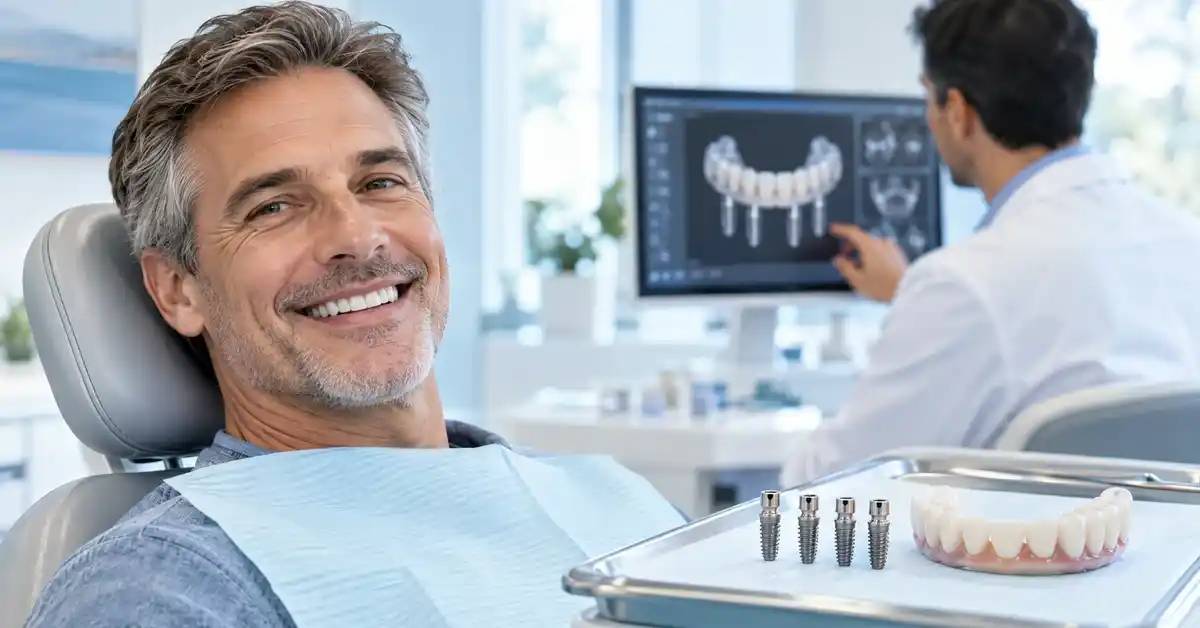






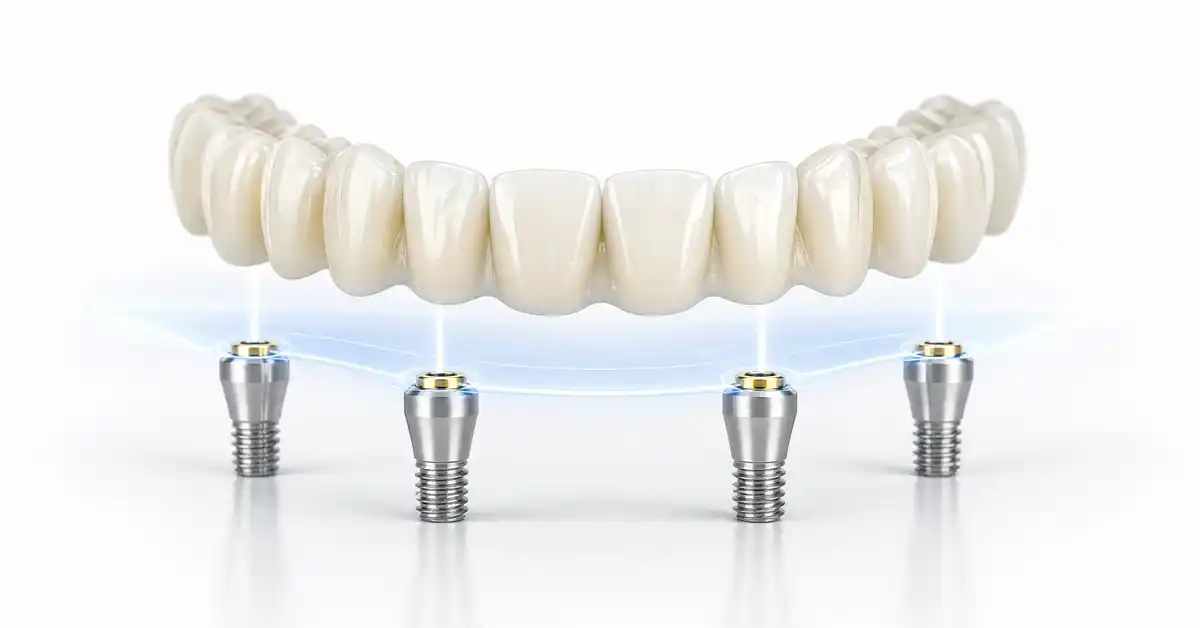
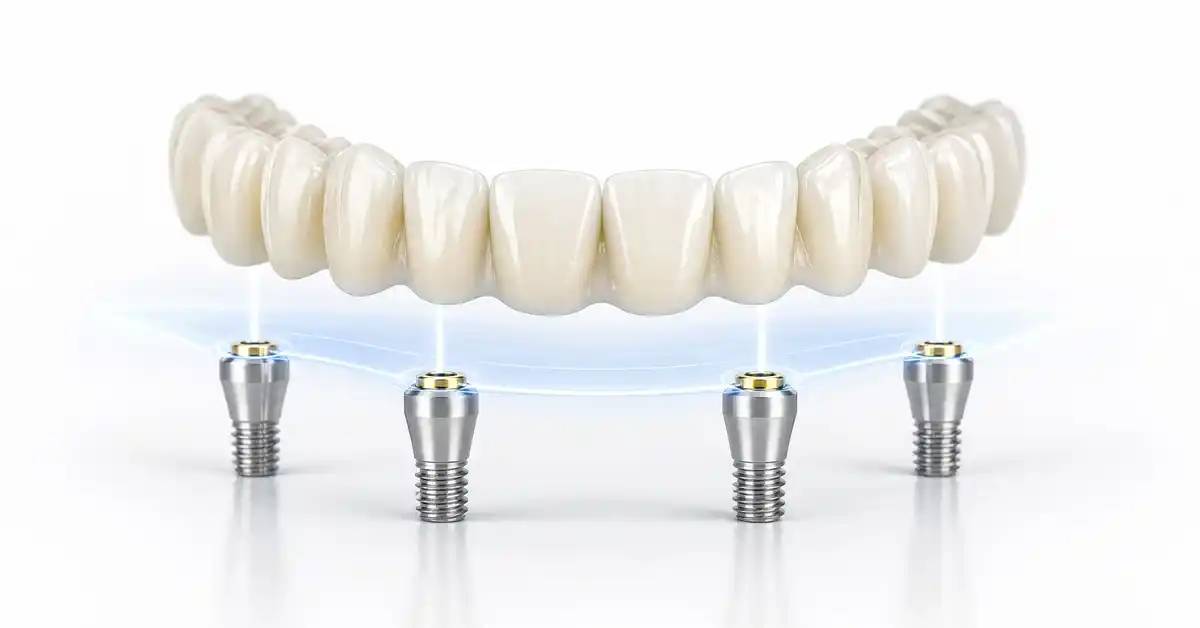
The All-on-4 dental implant concept allows a complete fixed dental arch to be supported by four strategically positioned implants in appropriately selected patients. Typically, two anterior implants are positioned relatively upright while the two posterior implants are tilted to make efficient use of available bone and widen the prosthetic support. Long-term clinical studies have shown that this approach can remain viable for many years when case selection, surgery, prosthetic design, and maintenance are appropriate.
At Safemedigo, All-on-4 assessment goes beyond asking whether four implants can physically be placed. Bone volume, gum health, jaw relationship, nerve and sinus anatomy, smile design, bite forces, bruxism, smoking, and long-term cleaning ability all influence the decision. “Teeth in a day” also requires qualification: immediate loading is possible only when adequate implant stability and a protected prosthetic design can be achieved.
How the All-on-4 Dental Implant Technique Supports a Complete Fixed Arch
All-on-4 uses four implant anchors to support a connected full-arch prosthesis. It does not mean that the patient receives only four teeth; the four implants support an entire set of replacement teeth.
Anterior and Tilted Posterior Implants in All-on-4 Treatment
The anterior implants are usually positioned relatively axially, while the posterior implants are angled to increase the usable anterior-posterior spread.
Clinical follow-up has shown that appropriately planned tilted implants do not inherently experience greater marginal bone deterioration than axial implants.
How Four Dental Implants Can Support Many Replacement Teeth
The implants are splinted together by one prosthetic framework, distributing chewing loads across the arch.
Clinical success depends on implant position, bone quality, primary stability, prosthetic framework design, cantilever length, occlusion, and patient-related forces rather than implant number alone.
Using All-on-4 in the Upper and Lower Jaw
The concept can be used in both arches, but treatment planning differs.
The upper jaw often has softer bone and is influenced by sinus anatomy. In the lower jaw, the location of the mandibular nerve becomes particularly important.
For this reason, four implants may be ideal in one jaw while the other may require six implants, grafting, or a different reconstruction.
Why Tilted Implants Are Used in All-on-4 Dental Rehabilitation
Tilting the posterior implants is intended to make better use of available bone and extend the support of the fixed prosthesis.
Using Tilted All-on-4 Implants Around Sinuses and Nerves
In selected upper-jaw cases, angulation can help use bone located in front of the maxillary sinus. In the lower jaw, strategic positioning can help avoid important neural anatomy.
This may reduce the need for grafting in selected cases, but All-on-4 does not eliminate grafting for every severely atrophic jaw.
Reducing the Posterior Cantilever in All-on-4 Bridges
Moving posterior implant support farther back can shorten the unsupported portion of the prosthesis behind the last implant.
Cantilever length and occlusal forces therefore remain important components of prosthetic design.
Are Tilted All-on-4 Implants Less Reliable?
Tilting alone does not make an implant weak.
Long-term clinical studies have documented comparable peri-implant bone behavior between tilted and axial implants in appropriately selected treatments.
Read about: Same-Day Dental Implants: Is It Possible?
Who Is a Good Candidate for All-on-4 and When Four Implants May Not Be Enough
All-on-4 is primarily intended for complete edentulism or terminal dentition in which the remaining teeth cannot provide a predictable long-term foundation.
Dental Conditions That May Be Suitable for All-on-4
Potential candidates include patients with:
- Complete tooth loss.
- Advanced periodontal destruction.
- Multiple severely compromised teeth.
- Unstable removable dentures.
- Failed extensive restorations.
- Adequate bone for strategically positioned implants.
Restorable natural teeth should not be removed merely to simplify treatment into an All-on-4 protocol.
Diabetes, Smoking, Gum Disease, and All-on-4 Risk
Medical stability and oral hygiene remain important.
Smoking, uncontrolled disease, active infection, and bruxism can influence biological or mechanical complications. Long-term clinical data have linked smoking and bruxism with increased problems in some full-arch implant populations.
When All-on-6 or Additional Implants May Be Preferred
More implants may be considered when bone availability, bite force, prosthetic design, or anatomical conditions favor additional support.
A five-year randomized trial comparing four and six implants for immediately loaded full-arch rehabilitation found no statistically significant difference in marginal bone loss or overall clinical outcomes between the groups studied. This supports individualized planning rather than assuming six is always superior to four.
Read about: Non-Surgical Dental Implant Techniques Available in Turkey
How All-on-4 Treatment Progresses From Digital Planning to Temporary Teeth
Accurate treatment starts with diagnosis and prosthetic planning before implant placement.
CBCT and Digital Planning Before All-on-4 Surgery
Assessment may include:
- Clinical dental examination.
- Three-dimensional jaw imaging.
- Bone-height and bone-width analysis.
- Nerve and sinus mapping.
- Bite assessment.
- Smile and tooth-position planning.
- Evaluation of prosthetic space.
- Assessment of bruxism.
Digital workflows and guided surgery can improve planning and support complex full-arch rehabilitation, although they do not remove the need for clinical judgment and surgical expertise.
Tooth Extraction and Immediate All-on-4 Implant Placement
When remaining teeth cannot be saved, extraction and implant placement may sometimes be performed during the same surgical session.
Whether this is appropriate depends on infection, remaining bone anatomy, required bone reshaping, and the ability to obtain implant stability.
Immediate Loading and Same-Day Teeth With All-on-4
When adequate primary stability is achieved, implants can sometimes be connected to a fixed provisional restoration on the day of surgery or shortly afterward.
Immediate function has been a central component of many clinical All-on-4 protocols.
The early prosthesis is usually provisional rather than the final long-term bridge, allowing healing and osseointegration before the definitive restoration is produced.

All-on-4 Versus All-on-6 and Conventional Dental Implant Treatment
The most appropriate approach depends on anatomy and prosthetic requirements rather than simply choosing the largest number of implants.
All-on-4 Versus All-on-6 for Full-Arch Dental Implants
All-on-6 provides six support points, while All-on-4 uses four strategically placed implants.
Six implants may offer additional support in some patients, but they also require appropriate bone and implant positions. Clinical trials have not established a universal rule that six implants are superior for every patient.
All-on-4 Versus Replacing Every Missing Tooth With an Implant
A completely edentulous patient does not need one implant for each missing tooth.
A full-arch prosthesis uses several implants as anchors for one connected restoration, reducing the number of implants while making prosthetic engineering and maintenance particularly important.
When Bone Grafting May Be Better Than an All-on-4 Shortcut
Bone augmentation may still be appropriate when the desired implant distribution cannot be safely achieved using existing bone.
Severe maxillary or mandibular atrophy can require more advanced reconstructive strategies, so All-on-4 should not be used simply to avoid grafting at all costs.
Read about: Front Teeth Dental Implants: Procedure and Recovery Time
Long-Term All-on-4 Results, Complications, and Implant Maintenance
Long-term studies support the viability of All-on-4, but implant survival should not be confused with freedom from maintenance.
A bridge may remain functional while requiring repair, screw tightening, relining, resurfacing, or eventual replacement of prosthetic components.
Long-Term Survival of All-on-4 Dental Implants
Follow-up data now extend well beyond ten years, including very-long-term retrospective cohorts.
These data show that full-arch four-implant rehabilitation can remain functional for many years, but individual longevity depends on health, hygiene, smoking, bite forces, design, and regular maintenance.
Biological and Mechanical Complications of All-on-4
Possible complications include:
- Failure of an implant to integrate.
- Peri-implant inflammation.
- Progressive bone loss.
- Screw loosening.
- Prosthetic fracture or chipping.
- Tooth wear.
- Occlusal problems.
- Hygiene difficulties.
Recent long-term research on fixed full-arch implant prostheses also shows that minor technical complications can accumulate over time, particularly in patients with bruxism.
Cleaning and Maintaining an All-on-4 Fixed Bridge
Patients must clean beneath the prosthesis and around each implant.
Long-term care includes professional assessment of peri-implant tissues, plaque control, bite, screws, prosthetic integrity, and bone levels when clinically indicated.
Read about: How to Choose the Best Dental Implant Center in Turkey
Conclusion
All-on-4 is an innovative full-arch rehabilitation strategy because it uses four strategically distributed implants, including tilted posterior implants, to support a complete fixed prosthesis and make efficient use of available bone. Long-term data support its use in appropriately selected patients, but four implants are not automatically better than six and the technique is not suitable for every jaw.
Successful treatment depends on diagnosis, implant stability, bone anatomy, prosthetic design, bite forces, and lifelong maintenance rather than the treatment name alone.
Frequently Asked Questions: Understanding All-on-4 Dental Implants
Can four implants really support an entire fixed set of teeth?
Yes, in appropriately selected patients, four strategically positioned and splinted implants can support a full-arch fixed prosthesis.
Are the final teeth fitted on the same day?
Not always. Immediate provisional teeth may be possible when adequate stability is achieved, but the definitive prosthesis is commonly completed after healing.
Does All-on-4 always avoid bone grafting?
No. It can reduce grafting requirements in selected patients, but severe bone loss may still require augmentation or another implant strategy.
Is All-on-6 better than All-on-4?
Not automatically. Clinical trial data show that both can perform predictably in selected patients, so anatomy and prosthetic requirements should determine the number of implants.
How long can All-on-4 implants last?
Long-term clinical data extend beyond a decade, but longevity depends on maintenance, oral hygiene, health, smoking, bite forces, and prosthetic care.