




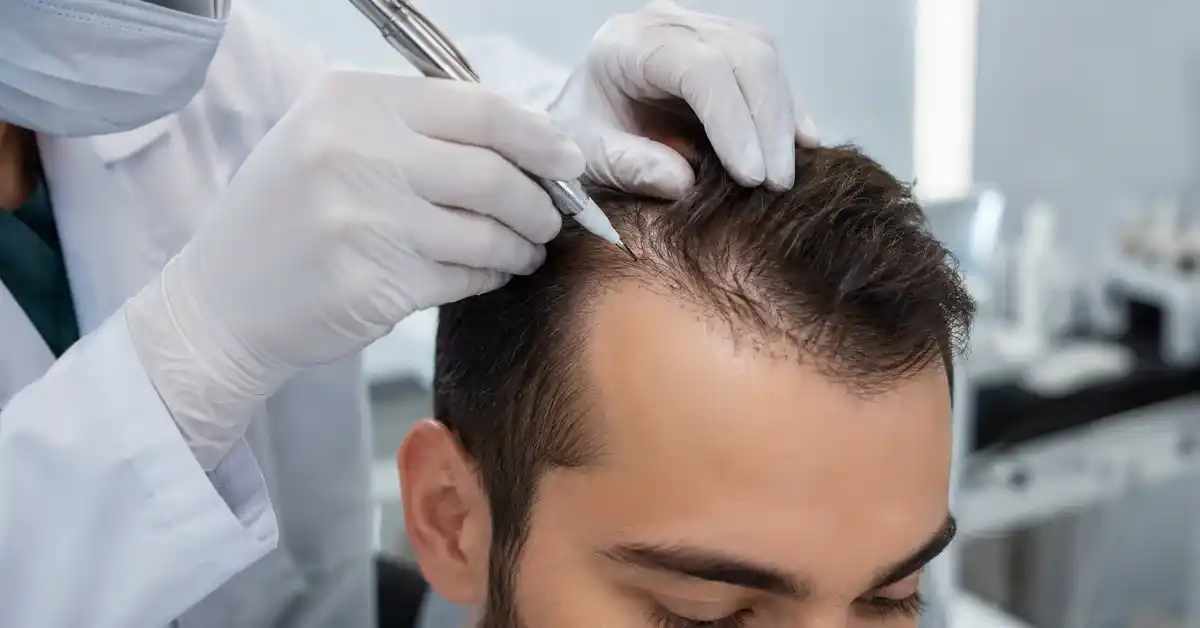
Partial baldness does not necessarily mean one small completely bald patch.
Patients may use the term to describe a receding hairline, temporal recession, frontal thinning, mid-scalp loss, early crown thinning or a localised area of hair loss following injury or disease.
These situations should not all be treated in the same way.
A patient with stable frontal androgenetic alopecia may be an excellent transplant candidate, while a suddenly appearing bald patch may represent alopecia areata or another condition that requires diagnosis before surgery.
The first question is therefore not simply:
How many grafts will fill the gap?
It is:
Why was hair lost in this area, and is the process sufficiently stable for transplantation?
What does partial baldness mean?
The term can describe hair loss confined predominantly to one part of the scalp while other regions remain relatively well preserved.
Common patterns include:
Hairline recession.
Temporal recession.
Frontal-zone thinning.
Mid-scalp thinning.
Crown or vertex thinning.
Hair loss from a scar or injury.
Selected cases of traction alopecia.
Limited stages of androgenetic alopecia.
The size of the area alone does not establish the diagnosis.
Why does diagnosis come before surgery?
Similar-looking areas of loss can have completely different causes.
Localised thinning or baldness may result from:
Androgenetic alopecia.
Alopecia areata.
Scarring alopecia.
Traction alopecia.
Trauma or burns.
Trichotillomania.
Previous inflammation.
Surgery.
Diffuse hair loss that appears more severe in one zone.
Transplantation can redistribute follicles into a stable area of loss.
It does not treat an active disease that continues to damage follicles.
When can partial androgenetic alopecia be suitable for transplantation?
A stronger candidate typically has:
A recognisable androgenetic pattern.
Adequate donor hair.
A clearly defined treatment zone.
Sufficient stability.
Realistic expectations.
A plan that considers future progression.
Even a small area should be planned with the future in mind.
Someone with minor temporal recession today may later develop mid-scalp and crown thinning.
Using excessive donor hair to create an unusually low hairline can therefore create problems later.
Hairline recession
This is one of the most common forms of partial hair loss treated surgically.
The problem may involve:
A high hairline.
Receded corners.
Asymmetry.
Reduced density behind the hairline.
Planning should consider:
Hairline height.
Shape.
Age appropriateness.
Future loss.
The number of single-hair grafts needed at the leading edge.
A natural hairline requires a soft transition rather than a straight wall of dense multi-hair grafts.
Temporal recession
The temples are visually sensitive areas.
Although the surface may be small, successful restoration depends on:
Fine donor hairs.
Precise direction.
Very acute implantation angles.
Facial proportion.
A small treatment area is therefore not automatically an easy procedure.
Poor temporal direction may be more noticeable than moderate density loss in a larger scalp region.
Frontal-zone thinning
Some patients retain a visible hairline but lose density immediately behind it.
These cases require assessment of:
Remaining native hair.
Degree of miniaturisation.
Expected progression.
Actual recipient-area size.
Whether medical treatment may help preserve existing follicles.
This is very different from transplanting completely bald skin.
Why is transplanting between native hairs more demanding?
Recipient sites need to be placed among existing follicles while avoiding unnecessary damage.
Some of the native hairs may also be significantly miniaturised.
They may appear present in a photograph but have limited long-term stability.
The plan therefore needs to ask:
What will this area look like if some native hair is lost later?
not only:
How dense can it look immediately after surgery?
Mid-scalp thinning
Mid-scalp loss can be:
Localised.
Connected to frontal thinning.
Part of progressively advancing androgenetic alopecia.
Selected cases can be improved surgically, but graft allocation must balance:
Hairline.
Frontal scalp.
Mid-scalp.
Crown.
Lifetime donor resources.
When donor supply is limited, concentrating grafts in visually important zones may produce a better result than spreading inadequate density across the entire scalp.
Crown or vertex thinning
The crown has different planning requirements.
Native hair follows a whorl pattern rather than a simple forward direction.
The surgeon must recreate this direction as well as coverage.
The crown can also consume substantial donor resources because of:
Its surface area.
Visibility from several directions.
The whorl pattern.
The challenge of creating visual coverage at conservative densities.
For patients with limited donor supply, the crown may therefore receive lower density or later priority.
Does every thinning crown need surgery?
No.
When crown loss is early and substantial miniaturised native hair remains, medical stabilisation and monitoring may be appropriate before using a large number of grafts.
This is particularly important in younger patients whose future pattern is not yet clear.
What about one isolated bald patch?
A single bald patch deserves diagnosis before surgery.
Sudden localised loss may represent alopecia areata, an autoimmune disorder affecting hair follicles.
Active alopecia areata is not treated by moving new follicles into the patch, and transplanted follicles can also become affected.

Can old stable alopecia areata be transplanted?
This is not a routine indication.
Even after a prolonged inactive period, recurrence remains possible.
Specialist evaluation is therefore important before considering surgery.
What about scarring alopecia?
Scarring alopecia destroys follicles and replaces them with scarred tissue.
Active scarring disease is generally unsuitable for transplantation.
In carefully selected, long-stable cases, surgery may sometimes be considered after specialist assessment.
However:
Blood supply may be reduced.
Graft survival can be less predictable.
Conservative density may be necessary.
Staged procedures may be preferable to aggressive dense packing.
This is fundamentally different from routine androgenetic alopecia.
Can hair be transplanted into a surgical or traumatic scar?
Sometimes, yes.
Stable secondary scars may be considered after evaluating:
Scar age.
Thickness.
Blood supply.
Cause.
Surface area.
Skin quality.
A small test session can occasionally be useful before attempting a larger reconstruction.
What about traction alopecia?
Repeated tight hairstyles can permanently damage follicles.
If traction continues, transplantation without correcting the cause risks further damage.
When traction has stopped and the area is stable, selected patients may become surgical candidates.
How is the graft number calculated?
The number cannot be calculated from the phrase “partial baldness.”
Planning considers:
Recipient-area size.
Existing density.
Additional density required.
Hair characteristics.
Hairs per follicular unit.
Safe donor capacity.
A small completely bald area may require a different density strategy from a larger thinning zone that still contains useful native hair.
Is one density appropriate everywhere?
No.
The frontal transition zone usually requires single-hair grafts and a soft density gradient.
Larger multi-hair units can be used behind it to improve coverage.
Crown density and density between native hairs should not simply copy the frontal-core plan.
The goal is convincing visual density, not a universal grafts-per-square-centimetre target.
Why not transplant at the highest possible density?
Because more is not automatically better.
Overly aggressive planning may:
Deplete the donor.
Reduce future options.
Increase complexity among fragile native hair.
Commit donor resources to a pattern that may later change.
The appropriate plan considers the lifetime course of hair loss.
How does hair calibre affect graft need?
Thick hair provides more visual coverage than fine hair.
Two patients with the same recipient area may therefore need different density strategies.
Does curly hair help coverage?
Wavy or curly hair can occupy more visual space and improve the appearance of density.
However, this is only one planning factor and does not create a fixed formula for reducing graft count.
Does hair-to-skin contrast matter?
Yes.
Low contrast between hair colour and scalp can make coverage appear stronger.
Dark hair against light scalp can make gaps more visible.
The same graft count can therefore produce a different visual result in different patients.
Can graft requirements be estimated from photographs?
A useful preliminary range can often be provided.
Good photographs should show:
Hairline.
Top.
Mid-scalp.
Crown.
Both sides.
Donor region.
However, photographs cannot accurately establish:
Donor density.
Miniaturisation.
Hair calibre.
Curved scalp surface area.
Subtle scalp disease.
A remote estimate should therefore remain preliminary.
What is shock loss?
Shock loss refers to shedding of native hairs around the operated recipient area.
It often begins during the first several postoperative weeks.
In many patients it is temporary.
However, severely miniaturised hairs may have a higher risk of not recovering fully.
This makes shock loss particularly relevant when transplanting partial thinning rather than completely bald skin.
Can shock loss be prevented?
No method guarantees complete prevention.
Risk can be managed by:
Identifying miniaturisation before surgery.
Avoiding unnecessary dense placement among fragile native hair.
Careful recipient-site creation.
Considering medical stabilisation when appropriate.
Patients should understand the risk before surgery.
Can medical treatment be more appropriate than transplantation?
Sometimes.
If a thinning zone still contains substantial miniaturised hair that may be preserved, stabilising the condition may be the better first step.
In early androgenetic alopecia, transplantation should not automatically replace treatment of existing hair.
Can medication regrow a completely bald area?
Not usually when follicles have been permanently lost.
Medical treatment may preserve or improve miniaturised existing follicles, but it does not create a new donor supply.
A stable bare area may therefore be a stronger surgical target than an actively changing thinning zone.
One session or two?
Many partial-baldness procedures can be completed in one session.
Staged treatment may be preferable when:
Several zones are involved.
Donor supply needs careful preservation.
Future progression is expected.
The crown is extensive.
Additional density may be desired after maturation.
A planned second procedure is not necessarily evidence that the first surgery failed.
Does a small area always require few grafts?
No.
A small region may still require:
Strong visual density.
Numerous single-hair grafts.
Difficult directional work.
Precise reconstruction.
A larger thinning region supported by healthy native hair may sometimes require less intensive reconstruction than expected.
Is DHI better for partial baldness?
Not as a universal rule.
DHI commonly describes implantation with an implanter device.
It may be useful in selected cases involving native hair, but it does not replace:
Diagnosis.
Donor assessment.
Graft calculation.
Native-hair protection.
Long-term planning.
Is FUE the best option?
FUE is widely used, but harvesting technique alone does not determine the quality of the result.
More important questions are:
Is the patient a good candidate?
Is donor supply sufficient?
Is the hairline appropriate?
Are grafts allocated intelligently?
Is native hair being protected?
What happens if hair loss continues after transplantation?
Transplanted follicles do not stop native follicles from miniaturising.
A transplanted hairline may remain strong while untreated hair behind it continues thinning.
A good surgical design should therefore remain reasonable even if future hair loss progresses.
Are younger patients suitable?
Age alone does not prohibit surgery.
However, rapidly changing patterns are harder to predict in younger patients.
A more conservative approach may include:
An age-appropriate hairline.
Controlled graft use.
Preserving donor reserves.
Stabilising progressive loss where possible.
What if donor density is weak?
A small bald area does not remove the need for donor assessment.
Surgery can be limited or inappropriate when the donor region is:
Low density.
Significantly miniaturised.
Affected by diffuse unpatterned alopecia.
Previously overharvested.
How can you tell whether a plan is sensible?
Ask:
What is the diagnosis?
Why did this area lose hair?
Is the process stable?
What is the recipient-area size?
How much native density remains?
How many grafts are planned?
What is my donor capacity?
Is there miniaturisation?
What is the shock-loss risk?
What happens if my hair loss progresses?
Is one session likely to be enough?
A plan consisting only of:
“The area is small, so we will fill it”
is incomplete.
What results should you expect?
The goal is not necessarily to restore original teenage density in every square centimetre.
A strong result aims for:
Natural distribution.
Convincing visual coverage.
Integration with native hair.
Protection of future donor options.
After surgery, early shedding may occur before new growth begins gradually over several months.
Progress is usually easier to judge between six and nine months, with further maturation toward approximately 12 months or beyond.
When should the result be reassessed?
Density at three or four months should not be treated as the final outcome.
After maturation, persistent concerns can be assessed by asking:
Did grafts grow appropriately?
Did native hair continue to thin?
Is additional density needed?
Is the issue density or design?
Conclusion
Hair transplantation can work very well for partial baldness when the cause of hair loss is understood, the condition is stable, donor hair is strong and the treatment plan anticipates future progression.
But “partial baldness” is not one diagnosis.
Hairline recession, mid-scalp thinning, crown loss, alopecia areata, scarring disorders and traction alopecia may all present as limited areas of hair loss while requiring very different treatment decisions.
Graft count is also determined by more than the visible size of the gap. Recipient area, existing density, hair calibre, visual priority and safe donor capacity all matter.
If you have a specific area of thinning or baldness, Safemedigo can review photographs of the affected zone, the rest of the scalp and the donor region to help determine whether the case appears suitable for hair-transplant assessment or whether diagnosis and stabilisation should come first. Contact Safemedigo on WhatsApp.
Frequently Asked Questions
Can only one small area of the scalp be transplanted?
Yes, when the cause of hair loss is established, the process is stable and donor hair is suitable. Future loss in surrounding hair should still be considered.
How many grafts are needed for partial baldness?
There is no fixed number. It depends on recipient-area size, existing density, target density, hair characteristics and safe donor capacity.
Can grafts be transplanted between existing hairs?
Yes, in selected cases, but native follicles need to be protected and miniaturisation and shock-loss risk should be assessed.
Can alopecia areata patches be transplanted?
Active alopecia areata is not a routine transplant indication. Even long-stable disease requires specialist assessment because recurrence remains possible.
Is one session enough for partial baldness?
Often it can be, but staged treatment may be preferable when several areas are involved, donor preservation is important or additional density may be required later.