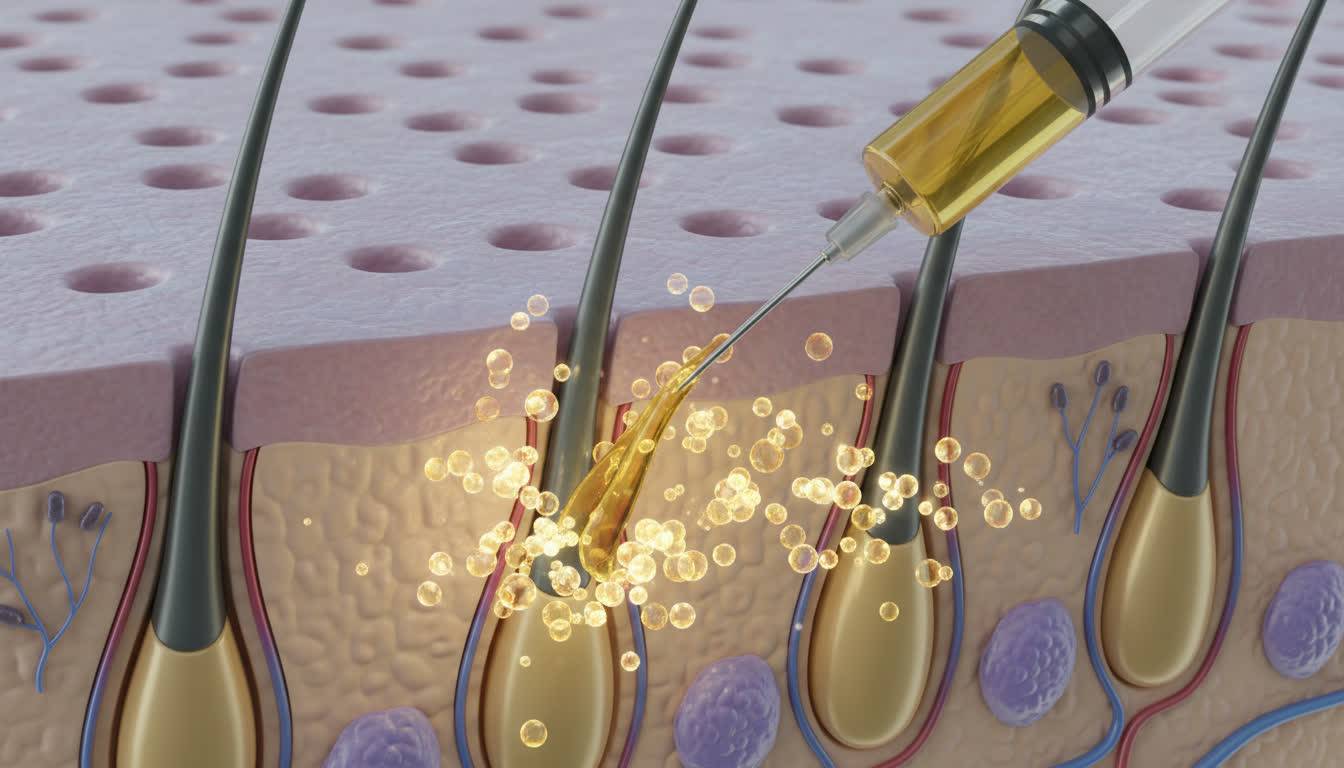





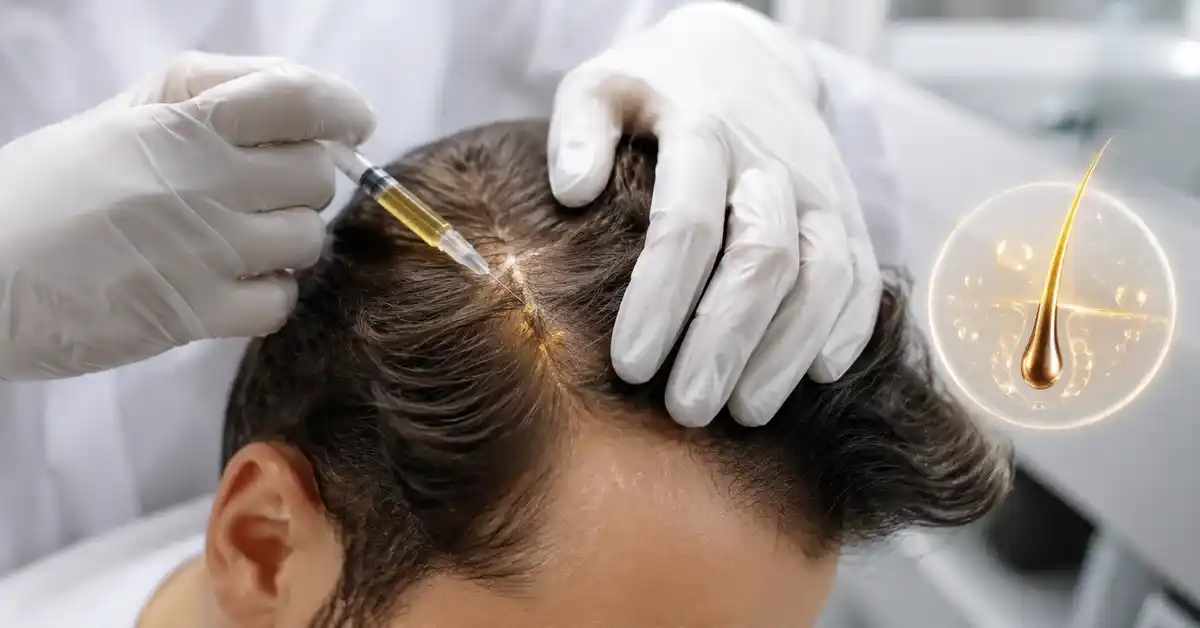
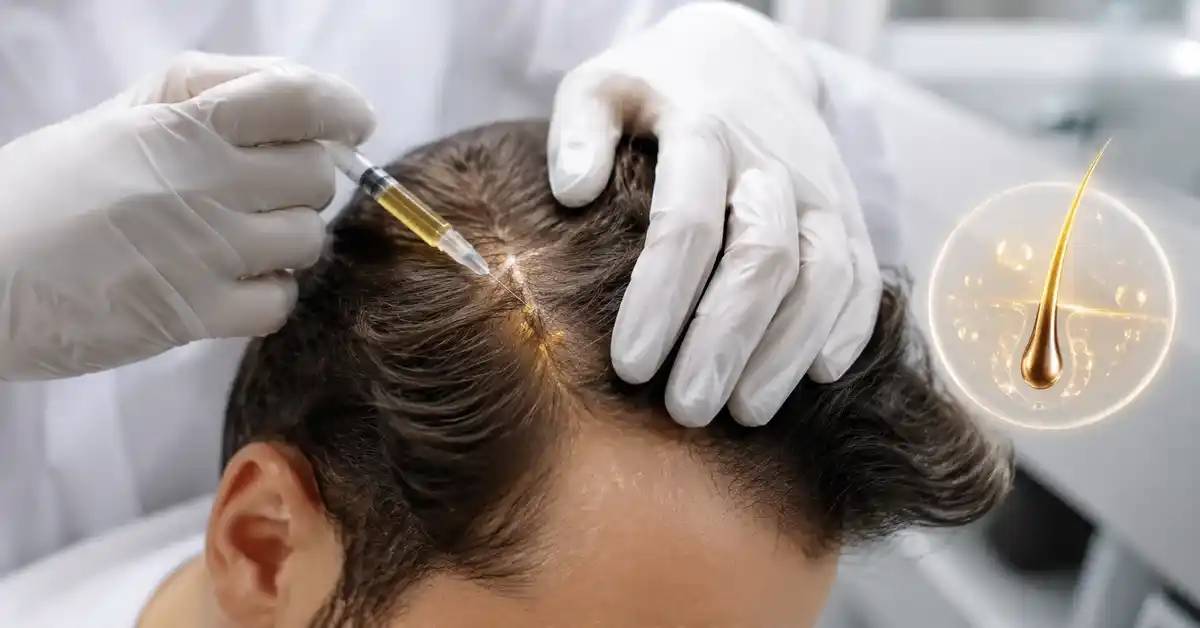
Hair mesotherapy is an injection-based procedure in which small amounts of selected substances are delivered into superficial layers of the scalp. The objective is to place the chosen treatment close to the hair follicles rather than relying exclusively on systemic delivery.
There is no single standardized “hair mesotherapy formula.” Different protocols may use prescription medicines, supportive compounds, peptides, vitamins, or combinations of substances. Consequently, two clinics may both offer “mesotherapy” while performing substantially different treatments.
Research has reported encouraging findings for some forms of pattern hair loss, but protocols remain heterogeneous and results are not sufficiently uniform to promise a specific response. The diagnosis, stage of follicle miniaturization, injected substance, treatment technique, and long-term maintenance strategy all influence the outcome.
How Hair Mesotherapy Works in the Scalp and Hair Follicles
Mesotherapy uses multiple small intradermal injections distributed across selected areas of the scalp. Its biological effect depends heavily on what is injected, meaning that mesotherapy is best understood as a delivery technique rather than one specific medication.
Local Delivery Near Hair Follicles
Intradermal injection allows an active substance to be placed close to the tissue surrounding the follicles. Depending on the drug or compound, this may increase local exposure while limiting the need for higher systemic doses.
However, local injection does not automatically make a substance effective. The formulation must be appropriate for the diagnosis, and poorly studied mixtures may increase the risk of irritation, inflammation, allergy, or other complications.
Does the Needle Stimulation Itself Help?
Repeated needle entry may create a local repair response, but mesotherapy and microneedling are not the same procedure. Mesotherapy involves injecting a substance, whereas microneedling primarily creates controlled microchannels.
It is also different from:
- Platelet-based scalp injections.
- Intralesional medication for specific scalp disorders.
- Topical hair-loss treatment.
- Hair transplantation.
Each approach has a different biological goal and evidence base.
How Mesotherapy Relates to the Hair-Growth Cycle
Hair follicles cycle through growth, transition, resting, and shedding phases. Even an effective treatment cannot produce visibly denser hair immediately because follicles need time to enter a productive growth phase and generate new shafts.
When improvement occurs, reduced shedding may be noticed before a visible change in density or shaft thickness. Meaningful evaluation therefore takes months rather than one or two sessions.
Read about: Best Treatments for Male Pattern Baldness in Turkey
Types of Hair Loss in Which Mesotherapy May Be Considered
Treatment should begin with a diagnosis rather than with the procedure itself. Mesotherapy may be considered as an adjunct in selected patients, but it does not correct iron deficiency, thyroid disease, active scalp inflammation, or irreversible scarring simply because substances are injected into the scalp.
Mesotherapy for Pattern Hair Loss
The largest portion of available research concerns androgen-related pattern hair loss, in which susceptible follicles gradually produce thinner and shorter hair.
When follicles are still present, treatment may aim to:
- Reduce progressive thinning.
- Improve the caliber of existing hairs.
- Increase visible density in selected areas.
- Complement another long-term therapy.
Pattern hair loss is progressive, so any improvement may decline when treatment and maintenance are discontinued.
Mesotherapy for Diffuse Hair Shedding
Diffuse shedding may follow illness, major stress, rapid weight loss, nutritional deficiency, hormonal changes, medication, or other triggers. Correcting the underlying cause remains the priority.
Assessment may include:
- When shedding started.
- Previous illness, surgery, or weight change.
- Diet and possible deficiencies.
- Current medications.
- Selected thyroid or hormonal investigations.
- Examination of the scalp and follicles.
Injecting the scalp without correcting an ongoing trigger is unlikely to provide a complete solution.
Hair-Loss Patterns That Require Diagnosis First
Specialist assessment is particularly important when there is:
- Sudden patchy hair loss.
- Marked redness or scaling.
- Persistent burning or pain.
- Loss of visible follicular openings.
- Scarring.
- Pustules or discharge.
- Rapid unexplained progression.
- Simultaneous eyebrow or body-hair loss.
These patterns may represent conditions requiring a different treatment strategy.

Substances Used in Hair Mesotherapy and Why Protocols Differ
There is no universal mesotherapy cocktail. Some protocols use medications, others use supportive compounds, and some combine multiple ingredients. This difference is important when comparing results or prices.
Substances That May Be Used in Mesotherapy
Depending on the medical plan, studied protocols have included:
- Medicines targeting mechanisms involved in pattern hair loss.
- Hair-growth-related active compounds.
- Amino acids or peptides.
- Vitamins and supportive ingredients.
- Selected biological preparations.
A formula containing more ingredients is not automatically superior. Complex mixtures can make it difficult to identify what produced either the benefit or an adverse reaction.
Do Vitamin Injections Correct Nutritional Hair Loss?
A proven nutritional deficiency should be treated appropriately throughout the body rather than assuming that scalp injection alone will correct it.
The distinction is important:
Confirmed deficiency: identify the cause and replace the missing nutrient appropriately.
No deficiency: injecting additional vitamins does not necessarily produce additional hair growth.
Not every case of hair loss is caused by vitamin deficiency.
What Should You Know Before Anything Is Injected?
Patients should ask:
- What exactly is being injected?
- What is the purpose of each ingredient?
- Is it a medication or supportive formulation?
- What adverse effects are known?
- Are any special precautions required?
- Is allergy possible?
- Are there reproductive or medical contraindications?
“Hair cocktail” alone is not an adequate medical description of an injectable treatment.
Read about: Best Modern Treatments for Female Hair Loss
Hair Mesotherapy Sessions and Expected Timeline of Results
No single session schedule has been established for every formulation. Treatment frequency depends on the agent, diagnosis, response, and clinician’s protocol. Some programs begin with closer sessions and later move toward maintenance.
What Happens During a Mesotherapy Session?
A typical appointment may include:
- Examination and treatment-area mapping.
- Cleansing and disinfection.
- Preparation of the selected formulation.
- Multiple small injections across the target areas.
- Cleaning of the scalp.
- Post-treatment instructions.
Stinging, burning, or mild discomfort can occur during injection.
When Might Hair Shedding Improve?
The first sessions should not be used to judge success. If treatment works, a reduction in shedding may precede measurable increases in density.
Results can be monitored using:
- Standardized photographs.
- Consistent part-line comparisons.
- Hair-density measurements.
- Hair-shaft caliber.
- A structured shedding history.
Different lighting, hairstyle, or camera angle can create misleading before-and-after comparisons.
Realistic Expected Results
| Possible outcome | What it means |
|---|---|
| Reduced shedding | May occur before density improvement |
| Thicker existing hairs | More plausible when follicles remain active |
| Improved visible density | Varies by disease stage |
| Regrowth in a long-standing smooth bald area | Limited when follicles are no longer functional |
| Permanent result after stopping treatment | Not guaranteed |
| Major change after one session | Not a realistic expectation |
| Complete restoration of previous density | Cannot be promised |
Mesotherapy Compared With Other Hair-Loss Treatments
Mesotherapy should be considered alongside established alternatives. Some patients require long-term medication, others may benefit from procedural adjuncts, while advanced permanent follicle loss may make hair transplantation more appropriate.
Mesotherapy Versus Topical and Medical Treatment
Topical therapy can be used at home without injections but requires consistent application and may irritate the scalp. Some medical treatments target specific pathways involved in pattern hair loss and require an individualized discussion of benefits and risks.
Mesotherapy provides intradermal delivery but requires repeated clinic visits, and its effectiveness depends heavily on the injected agent.
Mesotherapy, Platelet Therapy, and Microneedling
| Treatment | Main concept | Key consideration |
|---|---|---|
| Mesotherapy | Injection of a selected substance | Outcome depends on formulation |
| Platelet-based therapy | Concentrated components prepared from the patient’s blood | Requires blood collection and processing |
| Microneedling | Controlled scalp microchannels | Does not necessarily involve injected medication |
| Topical treatment | Medication applied to the scalp | Requires regular home use |
| Hair transplantation | Relocation of follicles | Relevant for selected permanent follicle loss |
Combining procedures should have a clear reason rather than simply increasing the number of treatments.
When Is Hair Transplantation More Logical?
Mesotherapy cannot create a completely new follicle where follicular structures have been permanently lost. Long-standing smooth areas of advanced baldness may therefore require transplantation if the donor area is suitable.
When miniaturized follicles are still present, preserving and strengthening existing hair may be a more appropriate first goal.
Read about: Hair PRP Injections: Is It Worth Trying
Hair Mesotherapy Risks and Choosing a Safe Treatment Plan
Mesotherapy involves skin penetration and is therefore a medical procedure rather than a superficial scalp treatment. Safety depends on sterile technique, accurate diagnosis, and knowing exactly what is being injected.
Possible Side Effects
Temporary effects may include:
- Injection-site discomfort.
- Redness.
- Mild swelling.
- Small bruises.
- Itching or local sensitivity.
- Temporary scalp tenderness.
- Small crusts at injection sites.
Less common complications can include infection, significant inflammation, allergic reactions, skin changes, and localized hair loss after injections.
When Should Mesotherapy Be Postponed?
Treatment may be delayed when there is:
- Active scalp infection or inflammation.
- Open wounds.
- Known allergy to an ingredient.
- Bleeding problems or relevant medication use.
- Unstable medical illness.
- Pregnancy or pregnancy planning when the proposed ingredients are inappropriate.
- An unclear diagnosis.
All medications, supplements, and previous hair treatments should be disclosed.
How to Choose a Mesotherapy Plan
Before treatment, five questions should have clear answers:
- What is causing my hair loss?
- What will be injected and why?
- What alternatives are available?
- How will improvement be measured?
- What is the plan if I do not respond?
A sound treatment plan begins with diagnosis, not with selling a predetermined number of sessions.
Read about: Precision FUE Eyebrow Transplant for Women
Conclusion
Hair mesotherapy may be a useful adjunct for selected forms of hair loss when viable follicles remain. Its effect depends on delivering carefully chosen substances into the scalp, but results vary considerably according to diagnosis, formulation, and stage of follicle loss.
Improvement is gradual rather than immediate, and there is no universal injection mixture or fixed number of sessions that guarantees success. Mesotherapy should therefore be compared with medical treatment, platelet-based procedures, microneedling, and transplantation according to the patient’s actual condition.
Frequently Asked Questions: Hair Mesotherapy for Hair Loss: How It Works and What Results to Expect
Can mesotherapy regrow lost hair?
It may support existing follicles and improve hair caliber in selected patients, but it cannot guarantee new follicles in permanently bald areas.
How many hair mesotherapy sessions are needed?
There is no universal number. Frequency depends on the injected substance, diagnosis, response, and treatment protocol.
When are hair mesotherapy results visible?
Reduced shedding may appear first, while changes in thickness and density generally require months to evaluate.
Is mesotherapy better than platelet therapy?
Neither is universally better. The choice depends on diagnosis, follicle condition, treatment goals, and the evidence supporting each option.
Are mesotherapy results permanent?
Not necessarily. Progressive pattern hair loss may require maintenance or another long-term treatment strategy.