










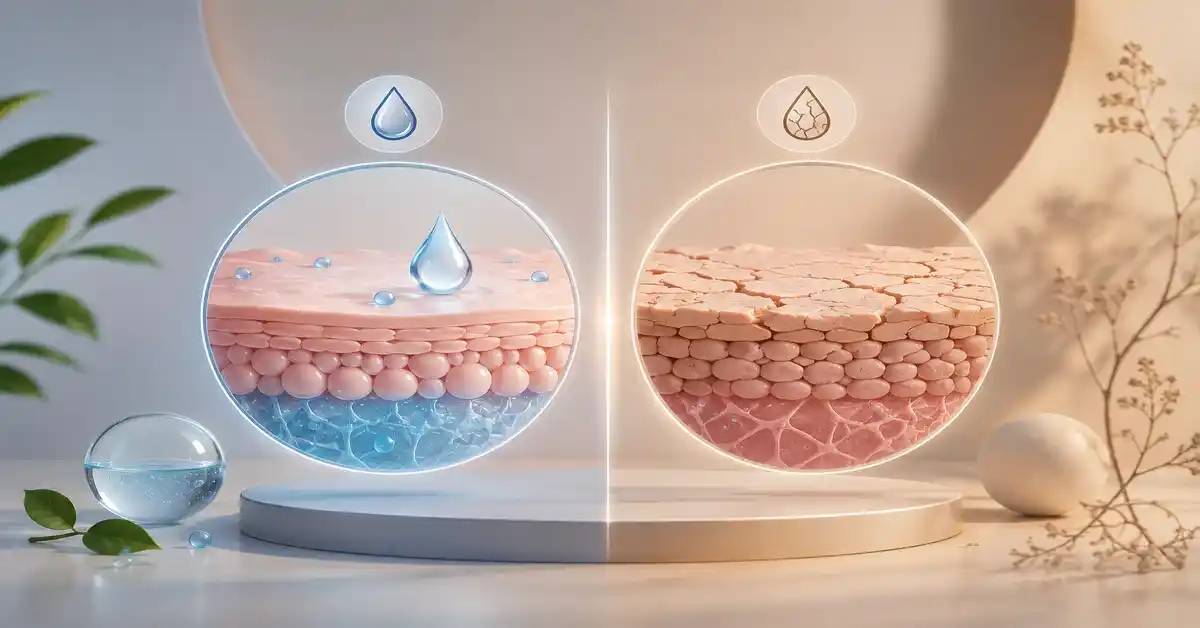
Dry skin and dehydrated skin are frequently treated as identical terms, but they describe different aspects of skin function. Dry skin is primarily associated with insufficient surface lipids and reduced barrier protection, while dehydrated skin refers to inadequate water content within the outer skin layer. This means that oily or combination skin can still become dehydrated.
The distinction affects product selection. Dry skin generally needs richer emollients, barrier-supporting lipids, and ingredients that limit evaporation. Dehydrated skin needs water-binding ingredients followed by a moisturizer that helps retain that water. Many people have both conditions simultaneously because a lipid-deficient barrier allows water to escape more easily.
“Dehydrated skin” is often used as a practical skincare description rather than a separate medical diagnosis. Persistent scaling, inflammation, cracking, or itching may indicate xerosis, dermatitis, or another condition that requires professional assessment.
The Fundamental Difference Between Dry and Dehydrated Skin
The main difference is the component that is insufficient. Dry skin commonly lacks the lipids that support flexibility and close spaces between surface cells. Dehydrated skin has reduced water within the stratum corneum. The two conditions overlap because lipid-barrier disruption can increase water loss.
Dry Skin Is Mainly Lipid and Barrier Deficiency
Dry skin tends to produce or retain fewer protective surface oils. It may be a long-standing skin type, although age, cold weather, harsh cleansing, medication, and inflammatory conditions can make it worse.
The dryness may affect both the face and body and is often noticeable on the cheeks, lips, hands, and legs. The skin may require a rich cream consistently rather than only after travel, exfoliation, or air-conditioning exposure.
Dehydrated Skin Has Insufficient Water
Dehydration can affect dry, normal, combination, oily, or acne-prone skin. Sebum production may be normal or high, while the outer skin remains low in water and feels tight.
The condition may change quickly with climate, product use, and cleansing habits. Skin may appear comfortable on one day but dull and tight after exfoliation, prolonged air-conditioning, or a disrupted routine.
Can Skin Be Both Dry and Dehydrated?
Yes. Lipid deficiency weakens the barrier and makes water evaporation easier, creating roughness, scaling, tightness, and fine surface lines together.
A light hydrating serum alone may not be enough for this combination. The routine should include water-binding ingredients, emollients, barrier lipids, and an appropriate occlusive component.
Signs of Dry Skin and Signs of Skin Dehydration
Both conditions may create tightness, dullness, and visible fine lines. Observing surface oil, scaling, body involvement, and how quickly the symptoms change provides a more useful distinction than relying on one home test.
Signs That Suggest Dry Skin
Dry skin commonly presents with:
- Rough texture.
- Visible scaling.
- Recurrent itching.
- Small cracks around the mouth or hands.
- Low surface oil throughout the day.
- Discomfort after foaming cleansers.
- A persistent need for rich moisturizer.
- Dryness affecting the arms, legs, or hands.
Clinical xerosis is commonly associated with roughness, scaling, itching, and impaired barrier function.
Signs That Suggest Dehydrated Skin
Possible features include:
- Tightness despite visible shine.
- Temporary fine dehydration lines.
- Dull or less plump appearance.
- Rapid absorption of lightweight moisturizer.
- Increased sensitivity after retinoids or acids.
- Patchy makeup application.
- Symptoms that vary from day to day.
- Oiliness combined with discomfort.
Visible pores and oil production do not exclude dehydration because sebum and water are different components.
Dry Versus Dehydrated Skin Comparison
| Feature | Dry skin | Dehydrated skin |
|---|---|---|
| Main problem | Lipid deficiency and weaker barrier | Low water content |
| Pattern | Often persistent | Commonly temporary or fluctuating |
| Sebum | Usually low | May be low, normal, or high |
| Texture | Rough, flaky, and sometimes itchy | Tight, dull, and sometimes shiny |
| Pores | May appear less prominent | May remain visible |
| Body involvement | Common | Often most noticeable on the face |
| Main need | Lipid replenishment and reduced evaporation | Water binding followed by moisture sealing |
| Typical texture | Rich cream or ointment when needed | Serum or gel followed by lotion or cream |
| Can coexist? | Yes | Yes |
Causes of Dryness and Water Loss From the Skin
Genetics influence skin type, but environment and skincare behavior often determine the severity of symptoms. A naturally dry complexion can become significantly worse through hot water and strong cleansers, while oily skin may become dehydrated through repeated degreasing and exfoliation.
Causes of Persistent Dry Skin
Contributing factors include:
- Naturally low oil production.
- Aging-related changes in barrier lipids.
- Long hot showers.
- Strong soap and alkaline cleansers.
- Cold, low-humidity weather.
- Frequent handwashing and household chemicals.
- Inflammatory or scaling skin conditions.
- Certain medications and medical conditions.
Effective care usually combines rehydration with lipid replenishment rather than relying on one ingredient.
Causes of Dehydrated Skin
Common triggers include:
- Excessive cleansing.
- Frequent exfoliating acids or retinoids.
- Skipping moisturizer after washing.
- Air-conditioning and indoor heating.
- Hot, dry, or windy weather.
- Repeated use of astringent products.
- Applying a humectant without a suitable moisturizer.
- Irritation from acne treatments.
- Introducing several active products simultaneously.
Transepidermal water loss is used to evaluate barrier integrity, although measurements vary with age, body area, environment, and skin inflammation.
Does Drinking More Water Correct Dehydrated Skin?
Adequate fluid intake supports general health and may help when a person is systemically dehydrated or drinks very little. However, additional water alone does not repair a damaged surface barrier or reverse excessive cleansing and exfoliation.
Research reviewing oral water intake has found limited or uncertain skin-hydration benefits in people who already drink adequate amounts. Topical care and correction of water-loss triggers therefore remain important.

How to Identify What Your Skin Needs
Skin type should not be judged immediately after a harsh cleanser because any complexion may feel tight in that situation. A more useful approach is to simplify the routine for several days and observe oil production, scaling, roughness, and changes throughout the day.
A Gentle Home Observation Method
Use the following process:
- Use a mild cleanser and pause exfoliation for several days.
- Observe the skin before applying moisturizer.
- Check whether oil develops on the forehead and nose.
- Feel the cheeks and chin for roughness or flakes.
- Observe whether fine lines soften after moisturizing.
- Record products associated with burning or tightness.
- Check whether the hands and legs are also dry.
- Compare the skin in different environments.
Pinching or pulling the skin is not a reliable test because the appearance of folds depends on age, elasticity, lighting, and technique.
Questions That Help Distinguish the Two Conditions
Consider the following:
- Is oil production consistently low throughout the year?
- Are there true flakes and roughness or mainly tightness?
- Does the face become shiny while remaining uncomfortable?
- Are retinoids, acids, or acne treatments being used?
- Does a lightweight serum help only briefly?
- Is rich cream needed even in humid weather?
- Are the hands and legs also dry?
- Is there itching, cracking, or recurrent rash?
Persistent scaling with low oil suggests dry skin. Shine combined with tightness and rapid fluctuation suggests dehydration. Mixed answers often indicate both.
When Home Assessment Is Not Enough
Persistent rash, severe itching, cracking, pain, swelling, crusting, or discharge should not be managed simply by buying richer skincare. These findings may reflect dermatitis, allergy, infection, or another skin condition.
Sudden widespread dryness, especially after a new medication or with general symptoms, also requires medical evaluation.
Skincare for Dry and Dehydrated Skin
Both conditions benefit from gentle cleansing, moisturizing, and sun protection. The difference lies in emphasis: dry skin generally needs more lipid replacement and occlusion, while dehydrated skin needs water-binding ingredients in a texture suitable for its oil level.
A Routine for Dry Skin
A practical sequence is:
- Creamy gentle cleanser: Use lukewarm water and avoid scrubbing.
- Optional hydrating layer: Consider glycerin, hyaluronic acid, or appropriately formulated urea.
- Rich moisturizer: Choose emollients and barrier-supporting lipids.
- Occlusive care for very dry areas: Apply to lips, hands, or cracked patches.
- Comfortable sunscreen: Avoid formulas that worsen tightness.
- Reduced active ingredients: Restart them slowly after recovery.
Moisturizers improve hydration through humectants, emollients, occlusives, and barrier-supporting components.
A Routine for Dehydrated Skin
Oily dehydrated skin does not automatically require a thick ointment. A suitable routine may include:
- Gentle cleansing according to need.
- Applying hydrating products to slightly damp skin.
- Using glycerin or another tolerated humectant.
- Following with a lotion, gel-cream, or cream.
- Pausing strong acids and retinoids during irritation.
- Avoiding astringent toners and repeated degreasing.
- Using a non-drying sunscreen.
- Adjusting moisturizer texture according to climate.
Moisturizer should not be eliminated simply because the face produces oil.
Ingredients for Each Condition
| Ingredient group | Main function | Dry skin | Dehydrated skin |
|---|---|---|---|
| Glycerin | Binds water | Yes | Yes |
| Hyaluronic acid | Supports surface hydration | Yes, followed by cream | Yes, followed by moisturizer |
| Urea | Hydrates and softens roughness | Yes | Yes |
| Ceramides | Support barrier lipids | Particularly useful | Useful when the barrier is impaired |
| Cholesterol and fatty acids | Replenish lipid components | Particularly useful | Helpful when irritation is present |
| Petrolatum | Strongly limits evaporation | Useful on very dry areas | May be heavy for oily skin |
| Emollients such as squalane | Smooth the surface | Useful | Depends on texture and skin type |
| Fragrance and essential oils | Do not treat dehydration and may irritate | Avoid when sensitive | Avoid when irritated |
Common Skincare Mistakes and When to Seek Help
Moisturizers may fail when the underlying trigger continues. A person may apply a hydrating serum while cleansing aggressively several times a day, or use a rich cream over skin that remains inflamed from repeated exfoliation.
Mistakes That Increase Dryness and Tightness
Common mistakes include:
- Assuming shiny skin does not need moisturizer.
- Using a harsh cleanser on oily dehydrated skin.
- Removing flakes with additional exfoliation.
- Applying a humectant without a moisturizing layer.
- Introducing multiple products at once.
- Taking long hot showers.
- Using fragrance on irritated skin.
- Applying unnecessarily heavy ointment to clog-prone areas.
- Relying only on drinking water.
- Expecting one moisturizer application to provide permanent correction.
Cleansing can temporarily change hydration, sebum, and barrier measurements, making the complete routine more important than the immediate post-wash appearance.
Signs That Require Dermatology Assessment
Seek assessment for:
- Severe or persistent itching.
- Redness that does not improve with a simple routine.
- Painful or bleeding cracks.
- Yellow crusting or discharge.
- Swelling or local warmth.
- Rash around the eyes or mouth.
- Widespread body dryness.
- Sudden unexplained dryness.
- Symptoms that persist despite gentle care.
- Sleep disturbance caused by itching.
Maintaining Balance After Improvement
Restart active ingredients one at a time and at a low frequency. Monitor burning, scaling, and tightness before increasing use.
Three useful principles are:
- Do not remove more oil than the skin can replace.
- Add water and reduce its evaporation.
- Choose texture according to natural oil production, not marketing labels alone.
Conclusion
Dry skin primarily lacks lipids and has a weaker barrier, while dehydrated skin lacks sufficient water in its outer layer and can affect any skin type, including oily skin. The conditions commonly coexist because lipid deficiency makes water loss easier.
Dry skin usually benefits from richer lipid-replenishing creams, while dehydrated skin needs humectants followed by a moisturizer that retains water. Gentle cleansing, fewer irritants, and environmental protection remain essential for both.
Frequently Asked Questions: The Essential Difference Between Dry and Dehydrated Skin
Can oily skin be dehydrated?
Yes. Skin may produce abundant sebum while still having insufficient water in its outer layer.
How can I tell whether my skin is truly dry?
Persistent roughness, scaling, low oil production, and dryness on the body suggest dry skin more than temporary dehydration.
Is hyaluronic acid enough to treat dehydration?
It may support water binding, but it is generally more useful when followed by a moisturizer that reduces evaporation.
Does drinking water treat dehydrated skin?
It helps when the body lacks fluid, but it does not replace topical barrier care or correct an irritating routine.
Do dry and dehydrated skin need the same products?
Both need gentle hydration, but dry skin generally requires richer textures and more lipid replacement.