





Dental implants are one of the most established ways to replace missing teeth, but their success depends on much more than placing a screw into the jaw. The biological foundation is osseointegration: healing that creates a stable interface between living bone and the implant surface.
Although modern implants have high long-term survival, they are not automatically the best choice for every missing or damaged tooth. Gum health, available bone, smoking, diabetes, bite forces, oral hygiene, and the condition of neighboring teeth all influence treatment planning.
At Safemedigo, implant assessment begins with a fundamental question: does this tooth actually need replacement with an implant, or could preserving the natural tooth, using a bridge, or selecting another restoration provide a better overall solution?
How Do Dental Implants Work?
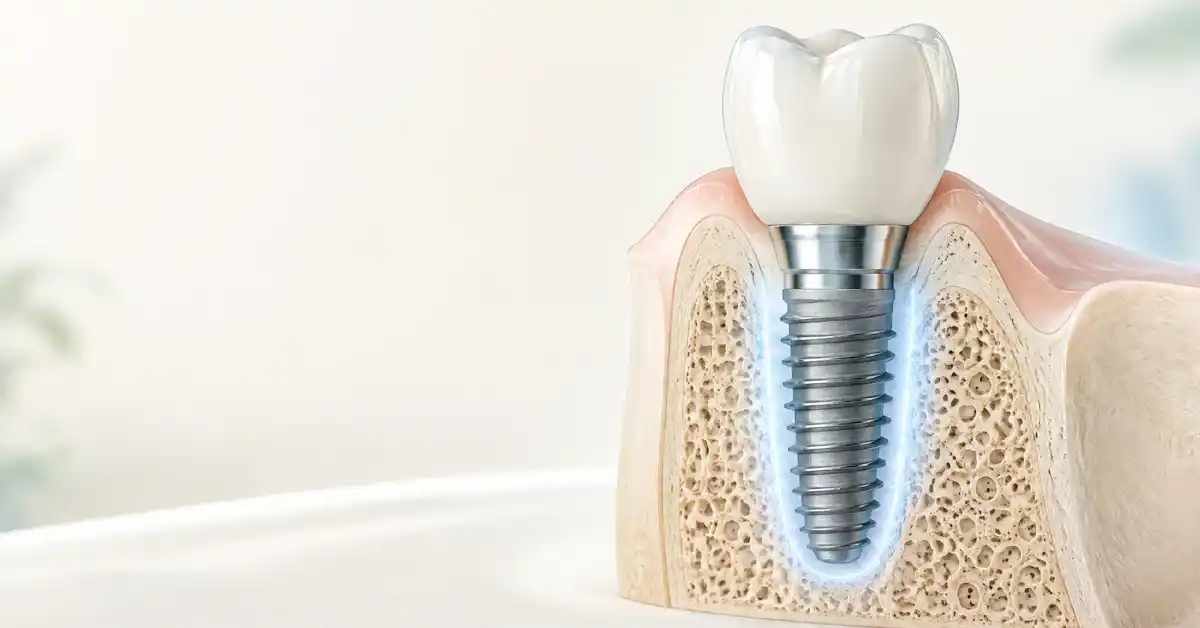
Implant stability depends on osseointegration, which allows the implant to function as a foundation for a crown, bridge, or removable prosthesis.
What Is Osseointegration?
After an implant is inserted, healing produces direct and stable contact between the implant surface and surrounding bone.
A natural tooth is different. Its root is suspended within bone through the periodontal ligament, whereas an implant lacks this ligament and becomes directly anchored within bone.
An implant can therefore reproduce the mechanical function of a missing root, but it is not biologically identical to a natural tooth.
What Are Implants Made From?
Titanium remains the most established implant material and has extensive long-term clinical experience.
Zirconia implants offer a metal-free alternative in selected situations and can achieve effective osseointegration. However, titanium still has a larger body of long-term clinical evidence.
Does the Implant Fuse With Bone?
The implant becomes biologically integrated and mechanically stable within the bone rather than literally turning into bone.
Successful healing depends on bone quality, implant design and surface, accurate positioning, initial stability, and how much mechanical loading occurs during healing.
Read about: Same-Day Dental Implants: Is It Possible?
Who Can Have Dental Implants?
There is no simple upper age limit. Suitability depends more on growth, general health, oral health, anatomy, and the ability to maintain the implant over time.
Is Age a Problem for Dental Implants?
Older age alone does not prevent implant treatment.
Healthy older adults can benefit from implants when healing capacity and oral maintenance are appropriate. In younger patients, treatment is generally delayed until jaw growth is complete because implants do not follow facial growth in the same way as natural teeth.
Can People With Diabetes Have Implants?
Many patients with diabetes can receive implants.
The important issues are metabolic control, periodontal health, healing capacity, and other risk factors. Diabetes, particularly when poorly controlled, is associated with a greater risk of inflammatory problems around implants.
Can Smokers Have Dental Implants?
Smoking is not an absolute contraindication in every patient, but it increases risk.
Smoking is associated with peri-implant disease, and risk becomes particularly relevant when combined with a previous history of periodontal disease or poor plaque control.

Do You Have Enough Bone?
Implants require adequate bone for stable and safe placement, but limited bone does not necessarily rule out treatment.
How Is Jawbone Checked?
Clinical examination and imaging are used to assess the implant site.
Three-dimensional imaging may be used when necessary to measure bone width and height and identify important structures such as the mandibular nerve and maxillary sinus.
Digital planning can then help determine implant position, length, diameter, and angulation.
Computer-guided surgery improves placement accuracy compared with freehand placement in many situations, although real implant positions can still differ from the digital plan. Surgical judgment and appropriate safety margins remain essential.
When Is Bone Grafting Needed?
Bone augmentation may be considered when there is insufficient width or height for predictable implant placement.
Options can include localized grafting, ridge augmentation, or sinus elevation.
However, not every deficient site requires extensive grafting. Short implants or modifications to the restorative plan can sometimes reduce the need for additional surgery in selected cases.
Does Bone Loss Mean Implants Are Impossible?
No.
The remaining bone and the cause of the bone loss must first be assessed. Active periodontal disease should be controlled before implantation because untreated inflammation can compromise long-term implant health.
Read about: Non-Surgical Dental Implant Techniques Available in Turkey
Are Immediate Implants Right for You?
Immediate placement and immediate loading are different concepts.
Immediate placement means inserting an implant at the time of tooth extraction. Immediate loading means attaching a restoration soon after implant insertion.
Can an Implant Be Placed After Extraction?
Yes, in selected sockets.
The clinician needs sufficient remaining bone to achieve appropriate primary stability and a site where infection, anatomy, and soft-tissue conditions do not make immediate placement unsuitable.
With appropriate selection, immediate and delayed placement can achieve similar implant survival, but immediate placement is not ideal for every extraction site.
Can You Get a Tooth the Same Day?
Sometimes.
A temporary restoration can be attached immediately in suitable cases, but the implant has not completed osseointegration on the day it is placed.
Immediate loading requires adequate initial stability and careful management of bite forces. Under appropriate clinical conditions, single implants loaded immediately can achieve survival comparable with conventional loading.
When Is Delayed Treatment Better?
A staged approach may be safer when primary stability cannot be achieved, extensive grafting is required, active disease is present, or uncontrolled mechanical forces could interfere with healing.
Speed should never take priority over predictable biology.
Read about: Front Teeth Dental Implants: Procedure and Recovery Time
What Are the Risks of Dental Implants?
Dental implants have high survival rates, but no implant should be presented as permanent or complication-free.
Why Do Dental Implants Fail?
Early failure can occur when adequate osseointegration does not develop.
Late complications can include peri-implant disease, progressive bone loss, excessive mechanical loading, crown damage, screw problems, or other prosthetic complications.
Implant survival and implant success are therefore not exactly the same. An implant can remain in the mouth while still requiring treatment or maintenance.
What Is Peri-Implantitis?
Inflammation can first affect the soft tissues around an implant and may progress to peri-implantitis with loss of supporting bone.
Periodontal disease history, smoking, and diabetes are important risk indicators, which is why plaque control and professional maintenance remain important even years after the implant is placed.
How Long Do Dental Implants Last?
There is no guaranteed lifespan.
Long-term evidence shows high survival for contemporary implants. One large analysis estimated approximately 96% implant survival at 10 years before adjustment for missing follow-up data. At 20 years, many implants remain functional, although estimates become more uncertain and cumulative biological or technical complications become increasingly relevant.
The implant can also survive longer than the crown placed on top of it, which may eventually need repair or replacement.
Read about: How to Choose the Best Dental Implant Center in Turkey
Are Implants Better Than Bridges?
Implants, bridges, preservation of the natural tooth, and removable prostheses each have situations in which they make sense.
Is an Implant Better Than a Bridge?
For a single missing tooth, one advantage of an implant is that neighboring healthy teeth usually do not need to be prepared to support a conventional bridge.
An implant, however, requires surgery and healing and may require bone augmentation.
A bridge can be very reasonable when neighboring teeth already require crowns or when implant surgery is unsuitable.
Is Extraction and Implant Better Than Saving a Tooth?
Not automatically.
A natural tooth that can be predictably treated and restored should not be assumed to be inferior simply because implant treatment is available.
Implants are highly useful for replacing missing or non-restorable teeth, but they do not reproduce every biological characteristic of a natural tooth.
How Do You Know if Implants Are Right for You?
The assessment should determine whether the tooth truly needs extraction, whether gum disease is controlled, whether sufficient bone is available, where nearby anatomical structures are located, whether the bite is stable, and whether bruxism or other mechanical risks are present.
Long-term cleaning and follow-up also matter.
Only after these questions are answered should implants be compared with bridges, removable options, or preservation of the natural tooth.
Read about: Immediate Laser Dental Implants: Fast and Advanced
Conclusion
Dental implants work through osseointegration, creating a stable bone-supported foundation for replacement teeth. Modern implants have strong long-term survival and can restore function and appearance effectively.
Their success, however, depends on much more than the implant itself. Bone volume, periodontal health, smoking, diabetes, bite forces, surgical planning, oral hygiene, and long-term maintenance all influence the outcome.
An implant should also not automatically replace a natural tooth that can still be predictably preserved.
Frequently Asked Questions: Are Dental Implants Right for You?
Are dental implants painful?
Placement is generally performed under local anesthesia, so surgical pain should be controlled during the procedure. Temporary soreness and swelling can occur afterward.
Do dental implants last forever?
No implant can be guaranteed for life. Many function for decades, but biology, maintenance, and mechanical complications affect longevity.
Can you have implants with bone loss?
Often yes. Depending on the anatomy, options can include bone augmentation, shorter implants, or a different restorative plan.
Can a dental implant be done in one day?
Immediate placement or immediate loading is possible in selected patients, but it is not suitable for every implant site.
Are implants better than natural teeth?
No. If a natural tooth can be predictably preserved, saving it remains an important option to consider.